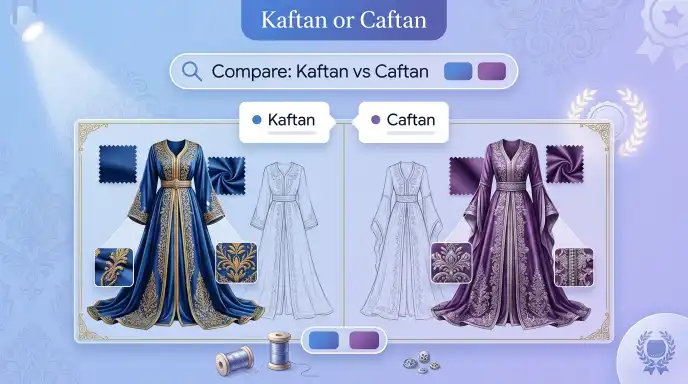
Kaftan and caftan are both correct spellings for the same type of loose, flowing garment. The main difference is spelling preference, not meaning. Both words describe a long garment that may have wide or long sleeves. The style can be worn as traditional clothing, formal wear, resort wear, or a beach cover-up.
People often search for kaftan or caftan because they see both spellings in dictionaries, fashion stores, blogs, and clothing descriptions. This can make it hard to know which form belongs in an article, product listing, email, or school assignment.
The confusion is understandable because kaftan and caftan are not two different garments. They are accepted English spellings of the same word. However, usage can vary by dictionary, country, publisher, and cultural context.
For example, Oxford lists kaftan with caftan as an alternative, while Collins treats caftan as a variant of kaftan in British English.
This guide explains the meaning, origin, regional usage, common mistakes, and practical examples. By the end, you will know which spelling to choose for different audiences.
Kaftan or Caftan : Featured Snippet & AI Overview
Kaftan and caftan are both correct spellings for the same loose garment. The terms have the same basic meaning. Dictionary usage varies by region and source, so neither spelling is simply “wrong.” Choose the form that fits your audience, publication style, or cultural context, and stay consistent.
Kaftan or Caftan : Quick Answer
The short answer is simple:
Kaftan = correct.
Caftan = correct.
Both spellings refer to a long, loose garment, often with long or wide sleeves. The garment has a long history across parts of the Middle East, Central Asia, North Africa, and other regions.
Examples include:
- She wore a kaftan to the wedding.
- She wore a silk caftan at the beach.
- The designer created a modern kaftan dress.
- The store sells embroidered caftans.
The difference is mainly in spelling preference and usage. Major dictionaries record both forms. Oxford lists kaftan and notes caftan as another form. Collins also records both spellings.
So, if you write caftan, you are not making a spelling mistake. If you write kaftan, you are correct too.
What Does Kaftan or Caftan Mean?
A kaftan or caftan is a type of long, loose clothing. Traditional versions may have long sleeves and a belt or sash around the waist. Modern versions can look like flowing dresses or lightweight cover-ups.
The word can describe different styles depending on the cultural or fashion setting.
Traditional Meaning
Historically, a kaftan could be a long robe worn in parts of the Middle East and surrounding regions. Some traditional versions were made from rich fabrics and worn with a belt or sash.
Modern Fashion Meaning
Today, the word can also describe a loose dress worn by women. Modern fashion uses include:
- Kaftan dress
- Caftan dress
- Beach kaftan
- Silk caftan
- Embroidered kaftan
- Designer caftan
- Long kaftan
Cambridge defines kaftan as a long, loose piece of clothing with wide sleeves and also gives the modern meaning of a loose dress that may be worn over swimwear.
Is Kaftan Different From Caftan?
No. In standard English usage, kaftan and caftan refer to the same type of garment.
The spelling does not normally change the meaning.
The Origin of Kaftan or Caftan
The history of kaftan and caftan explains why English has more than one spelling.
Oxford traces kaftan to Turkish and then to Persian kaftān. The word entered English in the late 16th century.
Collins gives a similar history and traces kaftan to Turkish qaftān. Its American English entry for caftan also records an earlier path through Russian and Turkish from Persian.
The spelling changed as the word moved between languages.
The original forms used sounds that could be represented in different ways when written in English. Some English sources therefore use k, while others use c.
This type of variation is common with words borrowed from other languages. English has adopted many foreign words through several stages of translation and spelling.
The two modern forms are:
kaftan
caftan
Both are now established English words.
The American Heritage Dictionary also records caftan or kaftan and traces the word through Russian and Ottoman Turkish to Persian and earlier Turkic forms.
British English vs American English
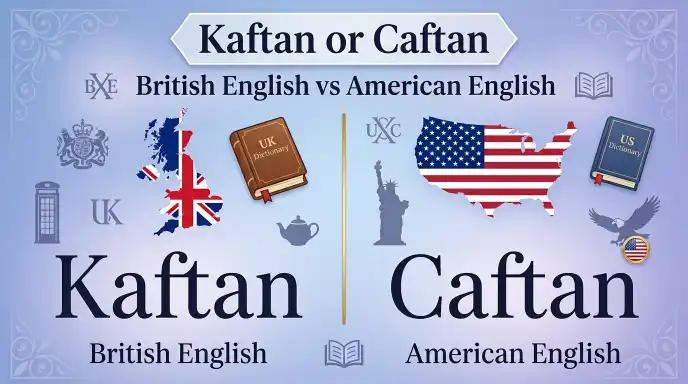
There is an important point to remember here: kaftan and caftan do not follow a simple British-versus-American spelling rule.
Some dictionaries show a regional preference. However, both forms are recognized in English on both sides of the Atlantic.
For example, Collins lists kaftan as a British English form and describes caftan as a variant spelling. In its American English entries, it records caftan and kaftan as alternative forms.
Oxford also lists kaftan with caftan as an alternative and provides an American English entry for caftan.
| Spelling | British English | American English | Example |
| Kaftan | Common and accepted | Accepted | She wore a silk kaftan. |
| Caftan | Accepted variant | Common and accepted | She bought a white caftan. |
What Does This Mean for Writers?
Do not treat kaftan as a British-only spelling.
Do not treat caftan as an American-only spelling either.
Instead, consider the dictionary, audience, publication style, and cultural context. If a publication has a house style, follow it.
Cambridge records both caftan and kaftan, with each entry pointing readers to the other form.
Which Version Should You Use?
Your choice can depend on who will read your content.
United States
Caftan is a natural choice for many American readers. Major American dictionary sources list caftan prominently, while also recognizing kaftan.
Example:
She wore a colorful caftan at the resort.
United Kingdom
Kaftan is a well-established British form. British dictionaries also recognize caftan as a variant.
Example:
She bought a cotton kaftan for the beach.
Canada
Canadian readers will understand both forms. Choose one based on the style of your publication or the wording used by your source.
Australia
Australian readers also recognize both spellings. For general writing, kaftan is a familiar form, but caftan is not incorrect.
International Writing
For a global audience, either spelling works.
The most important rule is consistency. If your article starts with kaftan, continue using kaftan unless you are discussing the alternate spelling.
Academic Writing
Use the spelling preferred by your institution, instructor, textbook, or chosen style guide.
When quoting or discussing a source, it can also be useful to preserve the source’s original spelling.
Business and Fashion Writing
Choose the form used by your brand, publication, catalog, or target market.
For product listings, consistency matters because customers may search for either kaftan or caftan.
Common Mistakes With Kaftan or Caftan
Because both forms are correct, the biggest mistakes come from treating one as completely wrong.
| Incorrect Assumption | Better Understanding | Explanation | Memory Tip |
| Caftan is always wrong. | Caftan is correct. | Major dictionaries record it. | C can be correct. |
| Kaftan is always wrong. | Kaftan is correct. | It is an established spelling. | K can be correct. |
| They describe different clothes. | They normally describe the same garment. | The spelling does not usually change the meaning. | Same garment, two spellings. |
| Only British writers use kaftan. | Both forms appear in different English varieties. | Usage varies by source and region. | Think preference, not strict rule. |
| Only Americans use caftan. | Caftan is used more broadly too. | British English also recognizes it. | C is not US-only. |
Common Incorrect Sentence
I bought a kaftan, so I used the wrong spelling in my American English essay.
Better Understanding
I bought a kaftan, which is an accepted spelling of caftan.
The key lesson is simple: do not mark either word as an automatic spelling error.
Kaftan or Caftan in Everyday Examples
Both spellings can appear in many types of writing. The choice often depends on the audience and context.
In Emails
I ordered a blue kaftan for the summer event.
Another option is:
I ordered a blue caftan for the summer event.
Both sentences are correct.
In Business Writing
Our new collection includes embroidered caftans for formal occasions.
A fashion company could also write:
Our new collection includes embroidered kaftans for formal occasions.
The main goal is consistency across the catalog.
In News Headlines
Designer Launches New Collection of Modern Kaftans
Or:
Designer Launches New Collection of Modern Caftans
Either spelling can work in a headline.
In Blogs
A lightweight kaftan can be a useful choice for a warm beach holiday.
The word often appears in travel and fashion content.
In Social Media
Loving this colorful caftan for summer! ☀️
A shorter post might say:
The new kaftan season is here!
Both forms are natural.
In Academic Writing
The kaftan has a long history in several cultures and regions.
Academic writers should use reliable sources and keep the spelling consistent.
In Daily Conversation
I love your caftan.
Or:
Where did you get that kaftan?
Both are understandable and correct.
Google Trends & Modern Usage
People search for kaftan or caftan for several reasons.
Some users want to check the correct spelling. Others are looking for clothing, fashion ideas, cultural history, or product descriptions.
Search behavior can also reflect regional spelling preferences. A shopper may search for kaftan dress, while another person may use caftan dress for the same type of clothing.
Current dictionary evidence confirms that both forms remain in use. Oxford lists kaftan with caftan as an alternative, while Cambridge provides separate entries that point to the same garment.
There is no reliable reason to claim that one spelling has completely replaced the other.
Exact Google Trends results also depend on the country, time period, search category, and comparison settings. Without a defined Trends dataset, exact search-volume figures or country rankings should not be invented.
For modern content, both keywords can be useful. Writers may include the main spelling naturally and mention the alternate form once when explaining the difference.
That approach helps readers while avoiding keyword stuffing.
Quick Comparison Table
| Version | Meaning | Correct? | Common Usage | Example |
| Kaftan | A long, loose garment | Yes | Common in British English and widely used internationally | She wore a silk kaftan. |
| Caftan | A long, loose garment | Yes | Common in American English and also used elsewhere | She wore a silk caftan. |
| Kaftan dress | A loose dress based on the kaftan style | Yes | Fashion and retail | The kaftan dress has wide sleeves. |
| Caftan dress | A loose dress based on the caftan style | Yes | Fashion and retail | The caftan dress is lightweight. |
| Kaftans | Plural of kaftan | Yes | General and fashion writing | The store sells colorful kaftans. |
| Caftans | Plural of caftan | Yes | General and fashion writing | The designer makes silk caftans. |
Key Takeaways
- Kaftan and caftan are both correct spellings.
- Both words normally describe the same type of garment.
- The difference is mainly a matter of spelling preference and usage.
- Kaftan is a well-established form in British English.
- Caftan is widely used in American English.
- Neither spelling should automatically be treated as wrong.
- Dictionary, publisher, audience, and cultural context can affect the preferred form.
- The safest approach is to choose one spelling and use it consistently.
FAQs About Kaftan or Caftan
Q1. Is it kaftan or caftan?
Both are correct. Kaftan and caftan are accepted spellings for the same type of loose garment. Usage varies by region and source. Some dictionaries favor kaftan, while others give caftan as the main form. The spelling does not normally change the meaning of the word.
Q2. Is kaftan the British spelling?
Kaftan is a common British form, but it is not exclusively British. British dictionaries also recognize caftan. Therefore, it is better to call kaftan a common British preference rather than a British-only spelling.
Q3. Is caftan the American spelling?
Caftan is widely used in American English, and American dictionaries list it as an established form. However, kaftan is also recognized in American English. So, American writers can use either spelling when their style guide does not require one specific form.
Q4. Do kaftan and caftan mean the same thing?
Yes. Kaftan and caftan normally mean the same type of garment. Both can describe a long, loose robe or dress. Modern fashion also uses the terms for lightweight clothing worn at resorts, beaches, and other casual settings.
Q5. Why are kaftan and caftan spelled differently?
The variation comes from the word’s history across several languages. English borrowed the word through forms connected with Turkish and Persian, and different spellings developed as the word moved between languages. Both k and c forms became established in English.
Q6. Which spelling should I use in an American article?
Caftan is a natural choice for many American readers. Still, kaftan is also correct. If your publication, brand, or style guide already uses kaftan, there is no need to change it simply because the audience is American. Consistency is more important than switching between forms.
Q7. Which spelling should I use in British English?
Kaftan is a well-established choice in British English. However, caftan is also recognized as a variant. If you are writing for a British publication, follow its house style. A consistent spelling will make the article look more polished.
Q8. Is kaftan a dress or a robe?
It can be either, depending on the context. Traditionally, a kaftan may refer to a long robe or coat-like garment. In modern Western fashion, the word can also describe a loose dress with wide sleeves. Context usually tells readers which style is meant.
Conclusion:
Kaftan and caftan are both correct spellings for the same type of garment. The difference is not a difference in clothing or meaning. Instead, the two forms reflect different spelling traditions and usage patterns.
Kaftan is especially familiar in British English, while caftan is widely used in American English. However, neither form belongs exclusively to one variety of English. Major dictionaries recognize both spellings, although they may give them different levels of preference.
For everyday writing, choose the form that best fits your audience, publication style, or source. American content can comfortably use caftan, while British content may naturally use kaftan. International writers can use either form.
The most important rule is to remain consistent. Do not treat the alternative spelling as an error.
Remember: one garment, two accepted spellings, and no need to worry when you see either form.
If you are writing about fashion, culture, or clothing, choose your preferred spelling and use it with confidence.

I’m Nora Ellis, an English language writer passionate about making grammar, spelling, and confusing words easy to understand. I share clear explanations and practical examples to help readers improve their English and use words with confidence.





7 thoughts on “Kaftan or Caftan: Correct Spelling, Meaning & Usage”