Primary and secondary are both correct words, but they describe different levels of importance, order, or source. The word primary usually means first, main, or most important. Secondary often means second, less direct, or dependent on something primary.
People often search for primary or secondary because the two terms appear in schoolwork, research, medicine, business, education, and everyday English. The confusion comes from the fact that their meanings can change slightly depending on context.
For example, a primary source gives direct evidence about an event. A secondary source discusses or explains information from other sources. In education, a primary school serves younger children, while a secondary school serves older students.
Understanding the difference helps you choose the right word in essays, reports, emails, and professional writing. It also makes technical terms easier to understand.
This guide explains the meaning of both words, their history, common uses, mistakes, and differences across contexts. You will also find simple examples and practical advice for choosing the right term.
Primary or Secondary : Quick Answer
Primary usually means first, main, or most important. Secondary usually means second, less important, or based on something primary.
Examples:
- Primary source: direct evidence or original material.
- Secondary source: material that analyzes or explains another source.
- Primary goal: the main goal.
- Secondary goal: an additional or less important goal.
- Primary school: education for younger children.
- Secondary school: education for older children.
The correct choice depends on what you are describing. If something comes first, provides direct evidence, or has the main role, primary is often appropriate. If it comes second, supports something else, or uses information from another source, secondary may be correct.
Definition and Meaning of Primary or Secondary
What Does Primary Mean?
Primary means first, main, original, or most important.
The exact meaning depends on the context.
For example:
Education is our primary concern.
Here, primary means the main concern.
In research:
The interview was a primary source.
Here, primary means the source provides direct or original information.
In order:
The primary stage comes before the secondary stage.
Here, primary relates to the first stage.
What Does Secondary Mean?
Secondary means second, less important, additional, or derived from something else.
For example:
Cost is a secondary concern.
Here, secondary means less important than the main concern.
In research:
The article is a secondary source.
It discusses or analyzes information rather than providing the original evidence.
The basic relationship is simple:
Primary = first or main
Secondary = second or supporting
Different Contexts
The words can have specific meanings in different fields.
| Context | Primary | Secondary |
| Importance | Main | Less important |
| Order | First | Second |
| Research | Original evidence | Analysis of existing evidence |
| Education | Earlier school level | Later school level |
| Medicine | Main or initial condition | Resulting or related condition |
| Business | Main objective | Supporting objective |
| Information | Original material | Material based on other sources |
The words are related, but they are not always opposites. Their meaning depends on the subject.
The Origin of Primary or Secondary

Primary comes from the Latin primarius, meaning “of the first rank” or “chief.” It developed through Old French and Middle English before becoming part of modern English.
The word is closely related to the Latin primus, meaning first.
Secondary comes from the Latin secundarius, meaning “of the second rank” or “following.” It is related to secundus, meaning “second” or “following.”
This history explains the basic relationship between the two words.
- Primary → first
- Secondary → second
English has used these words for centuries. Their meanings later expanded into specialized areas such as education, science, medicine, research, and business.
Unlike words such as colour/color or analyse/analyze, primary and secondary do not have a major British-American spelling difference. The spelling is generally the same in both varieties of English.
The main differences you see with these words usually come from context, not regional spelling.
British English vs American English Spelling
There is no major spelling difference between primary and secondary in British and American English.
Both varieties normally use:
- primary
- secondary
- primarily
- secondarily
| Word | British English | American English | Example |
| Primary | primary | primary | This is the primary reason. |
| Secondary | secondary | secondary | This is a secondary issue. |
| Primarily | primarily | primarily | The course is primarily practical. |
| Secondarily | secondarily | secondarily | The issue is secondarily important. |
The spelling stays the same. What may change is the terminology surrounding the words.
For example, primary school and secondary school are common terms in British English. American English more often uses terms such as elementary school, middle school, and high school for different stages of education.
Therefore, spelling is not the main issue with primary or secondary. The key is understanding the intended meaning.
Which Spelling Should You Use?
Since primary and secondary are spelled the same in British and American English, you do not need to choose between different spellings.
Instead, choose the word that matches your meaning.
For US Readers
Use primary when you mean the main or first item.
The primary objective is to improve safety.
Use secondary for an additional or less central point.
Cost is a secondary concern.
For UK and Commonwealth Readers
The same spelling rules apply.
Primary research provides original evidence.
Secondary research examines existing information.
For Global Writing
Both words are widely understood internationally.
Focus on clarity and context rather than regional spelling.
For Academic Writing
The distinction is especially important in research.
A primary source provides direct or original evidence. A secondary source interprets, discusses, or analyzes information from other sources.
Always follow the definitions and terminology required by your academic field.
For Business Writing
Use primary for the main objective, customer, market, or reason.
Use secondary for supporting objectives or additional factors.
For example:
Our primary market is North America.
Europe is a secondary market.
Common Mistakes with Primary or Secondary
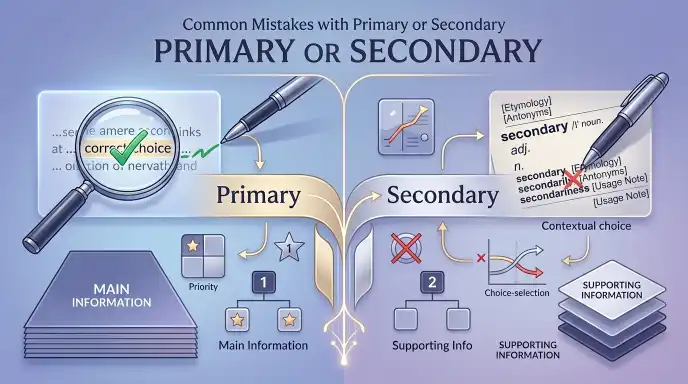
The most common mistakes involve confusing importance with order.
| Incorrect | Correct | Why? |
| This is my secondary goal, and it is the main goal. | This is my primary goal. | The main goal is primary. |
| The primary source analyzes another study. | The secondary source analyzes another study. | Analysis of another source is generally secondary. |
| Secondary school is always the first school level. | Primary school usually comes earlier. | Primary comes before secondary in this context. |
| This is a primary concern after the main issue. | This is a secondary concern. | A supporting concern is secondary. |
| The secondary objective is our main objective. | The primary objective is our main objective. | The main objective is primary. |
Easy Memory Tip
Think about numbers:
Primary = first
Secondary = second
You can also remember:
Primary leads. Secondary follows.
This simple rule works in many common contexts.
Primary or Secondary in Everyday Examples
In Emails
Primary:
Our primary goal is to complete the project by Friday.
Secondary:
A secondary goal is to reduce future costs.
In Business Writing
Customer satisfaction is our primary objective.
Brand awareness is a secondary objective.
The first objective receives the main focus.
In News Writing
Officials identified road safety as the primary concern.
A report may then mention traffic delays as a secondary issue.
On Social Media
My primary focus this month is studying.
Fitness is a secondary goal for now.
Both terms work naturally when the writer wants to show different levels of priority.
In Formal Writing
The study had one primary research question and several secondary questions.
This structure is common in academic and professional documents.
In Research
The interview transcript is a primary source.
A journal article discussing the interview may be a secondary source.
The distinction is based on the relationship between the evidence and the person using it.
Primary or Secondary : Google Trends & Usage Data
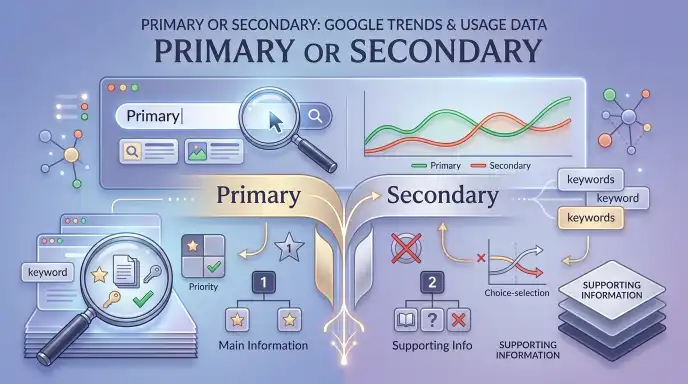
The phrase primary or secondary appears in many search contexts because these words are used across several fields.
Common search purposes include:
- Primary vs secondary sources
- Primary and secondary research
- Primary vs secondary education
- Primary vs secondary data
- Primary vs secondary evidence
- Primary vs secondary markets
- Primary vs secondary causes
- Primary vs secondary information
Search interest can vary by country and topic. Students may search these terms when studying research methods or writing essays. Professionals may encounter them in business, science, medicine, or education.
There is no meaningful British-American spelling split to explain here because primary and secondary are normally spelled the same in both varieties.
Exact Google Trends numbers also depend on the country, date range, search category, and search term selected. Therefore, specific popularity statistics should not be assumed without checking current Google Trends data.
The important point is that context drives the meaning. Someone searching “primary or secondary source” has a different question from someone searching “primary or secondary school.”
Primary vs Secondary: Quick Comparison Table
| Feature | Primary | Secondary |
| Basic meaning | First or main | Second or supporting |
| Importance | Usually more central | Usually less central |
| Order | Comes first | Comes after |
| Research | Original evidence | Analysis or discussion |
| Goal | Main objective | Supporting objective |
| Source | Direct information | Information based on other material |
| School context | Earlier level | Later level |
| Spelling in US | Primary | Secondary |
| Spelling in UK | Primary | Secondary |
FAQs
Q1. What is the difference between primary and secondary?
Primary usually means first, main, or original. Secondary usually means second, supporting, or derived from something else. The exact meaning depends on context.
For example, a primary source provides original evidence, while a secondary source usually analyzes or discusses information from other sources.
Q2. Is primary the same as main?
In many contexts, yes. Primary can mean the main or most important thing. For example, “The primary objective is safety” means safety is the main objective. However, primary can also mean first in order or original, so the exact meaning depends on the sentence.
Q3. What does secondary mean?
Secondary generally means second, less central, supporting, or based on something else. For example, a secondary goal supports the primary goal. In research, a secondary source usually examines or interprets information from primary sources.
Q4. Is primary or secondary used in both British and American English?
Yes. Primary and secondary have the same spelling in British and American English. The main difference may appear in related terminology. For example, British English commonly uses “secondary school,” while American education uses terms such as “high school” for certain stages.
Q5. What is a primary source?
A primary source is original or direct evidence connected to an event, study, person, or subject. Examples can include original research data, interviews, photographs, official records, letters, and historical documents. The exact definition can vary slightly by academic discipline.
Q6. What is a secondary source?
A secondary source usually analyzes, interprets, summarizes, or discusses information from primary sources. Examples include many textbooks, review articles, biographies, and historical analyses. if a source is primary or secondary can depend on the research question and the field of study.
Q7. How can I remember the difference between primary and secondary?
Use the simple number rule: primary means first, and secondary means second. You can also remember that the primary item usually leads or has the main role, while the secondary item follows or supports it. This rule works well in many everyday contexts.
Conclusion:
Primary and secondary are both important English terms, but they serve different purposes. Primary usually means first, main, or original, while secondary often means second, supporting, or derived from something else.
The meaning becomes clearer when you consider the context. A primary goal is the main goal. A secondary goal provides additional support. A primary source gives original evidence, while a secondary source usually examines or explains existing evidence.
There is no major British-American spelling difference. Both British and American English use primary and secondary with the same spelling. The terminology around them can differ in fields such as education, but the core words remain the same.
When choosing between them, ask one simple question: Is this the first, main, or original thing, or does it follow or support something else? That answer will usually guide you to the right word.
Remember: primary leads, while secondary follows or supports.

I’m Nora Ellis, an English language writer passionate about making grammar, spelling, and confusing words easy to understand. I share clear explanations and practical examples to help readers improve their English and use words with confidence.