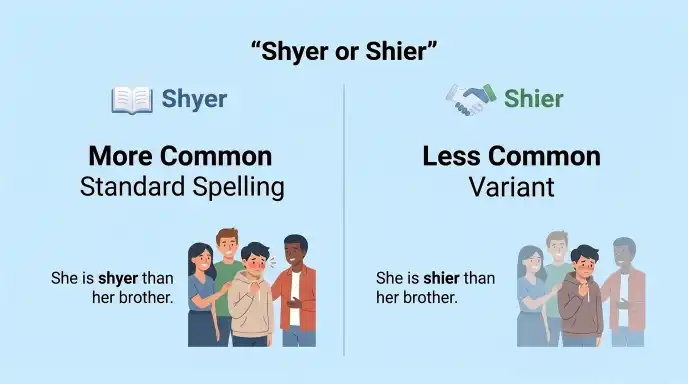
Shyer and shier are both correct spellings. They are comparative forms of the word shy and mean more shy or less confident than someone or something else.
People often search for shyer or shier because these words look different but have the same meaning. It can be hard to know which spelling to use in schoolwork, emails, articles, or daily writing. Both forms are accepted in English, so neither is always wrong.
The word shy describes someone who feels nervous, quiet, or unsure around other people. When we compare two people, we may say that one person is shyer than another. We can also write more than another. Both sentences express the same idea.
The main difference is spelling, not meaning. Shyer is a common and widely used form, while shier is also correct. Your choice may depend on your preferred writing style or the spelling guide you follow.
In this guide, you will learn the meaning, origin, and correct use of both words. You will also see examples, common mistakes, and practical advice for choosing the best spelling in American English, British English, and international writing.
Shyer or Shier : Quick Answer
Shyer and shier are both correct comparative forms of shy. They mean more shy, more timid, or less confident.
Examples:
- Shyer: My brother is shyer than I am.
- Shier: My brother is shier than I am.
Both sentences are correct.
Which spelling should you use?
Choose shyer for a simple, widely recognized spelling. Use shier if it matches your preferred dictionary or writing style. Most importantly, stay consistent throughout your writing.
Definition and Meaning of Shyer or Shier
The words shyer and shier describe someone who is more shy than another person or someone who feels more uncomfortable in a social situation.
What Does Shyer Mean?
Shyer is the comparative form of shy. It describes a person who feels more nervous, quiet, or uncomfortable around others.
Examples:
- She is shyer than her older sister.
- He became shyer after changing schools.
- My youngest child is shyer around strangers.
In each example, the word compares a person’s level of shyness with another person or an earlier situation.
What Does Shier Mean?
Shier has the same meaning as shyer. It describes someone who is more reserved, timid, or hesitant in social situations.
Examples:
- The new student is shier than his classmates.
- She seems shier when meeting new people.
- He grew shier after the difficult experience.
These sentences are correct. You can replace shier with shyer without changing the basic meaning.
When Should You Use These Words?
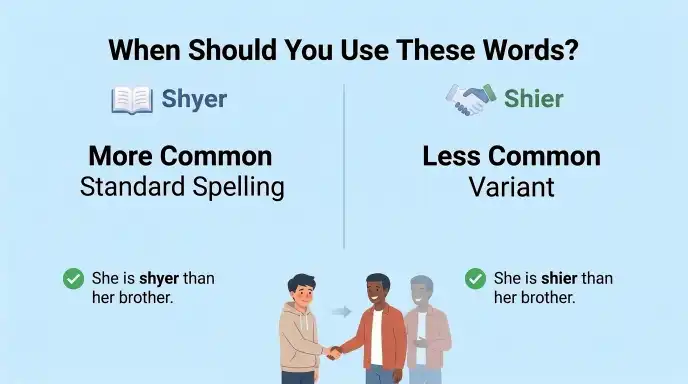
Use shyer or shier when comparing two people, animals, or things that show shyness.
For example:
- People: Mia is shyer than Emma.
- Animals: The younger puppy is shier around visitors.
- Behavior: He became shyer after moving to a new town.
Both spellings work in casual and formal writing.
However, these words do not mean more intelligent, less friendly, or less interested. A shy person may enjoy spending time with others but feel nervous when meeting new people.
The Origin of Shyer or Shier
The words shyer and shier come from the adjective shy. The word shy has a long history in English and has been used to describe people who are timid, reserved, or easily frightened.
The word shy comes from Old English scēoh, which meant timid or easily frightened. Over time, its meaning developed to include social hesitation and a lack of confidence.
English uses comparative forms to compare qualities. For many short adjectives, writers add -er to form the comparative.
For example:
- Tall → taller
- Fast → faster
- Small → smaller
- Shy → shyer
The spelling shier follows another pattern. In English, the letter y often changes to i before an ending, as in happy → happier. Some writers apply this pattern to shy, producing shier.
Both spellings have gained acceptance in English. The difference reflects variations in how writers form comparative words, rather than a difference in meaning.
Today, shyer is a familiar choice, while shier remains an accepted alternative. Neither form changes the meaning of the original adjective.
British English vs American English Spelling
Both shyer and shier are used in British and American English. This is not a spelling difference that divides the two varieties in the way that color/colour or center/centre does.
The preferred form can depend on the dictionary, editor, or style guide being followed.
| Feature | American English | British English |
| Accepted spelling | Shyer, shier | Shyer, shier |
| Common choice | Shyer | Shyer |
| Alternative form | Shier | Shier |
| Meaning | More shy | More shy |
| Formal writing | Both accepted | Both accepted |
| Main spelling difference | No fixed national rule | No fixed national rule |
Examples in American English
- My daughter is shyer than her brother.
- He is shier around new people.
Both forms are understandable and accepted.
Examples in British English
- The child became shyer at school.
- She was shier when she first joined the group.
Both sentences are correct in British English too.
Is One Spelling More British or American?
There is no firm rule that makes shyer exclusively American or shier exclusively British. It is better to check the dictionary or style guide used by your school, publisher, or workplace.
For most readers, both forms are clear. If you want a straightforward default, shyer is a good choice.
Which Spelling Should You Use?
The best spelling depends on your audience and your writing needs. Since shyer and shier have the same meaning, you do not need to change your sentence to use one rather than the other.
For American Readers
Use shyer as your default spelling. It is a familiar form and works well in school assignments, business emails, articles, and everyday messages.
Example: The new employee is shyer than his manager.
For British and Commonwealth Readers
Both shyer and shier are acceptable. Follow the dictionary or style guide used by your school, workplace, or publisher.
Example: The younger child is shyer around visitors.
For International Writing
Choose shyer if you want a simple, familiar option for a broad audience. Readers can understand both spellings, but one consistent form makes your writing easier to follow.
For Academic and Professional Writing
Use the form recommended by your chosen dictionary or editorial guide. Avoid switching between shyer and shier in the same document without a clear reason.
My recommendation: Use shyer in most situations. It is a practical default, while shier remains a correct alternative.
Common Mistakes with Shyer or Shier
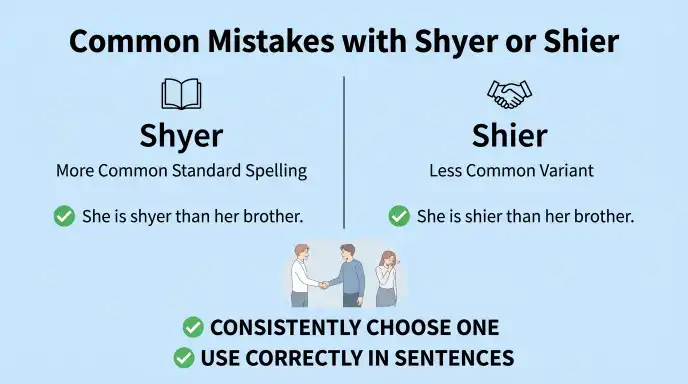
Writers sometimes confuse these spellings or use the wrong form when comparing people. Here are the most common mistakes and how to correct them.
Thinking Shier Is Always Wrong
Incorrect claim: Shier is never a correct word.
Correction: Shier is an accepted spelling of the comparative form of shy.
Example: She is shier than her cousin.
Thinking Shyer Is the Only Correct Form
Some writers believe that only shyer is acceptable. However, shier is also correct.
Example: He became shyer after moving to a new school.
Using More Shy Instead of a Comparative Form
The phrase more shy can also be used, but shyer or shier is often more concise.
Less concise: She is more shy than her brother.
Concise: She is shyer than her brother.
Both constructions are understandable, but the comparative form is a natural choice in many sentences.
Using Shyest Instead of Shyer
Use a comparative form when comparing two people or things. Use a superlative form when identifying the highest degree among a group.
- Comparative: Liam is shyer than Noah.
- Superlative: Liam is the shyest child in the class.
Switching Spellings Without a Reason
Using shyer in one paragraph and shier in the next can distract readers.
Better approach: Choose one spelling and use it consistently throughout your article, essay, or report.
| Incorrect or less suitable usage | Better usage | Reason |
| She is shyer than him. | She is shyer than him. | Correct spelling |
| He is shyer than his friend. | He is shyer than his friend. | Correct comparative form |
| She is the shyer of everyone. | She is the shyest in the group. | Correct superlative form |
| Shier is always wrong. | Shier is also accepted. | Both forms are correct |
Shyer or Shier in Everyday Examples
Seeing both words in context can help you understand how to use them naturally. The examples below cover common situations.
In Emails
You may use these words when describing a person’s behavior in a polite and professional way.
- The new team member is shyer during meetings but shares great ideas in writing.
- She is shier when speaking to large groups.
In News and Reports
Writers can use either form when describing a person’s behavior or a change in confidence.
- The younger candidate appeared shyer during the interview.
- The report described the child as shier around unfamiliar adults.
On Social Media
Both spellings work in casual posts, comments, and messages.
- I was much shyer when I was younger.
- My cat is shier around guests than it is around family.
In School Assignments
Students can use either spelling when comparing people or describing personal experiences.
- I was shyer than my classmates in primary school.
- My younger sister is shier when meeting new people.
In Formal Writing
Formal writing benefits from clear comparisons and consistent spelling.
- The participant appeared shyer during the first interview than during the second.
- The researcher noted that the younger children were shier in unfamiliar settings.
These examples show that both spellings can fit different types of writing.
Shyer or Shier : Google Trends & Usage Data
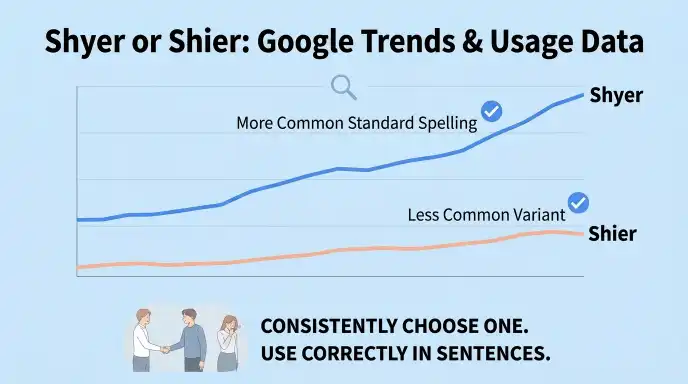
People may search for shyer or shier when checking spelling, editing an essay, or deciding which form sounds more natural. However, search interest alone does not determine if a spelling is correct.
Which Spelling Is More Popular?
Shyer is a familiar and widely used spelling. Shier is also correct, although writers may encounter it less often depending on the dictionary, publication, and region.
Without a current, verified Google Trends comparison, exact search volumes or country-by-country rankings should not be stated as facts.
Usage by Country
| Region | Accepted spelling | Practical advice |
| United States | Shyer, shier | Prefer shyer as a simple default |
| United Kingdom | Shyer, shier | Follow your preferred dictionary |
| Canada | Shyer, shier | Use a consistent spelling |
| Australia | Shyer, shier | Follow your style guide |
| International English | Shyer, shier | Choose one form and keep it consistent |
This table shows general spelling guidance, not measured search popularity.
What Affects Search Interest?
Several factors can affect searches for these words:
- Spelling uncertainty: People may wonder if to keep the y or change it to i.
- Schoolwork: Students may check comparative adjective forms.
- Editing: Writers may look for the accepted spelling before publishing.
- Grammar learning: English learners may compare shyer, shier, and shyest.
To compare actual search interest, use Google Trends and set the terms to the same time period and region. Check if the comparison uses web searches, the same language, and comparable search settings.
Remember that Google Trends reports relative search interest, not exact search volume. Do not assume that a spelling is incorrect simply because it receives fewer searches.
Shyer or Shier : Comparison Table
Use this table for a quick review of the main differences and similarities.
| Feature | Shyer | Shier |
| Base word | Shy | Shy |
| Part of speech | Comparative adjective | Comparative adjective |
| Meaning | More shy | More shy |
| Correct spelling | Yes | Yes |
| Used in sentences | Yes | Yes |
| Suitable for formal writing | Yes | Yes |
| Suitable for casual writing | Yes | Yes |
| Recommended default | Yes | Accepted alternative |
The two words have the same grammatical role and meaning. The main difference is how they are spelled.
FAQs About Shyer or Shier
Q1. Is shyer or shier correct?
Both shyer and shier are correct. They are comparative forms of shy and mean more shy or more timid. You can use either spelling, depending on your preferred style.
Q2. Is shyer a real word?
Yes. Shyer is a standard comparative form of shy. For example, “She is shyer than her brother” means she is more shy than he is.
Q3. Is shier a real word?
Yes. Shier is also an accepted comparative form of shy. It has the same meaning as shyer and can appear in both casual and formal writing.
Q4. Which is more common, shyer or shier?
Shyer is a familiar and widely used choice. However, exact popularity can vary by publication and region. Check a current dictionary or a properly configured usage tool if you need specific evidence.
Q5. Do Americans write shyer or shier?
American writers use both spellings. Shyer is a practical default for general American English, but shier is not automatically incorrect.
Q6. Do British people use shier?
Yes. Shier can be used in British English, just as shyer can. Neither spelling belongs exclusively to Britain or the United States.
Q7. What is the difference between shyer and shyest?
Shyer is the comparative form, usually used to compare two people or things. Shyest is the superlative form, used to identify the person or thing with the greatest degree of shyness in a group.
Examples:
- Comparative: Ava is shyer than Mia.
- Superlative: Ava is the shyest student in the class.
Conclusion: Shyer or Shier
Choosing between shyer and shier is simple once you understand that both spellings are correct. Each word is a comparative form of shy, and both mean more shy, more timid, or less confident than someone or something else.
You can use either spelling in everyday conversations, emails, school assignments, articles, and formal writing. There is no strict rule that makes one spelling American and the other British. The choice often depends on personal preference, dictionary guidance, or the style used by a publisher.
For most writers, shyer is a practical default because it is familiar and easy to recognize. However, shier is also acceptable, so you do not need to mark it as a spelling error.
Remember to use the comparative form when making a comparison. For example, “She is shyer than her friend.” When describing the most shy person in a group, use the superlative form: “She is the shyest person in the class.”
The most important rule is to choose one spelling and use it consistently. This keeps your writing clear, natural, and professional.

I’m Nora Ellis, an English language writer passionate about making grammar, spelling, and confusing words easy to understand. I share clear explanations and practical examples to help readers improve their English and use words with confidence.