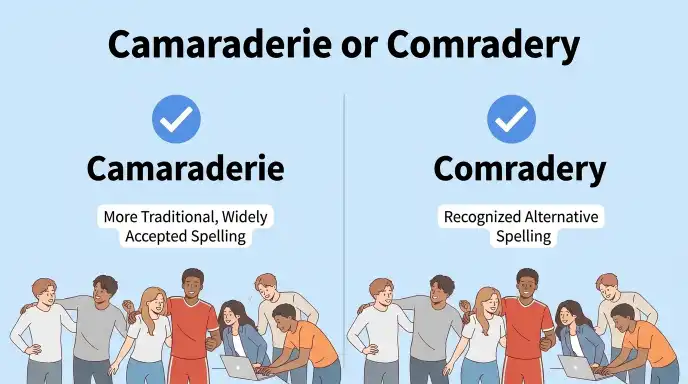
Camaraderie is the more common spelling, but comradery is also correct. Both words mean friendship, trust, and support among people who share work, goals, or experiences.
Have you ever stopped while writing because you were unsure if to use camaraderie or comradery? You are not alone. Many students, English learners, writers, and professionals search for these words because they look different but have the same meaning.
The confusion comes from their spelling and history. Camaraderie comes from French, while comradery looks more like the familiar English word comrade. This makes some people think that one form must be wrong.
The good news is that both spellings are accepted in English. You can use either word to describe a close bond between people. However, one form is much more common in books, articles, and formal writing.
In this guide, you will learn the meaning and origin of both words. You will also see British and American English examples, common spelling mistakes, and useful tips for choosing the right form. By the end, you will know which spelling works best for school, work, and everyday writing.
Camaraderie or Comradery : Quick Answer
Camaraderie is the preferred spelling in most situations. Comradery is also correct, but it is less common.
Both words describe friendship, trust, and support among people who share an experience or goal.
Examples:
- The players showed great camaraderie after the game.
- The workers enjoyed the comradery they built during the project.
Both sentences are correct and express the same idea.
Quick tip: Use camaraderie in essays, business emails, articles, and formal documents. It is the more common form and is widely understood by English readers.
Definition and Meaning of Camaraderie or Comradery
Both camaraderie and comradery are nouns. They describe a feeling of friendship, trust, and unity among people.
This feeling often grows when people work together, face challenges, or share common interests.
What Does Camaraderie Mean?
Camaraderie means a close bond between people who share an activity, goal, or experience.
It often develops among friends, coworkers, classmates, athletes, and team members. People may feel camaraderie when they help each other or work toward the same goal.
Examples:
- The team built strong camaraderie during training.
- Our office encourages camaraderie among coworkers.
- The students developed camaraderie during their school trip.
In each sentence, the word describes a positive connection between people.
What Does Comradery Mean?
Comradery has the same meaning as camaraderie. It describes friendship, unity, and mutual support among people.
Examples:
- The volunteers showed great comradery during the event.
- A strong sense of comradery helped the team succeed.
- The group formed lasting bonds through their shared comradery.
Although this spelling is correct, it is less common than camaraderie.
Are the Two Words Different in Meaning?
No. There is no standard difference in meaning between the two spellings.
| Feature | Camaraderie | Comradery |
| Part of speech | Noun | Noun |
| Meaning | Friendship and support | Friendship and support |
| Spelling status | Correct | Correct |
| Frequency of use | More common | Less common |
| Best general choice | Yes | Acceptable alternative |
Remember: Both words express the same idea. The main difference is how often people use each spelling.
The Origin of Camaraderie or Comradery
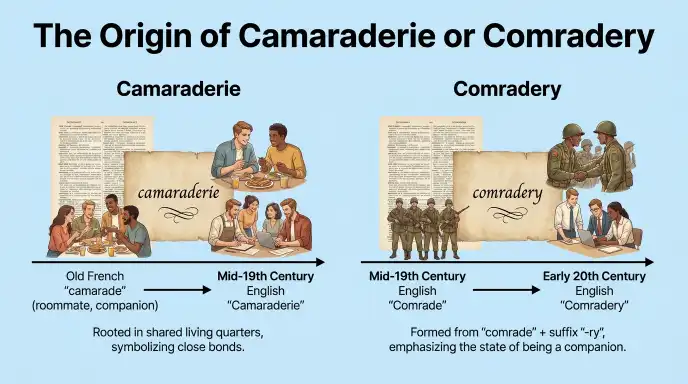
The two spellings share a connection, but they developed in different ways.
The History of Camaraderie
Camaraderie came into English from French during the 19th century. The French word camaraderie is linked to camarade, meaning a companion or comrade.
The word has older roots connected to the idea of a room or chamber. This history reflects the bond that can grow among people who live or work together.
Over time, camaraderie came to mean friendship, trust, and a shared sense of purpose.
The History of Comradery
Comradery developed later in English. It was formed from the word comrade and the suffix -ery.
Because comrade is a familiar English word, the spelling comradery may look easier or more natural to some writers.
Both forms became accepted, but camaraderie remained the more common spelling.
Why Do Two Spellings Exist?
English has many words that come from other languages. Their original spellings often remain, even when they look unusual.
English speakers also create new words from familiar words. This helps explain why both camaraderie and comradery exist.
The key point: Both spellings are correct, but camaraderie is the more widely used form.
British English vs American English Spelling
The difference between camaraderie and comradery is not a strict British-versus-American spelling rule.
Both forms are recognized in English. However, camaraderie is the more common choice in both British and American writing.
| Feature | British English | American English |
| Preferred spelling | Camaraderie | Camaraderie |
| Alternative spelling | Comradery | Comradery |
| Formal writing | Camaraderie | Camaraderie |
| Meaning | Friendship and unity | Friendship and unity |
| General advice | Prefer the common form | Prefer the common form |
British English Examples
- The players developed strong camaraderie during the season.
- The school values camaraderie among its students.
- The volunteers worked together with great camaraderie.
American English Examples
- The employees built camaraderie through team activities.
- The players showed strong camaraderie after the game.
- The group enjoyed the comradery they developed during training.
These examples show that both spellings can be understood in either variety of English.
Is Comradery Only American?
No. Comradery is not limited to American English. It is also recorded in British English dictionaries.
Some dictionaries describe it as especially common in North America. Still, this does not make it an American-only spelling.
For schoolwork, professional writing, and international communication, camaraderie is the safer choice.
Which Spelling Should You Use?
Your choice depends on your audience and the type of writing you are doing. When in doubt, choose camaraderie.
For American Readers
Use camaraderie in essays, reports, business emails, and professional documents. American readers may also see comradery in everyday writing.
Both forms are accepted, but camaraderie is more common.
For British and Commonwealth Readers
Choose camaraderie for school assignments, formal documents, news writing, and workplace communication.
This spelling is widely recognized in the United Kingdom and is suitable for readers in countries such as Australia, New Zealand, and Canada.
For International Readers
Camaraderie is the best general choice for a global audience.
Use it when writing for:
- Students who need standard spelling.
- English learners who want to build their vocabulary.
- Writers who publish for readers in different countries.
- Businesses that communicate with international teams.
- Editors who need consistent spelling.
For Academic and Professional Writing
Use camaraderie in research papers, reports, presentations, and formal emails unless your style guide says otherwise.
Avoid switching between the two spellings in the same document. Consistency makes your writing easier to read.
Common Mistakes with Camaraderie or Comradery
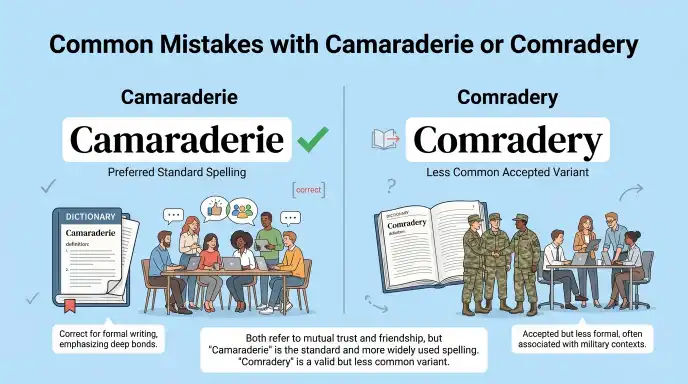
These words can cause spelling problems because they look unusual or similar.
The table below shows common errors and how to correct them.
| Incorrect form | Correct form | Explanation |
| Comraderie | Camaraderie or comradery | Missing letters create an incorrect spelling. |
| Camraderie | Camaraderie | The standard form includes the second a. |
| Camarady | Camaraderie | This is a misspelling of the common form. |
| Comradery means something different | Same meaning | Both words describe friendship and unity. |
| Changing spellings in one article | Use one spelling consistently | Consistency improves clarity. |
Thinking Comradery Is Always Wrong
Some writers believe comradery is a spelling mistake. However, it is an accepted variant.
Still, camaraderie is the better default because it is more common.
Assuming the Words Have Different Meanings
Both words describe a bond among people. Neither spelling has a separate standard meaning.
Confusing Camaraderie with Comradeship
Comradeship is another word for friendship, unity, or mutual support. It is a separate word, not another spelling of camaraderie.
Examples:
- The team developed strong camaraderie.
- The team developed strong comradeship.
Both sentences are correct.
Forgetting Your Audience
A spelling may be correct but less familiar to some readers. For formal or international writing, use camaraderie unless your publication follows a different rule.
Camaraderie or Comradery in Everyday Examples
Both words can describe friendship and trust in daily life. Here are examples from common writing situations.
In Emails
Use camaraderie when discussing teamwork or workplace relationships.
Examples:
- Subject: Building Team Camaraderie
- Our weekly meetings help build camaraderie among team members.
- Thank you for creating a workplace where trust and camaraderie can grow.
Camaraderie is a strong choice for professional emails because it is familiar and widely accepted.
In News Writing
News articles may use camaraderie to describe relationships among athletes, workers, or community members.
Examples:
- The players’ camaraderie helped them face a difficult season.
- The volunteers showed great camaraderie during the cleanup.
- The event created a sense of camaraderie across the community.
On Social Media
Both spellings may appear in casual posts, but camaraderie is the more common choice.
Examples:
- Great friends, shared goals, and lasting camaraderie.
- Nothing beats the camaraderie of a close team.
- Our group is built on trust, friendship, and camaraderie.
These examples work well for posts about school, work, sports, and friendship.
In Formal Writing
Use camaraderie in reports, essays, and professional documents.
Examples:
- Strong camaraderie can improve teamwork.
- The report examined camaraderie among employees.
- Shared challenges helped build camaraderie among participants.
In Everyday Conversation
You can use the word to describe a bond that grows through shared experiences.
Examples:
- There was great camaraderie among the classmates.
- The hikers felt camaraderie after helping each other.
- The new employee soon felt the team’s camaraderie.
Writing tip: Choose camaraderie when you want a clear and professional word for friendship within a group.
Camaraderie or Comradery : Google Trends & Usage Data
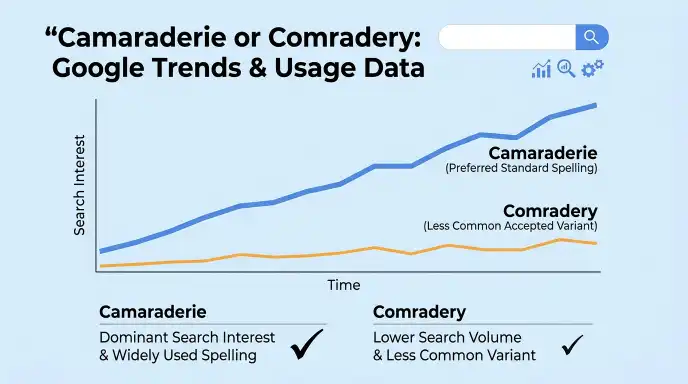
People search for camaraderie or comradery because both spellings exist, but they may not know which one is more common.
To understand their popularity, it helps to separate published usage from online search interest.
Which Spelling Is More Common?
Camaraderie is the most common spelling in published English. Comradery is less common, but it remains an accepted variant.
| Measure | Camaraderie | Comradery |
| Published usage | More common | Less common |
| Dictionary recognition | Widely recognized | Recognized variant |
| Formal writing | Preferred | Less usual |
| North American usage | Common | Also used |
| Global writing | Recommended | Secondary choice |
Usage by Country
- United States: Both spellings appear, but camaraderie is the stronger general choice.
- United Kingdom: Camaraderie is the preferred choice for most formal writing.
- Canada: Camaraderie is suitable for professional and international audiences.
- Australia and New Zealand: Camaraderie is the safer spelling for general use.
- Other English-speaking regions: Camaraderie is widely understood and works well for global readers.
These points describe general spelling preferences. They are not exact search rankings for each country.
What Does Google Trends Measure?
Google Trends shows relative search interest for selected terms, places, and time periods. It does not count every use of a word in books, articles, or conversations.
You can compare camaraderie and comradery by selecting both terms, choosing a country, and setting the same date range.
Book-frequency tools can offer another view of their use in published writing, but book data and search data measure different things.
Important: Exact search volumes and country rankings should not be reported without checking current data.
Which Spelling Is Better ?
For educational articles and general web content, use camaraderie as your main spelling because it is more common.
You can also mention comradery when explaining spelling differences. This helps readers find an answer to their question while keeping the article clear and natural.
Camaraderie vs Comradery : Comparison Table
Use this table to review the main differences.
| Comparison point | Camaraderie | Comradery |
| Correct spelling | Yes | Yes |
| Part of speech | Noun | Noun |
| Meaning | Friendship, trust, and unity | Friendship, trust, and unity |
| Word origin | French-based | Formed from comrade |
| General usage | More common | Less common |
| Formal writing | Preferred | Acceptable |
| British English | Used | Recognized |
| American English | Used | Recognized |
| Best for global readers | Yes | Less preferred |
The main lesson is simple: both spellings are correct, but camaraderie is the better general choice.
FAQs: Camaraderie or Comradery
Q1. Is camaraderie or comradery correct?
Both spellings are correct. However, camaraderie is more common and is the preferred choice for most types of writing.
Q2. What is the difference between camaraderie and comradery?
There is no standard difference in meaning. Both words describe friendship, trust, and a shared bond among people. The main difference is spelling and frequency of use.
Q3. Is comradery a real word?
Yes. Comradery is an accepted spelling, but it is less common than camaraderie.
Q4. Is camaraderie British or American English?
Camaraderie is used in both British and American English. It is suitable for readers around the world.
Q5. Is comradery more common in American English?
Some dictionaries describe comradery as especially North American. However, it is also recognized in British English.
Q6. How do you pronounce camaraderie?
Camaraderie is commonly pronounced kah-muh-RAH-duh-ree in American English, although pronunciation can vary by accent.
Q7. Which spelling should I use in an essay?
Use camaraderie in an essay unless your teacher or style guide requests another form. It is widely recognized and suitable for formal writing.
Q8. Can I use comradery in professional writing?
Yes. Comradery is accepted, but camaraderie is usually the better choice for reports, business emails, and professional documents.
Conclusion: Camaraderie or Comradery
Choosing between camaraderie and comradery is simple once you know their meaning and usage. Both spellings describe friendship, trust, and a sense of unity among people who work together or share an experience. Neither spelling has a different standard meaning.
However, camaraderie is the more common and widely preferred spelling. It came into English from French, while comradery developed from the familiar word comrade. Both forms are accepted, but they are not used equally often.
For British English, American English, and international writing, camaraderie is the safest choice. Use it in school assignments, business emails, articles, reports, and formal documents. You can use comradery when it suits your style, but try to keep one spelling throughout your work.
Remember that this is not a strict British-versus-American spelling difference. Both forms are recognized in English, although camaraderie is more common.
The easiest rule is to choose camaraderie for clear, professional, and widely understood writing. This simple choice helps you avoid spelling confusion and communicate your ideas with confidence.

I’m Nora Ellis, an English language writer passionate about making grammar, spelling, and confusing words easy to understand. I share clear explanations and practical examples to help readers improve their English and use words with confidence.