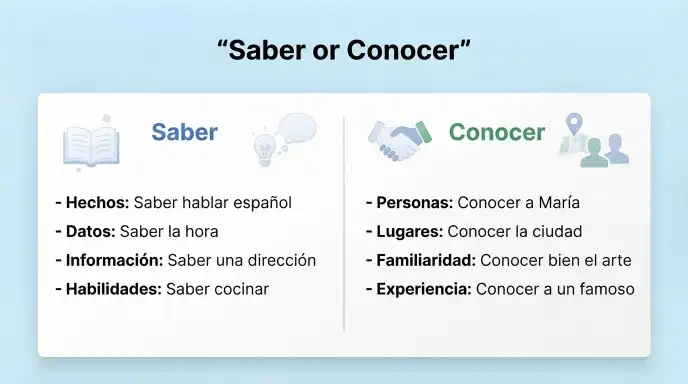
Saber and conocer both mean “to know” in Spanish, but they are not used in the same way. Saber is generally used for facts, information, and knowing how to do something, while conocer is used for knowing people, places, and being familiar with something.
This difference causes problems for many Spanish learners because English uses one main verb, know, for both meanings. A learner may know the English sentence “I know Maria” and try to translate it directly into Spanish. However, Spanish requires conozco a María, not sé a María. In the same way, “I know the answer” becomes sé la respuesta, not conozco la respuesta.
People search for saber or conocer because both verbs can translate as “to know,” yet their meanings change with the context. The key is to ask what you know. Do you know a fact, an answer, or how to do something? Use a saber. Do you know a person, place, or something through experience or familiarity? Use conocer.
Once this simple difference is clear, choosing the right verb becomes much easier.
Saber or Conocer: Featured Snippet & AI Overview
Saber and conocer both mean “to know,” but they are used differently in Spanish. Use saber for facts, information, answers, and knowing how to do something. Use conocer for people, places, and things you are familiar with. For example, sé la respuesta means “I know the answer,” while conozco a Ana means “I know Ana.”
Saber or Conocer: Quick Answer
The easiest way to remember the difference is:
- Saber = know information or know how
- Conocer = know someone or be familiar with something
Use Saber for:
- Facts
- Information
- Answers
- Knowledge
- Knowing how to do something
Examples:
Sé la respuesta.
I know the answer.
Sé hablar español.
I know how to speak Spanish.
¿Sabes dónde vive?
Do you know where he lives?
Use Conocer for:
- People
- Places
- Cities
- Countries
- Being familiar with something
Examples:
Conozco a María.
I know María.
Conocemos Madrid.
We know Madrid / We are familiar with Madrid.
¿Conoces este restaurante?
Do you know this restaurant?
A useful memory rule is:
Saber is about knowledge. Conocer is about familiarity or experience.
What Does Saber or Conocer Mean?
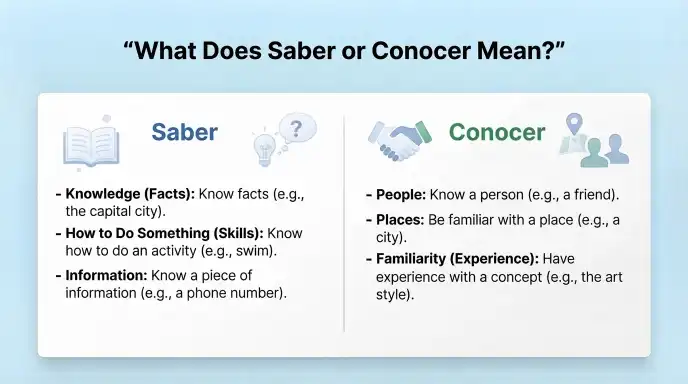
Both saber and conocer are Spanish verbs. Their basic English translation is often “to know.”
The problem is that English does not normally make the same distinction.
What Does Saber Mean?
Saber means to know a fact, piece of information, answer, or detail. It can also mean to know how to do something.
For example:
Sé tu nombre.
I know your name.
Sabemos la verdad.
We know the truth.
Ella sabe la respuesta.
She knows the answer.
Saber is also used with an infinitive to express knowing how to do something:
Sé nadar.
I know how to swim.
Él sabe cocinar.
He knows how to cook.
Here, saber does not simply mean having information. It describes a learned ability or skill.
What Does Conocer Mean?
Conocer means to know or be familiar with a person, place, or thing through experience or familiarity.
For example:
Conozco a Juan.
I know Juan.
Conocemos París.
We know Paris / We are familiar with Paris.
¿Conoces esta canción?
Are you familiar with this song?
Conocer often has the sense of having met, having experienced, or being familiar with something.
The Important Difference
Compare these sentences:
Sé quién es ella.
I know who she is.
La conozco.
I know her.
The first sentence is about information. The second is about familiarity with a person.
This distinction is one of the most important rules for Spanish learners.
The Origin of Saber or Conocer
The two verbs have different Latin roots and developed different meanings in Spanish.
Saber comes from Latin sapere, a verb associated with knowing, understanding, and having good judgment. Over time, Spanish developed saber as the verb used for knowledge, information, facts, and skills.
Conocer comes from Latin cognoscere, which was related to recognizing, learning about, or becoming acquainted with something or someone. Spanish developed conocer for familiarity and acquaintance.
This history helps explain why Spanish has two separate verbs where English commonly uses one word, know.
The distinction is not a recent spelling rule. It is part of the normal structure of modern Spanish.
The verbs also have different conjugations. For example:
- Yo sé = I know
- Yo conozco = I know / I am familiar with
Notice that both forms can translate as “I know” in English. The correct choice depends on what follows and what kind of knowledge is meant.
British English vs American English
The difference between saber and conocer is not a British English versus American English spelling difference. These are Spanish verbs, and the distinction applies across Spanish-speaking regions.
English speakers in both the United States and the United Kingdom may need to learn the same Spanish rule.
| Context | Spanish Verb | English Meaning | Example |
| Fact | Saber | Know | Sé la verdad. |
| Information | Saber | Know | Sabemos su nombre. |
| Answer | Saber | Know | Ella sabe la respuesta. |
| Skill | Saber | Know how | Sé nadar. |
| Person | Conocer | Know | Conozco a Carlos. |
| Place | Conocer | Know / be familiar with | Conozco Roma. |
| Thing or work | Conocer | Be familiar with | Conozco esa película. |
| Experience | Conocer | Have experienced | Conocemos la ciudad. |
English style does not change the Spanish rule. The same distinction applies if the learner speaks American English, British English, Canadian English, or another variety of English.
Saber or Conocer: Which Version Should You Use?
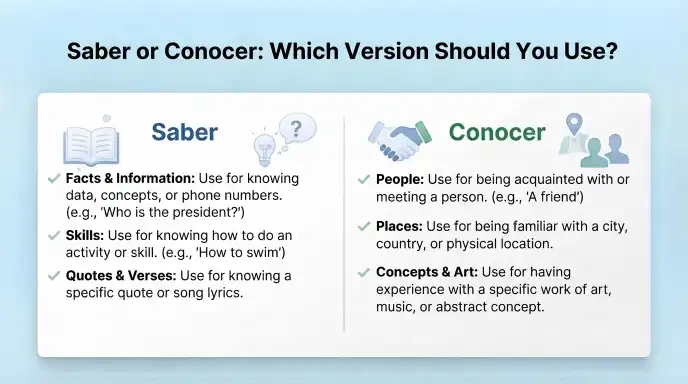
There is no regional choice between saber and conocer in the way there is between some English spellings. You should choose the verb based on meaning and context.
United States
Spanish learners in the United States should use sabers for information and skills and conocer for people and familiarity.
Sé la respuesta.
Conozco a tu hermano.
United Kingdom
The same rule applies to British English speakers learning Spanish.
¿Sabes la dirección?
¿Conoces Londres?
Canada
Canadian Spanish learners should use the same distinction.
The important point is not the variety of English spoken by the learner. It is the meaning of the Spanish sentence.
Australia
Australian English speakers learning Spanish also follow the same rule.
Use saber for knowledge and conocer for familiarity.
International Writing
For international Spanish learners, the safest approach is to learn the core distinction rather than trying to memorize English translations.
Think:
Saber = information or ability.
Conocer = familiarity or acquaintance.
Academic Writing
In academic Spanish, use the verb that matches the meaning.
El investigador sabe los resultados.
For familiarity with a subject, place, or work:
El investigador conoce bien el tema.
Business Writing
Business Spanish follows the same basic rule.
Sabemos los detalles del proyecto.
Conocemos a su representante.
Common Mistakes with Saber or Conocer
The most common mistake is translating “know” directly into Spanish without checking its meaning.
| Incorrect | Correct | Why? |
| Sé a María. | Conozco a María. | María is a person. |
| Conozco la respuesta. | Sé la respuesta. | A response is information. |
| Conozco cómo hacerlo. | Sé cómo hacerlo. | Knowing how to use a saber. |
| Sé Madrid. | Conozco Madrid. | A city is something you are familiar with. |
| Conozco nadar. | Sé nadar. | A learned skill uses saber. |
Memory Tip
Ask yourself:
“Am I talking about information or familiarity?”
- Information, facts, answers, or skills → SABER
- People, places, or familiarity → CONOCER
One More Important Point
The phrase saber + infinitive is especially useful.
Sé conducir.
I know how to drive.
Sabemos cocinar.
We know how to cook.
Do not replace saber with conocer in these sentences.
Saber or Conocer in Everyday Examples
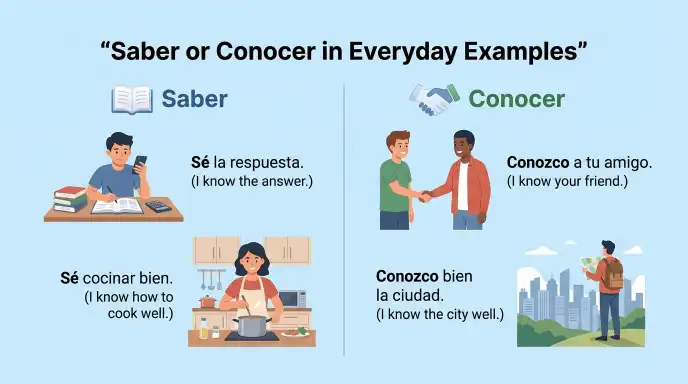
Seeing the verbs in real situations makes the difference easier to remember.
Emails
Saber:
Sé que la reunión empieza a las nueve.
I know that the meeting starts at nine.
Conocer:
Conozco a la nueva directora.
I know the new director.
Business Writing
Saber:
La empresa sabe cuáles son los principales problemas.
The company knows what the main problems are.
Conocer:
La empresa conoce bien el mercado local.
The company knows the local market well.
Here, conocer suggests familiarity with the market.
News Headlines
El gobierno sabe la causa del problema.
The government knows the cause of the problem.
El ministro conoce la situación.
The minister is familiar with the situation.
Blogs
¿Sabes cómo preparar este plato?
Do you know how to prepare this dish?
¿Conoces este restaurante?
Do you know this restaurant?
Social Media
¿Conoces a este cantante?
Do you know this singer?
¡Ahora sé cómo hacerlo!
Now I know how to do it!
Academic Writing
Los estudiantes saben la respuesta.
The students know the answer.
Los estudiantes conocen el tema.
The students are familiar with the topic.
Daily Conversation
¿Sabes dónde está Ana?
Do you know where Ana is?
Sí, conozco a Ana.
Yes, I know Ana.
Notice how one conversation can use both verbs because the meaning changes.
Saber or Conocer: Google Trends & Modern Usage
People often search for saber or conocer because English uses know for several meanings that Spanish separates into two verbs.
The most common confusion usually comes from sentences such as:
- I know the answer.
- I know Maria.
- I know how to swim.
- I know Madrid.
- I know this song.
An English learner may expect one Spanish verb to work in all five sentences. It does not.
Modern Spanish uses both verbs as normal parts of everyday speech and writing. The difference is based on meaning, not on an old-fashioned spelling rule.
Exact search popularity can vary by country and time. Without a specific current data set, it is better not to claim exact Google Trends numbers. The general search pattern is clear: learners often look up the two verbs together because both translate as “to know.”
For learners, the best solution is not to memorize which verb is “more common.” Instead, learn the type of knowledge each verb expresses.
Saber or Conocer: Quick Comparison Table
| Version | Meaning | Correct? | Main Use | Example |
| Saber | To know | Yes | Facts and information | Sé la respuesta. |
| Saber | To know how | Yes | Skills and abilities | Sé nadar. |
| Conocer | To know | Yes | People | Conozco a Ana. |
| Conocer | To know / be familiar with | Yes | Places | Conozco Madrid. |
| Conocer | To be familiar with | Yes | Things and subjects | Conozco ese libro. |
Key Takeaways
- Saber and conocer can both mean “to know.”
- Use saber for facts and information.
- Use saber + infinitive for knowing how to do something.
- Use conocer for people.
- Use conocer for places you know or are familiar with.
- Use conocer for things, subjects, or works you are familiar with.
- English uses know for both meanings, which causes much of the confusion.
- The choice depends on meaning, not English dialect.
FAQs About Saber or Conocer
Q1. What is the difference between saber and conocer?
Saber is used for facts, information, answers, and knowing how to do something. Conocer is used for people, places, and familiarity with something. Both can translate as “to know,” but they describe different kinds of knowledge.
Q2. Do saber and conocer both mean “to know”?
Yes. Both verbs can translate as “to know” in English. However, Spanish uses them in different situations. Saber usually refers to information or ability, while conocer usually refers to familiarity, people, and places.
Q3. Is it “sé a María” or “conozco a María”?
The correct sentence is “Conozco a María.” Use conocer when you know a person or have met someone. Saber is not normally used to say that you know a person.
Q4. Should I use a saber or conocer for a city?
Use conocer when you mean that you know or are familiar with a city because you have experienced it or know it well. For example, “Conozco Madrid” means “I know Madrid” or “I am familiar with Madrid.”
Q5. Which verb means “to know how”?
Use saber followed by an infinitive. For example, “Sé nadar” means “I know how to swim,” and “Sabe cocinar” means “ such as they knows how to cook.”
Q6. Is “conozco la respuesta” correct?
Usually, “Sé la respuesta” is the natural choice when you mean “I know the answer.” An answer is information, so saber is normally used. Conocer is generally used for familiarity rather than knowing a specific fact.
Q7. Is saber used for facts?
Yes. Saber is the main verb for knowing facts, information, answers, and details. For example, “Sé la verdad” means “I know the truth,” and “Sabemos su nombre” means “We know his or her name.”
Q8. Is conocer used for people?
Yes. Conocer is used when you know or have met a person. For example, “Conozco a Pedro” means “I know Pedro.” The personal a is normally used before a specific person who is the direct object.
Conclusion:
Saber and conocer both mean “to know,” but Spanish uses them for different types of knowledge. This is one of the most important distinctions for English speakers learning Spanish because English usually uses one verb, know, for both ideas.
Use a saber when you know a fact, answer, piece of information, or how to do something. For example, sé la respuesta means “I know the answer,” while sé nadar means “I know how to swim.”
Use conocer when you know a person, place, or something through familiarity or experience. Conozco a María means “I know María,” and conozco Madrid means “I know Madrid” or “I am familiar with Madrid.”
The easiest way to remember the difference is to think about what kind of knowing you mean. Saber is knowledge. Conocer is familiarity. Once you learn this simple rule, many common Spanish sentences become much easier to build.
Keep practicing with real examples, and the difference will soon feel natural.
Remember: if you know the fact, use a saber; if you know the person or place, use conocer.

I’m Nora Ellis, an English language writer passionate about making grammar, spelling, and confusing words easy to understand. I share clear explanations and practical examples to help readers improve their English and use words with confidence.