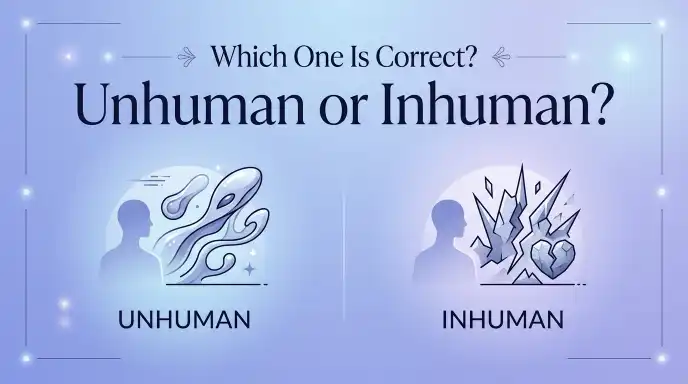
Inhuman is the more common and standard choice, but unhuman is also a real English word with less common uses. The two words overlap, but they do not always carry the same meaning or tone.
People often search for unhuman or inhuman because both words contain the same basic idea: something that does not fit normal human qualities. The problem comes from the small difference between the prefixes in- and un-.
Unhuman also has dictionary support, but it appears much less often. Dictionaries describe it as something lacking human attributes, something beyond normal human limits, or something that does not belong to the human species.
This article explains the difference, shows when each word works, and gives practical advice for American, British, academic, business, and international writing.
Unhuman or Inhuman : Quick Answer
Inhuman is usually the better choice because English speakers use it much more often.
Unhuman is not simply a spelling mistake. It is a legitimate but less common word.
Use inhuman when you mean:
- extremely cruel or brutal
- lacking human kindness or sympathy
- strange or unlike a human
- not produced by or typical of humans
Use unhuman when you want to stress that something lacks human qualities or falls outside normal human experience. It can also describe something beyond ordinary human ability.
Examples
The prisoners suffered inhuman treatment.
The creature had an inhuman appearance.
The athlete showed inhuman strength.
The machine moved with an almost unhuman precision.
For normal formal writing, inhuman will usually sound more natural.
What Does Unhuman or Inhuman Mean?
The words unhuman and inhuman share a connection with the word human, but they can express different ideas.
What Does Inhuman Mean?
Inhuman usually describes something that lacks normal human kindness or sympathy. It can also describe something that seems unlike a human or produces a strange, frightening feeling.
Cambridge Dictionary gives two main meanings. First, inhuman can mean extremely cruel. Second, it can describe something that does not seem human in an unusual or frightening way.
Examples:
The prisoners received inhuman treatment.
Here, inhuman means cruel and lacking compassion.
The robot made an inhuman sound.
Here, inhuman means strange or unlike something produced by a human.
Oxford gives a similar distinction. It defines inhuman as lacking kindness and sympathy or as something that does not seem human and therefore feels frightening.
What Does Unhuman Mean?
Unhuman has a narrower and less common role.
Dictionary.com defines it as something that lacks human attributes, has qualities beyond normal human limits, or does not belong to the human species.
For example:
The creature had an unhuman appearance.
This suggests that the creature did not look or behave like a normal human.
Another example:
She showed unhuman strength.
Here, unhuman suggests strength beyond normal human ability.
Collins also lists unhuman as an English adjective. It gives meanings such as “not human in kind or quality” and notes that the word is rare in some uses.
The Simple Difference
A useful way to remember the difference is:
Inhuman often focuses on cruelty, lack of compassion, or something strangely unlike a human.
Unhuman often focuses on something outside normal human qualities or limits.
However, the meanings can overlap. That is why writers sometimes use the two words in similar contexts.
The Origin of Unhuman or Inhuman
Both words developed from humans with a negative prefix.
The word unhuman combines un- with human. Etymonline records inhumans from the 1540s. It first described actions and later described people as lacking human qualities. The word also developed a meaning connected with qualities beyond normal human limits.
The history of inhuman goes further back. Oxford traces it to Late Middle English and connects it to Latin inhumanus, from in- meaning “not” and humanus, meaning “human.”
English speakers have used inhuman for centuries to describe a lack of human kindness or sympathy. Over time, the word also developed the meaning “not human” or “unlike a human.”
This history helps explain why inhuman has such a wide range of meanings today.
Why Do People Confuse the Two?
The prefixes create most of the confusion.
English uses both in- and un- to create negative meanings. However, we cannot always choose one prefix freely.
For example:
- human → inhuman
- humane → inhumane
- usual → unusual
- kind → unkind
English developed these words over time. Writers cannot always create a standard word simply by adding in- or un-.
That explains why inhuman became the common choice while unhuman remained much less common.
British English vs American English
British and American English both recognize inhuman and unhuman. The main difference does not involve spelling. It involves frequency, context, and style.
Inhuman has a much stronger position in everyday and formal English. Major dictionaries such as Cambridge and Oxford list it as a standard adjective.
Unhuman also appears in dictionaries, but Collins labels some of its uses as rare.
| Feature | British English | American English |
| inhuman | Very common and standard | Very common and standard |
| unhuman | Correct but uncommon | Correct but uncommon |
| Cruel treatment | inhuman | inhuman |
| Strange or nonhuman quality | inhuman often preferred | inhuman often preferred |
| Beyond normal human ability | unhuman can work | unhuman can work |
| Formal writing | Prefer inhuman in most cases | Prefer inhuman in most cases |
Does the Spelling Change?
No.
You do not need a British spelling and an American spelling for these words.
Both varieties use:
inhuman
and
unhuman
The main issue concerns which word sounds more natural in the context.
What Do Editors Usually Prefer?
Editors usually favor the more familiar word when both choices can express the same idea.
Because inhuman occurs more often and has clearer established meanings, it usually gives readers the quickest and clearest message.
If you mean cruelty, inhuman is especially strong:
The prisoners faced inhuman conditions.
If you mean something outside ordinary human limits, unhuman can add a different tone:
The character possessed inhuman strength.
Which Version Should You Use?
Your choice should depend on your audience and meaning.
United States
Use inhuman for most everyday and professional writing.
For example:
The workers faced inhuman conditions.
Use unhuman only when you have a clear reason to emphasize something outside normal human qualities.
United Kingdom
British writers can use both words, but inhuman remains the safer general choice.
For example:
The treatment was inhuman.
This sounds natural and clear.
Canada
Canadian English also favors familiar standard vocabulary in formal writing. Inhuman works well for most contexts.
Use unhuman only when its specific meaning adds something useful.
Australia
Australian writers can follow the same practical rule. Choose inhuman for general use and unhuman when the context calls for its less common meaning.
International Writing
Inhuman is usually the best choice for an international audience.
Readers around the world are more likely to recognize it immediately.
Academic Writing
Use inhuman when you discuss cruelty, human behavior, ethics, history, or social conditions.
For example:
The study examines the effects of inhuman treatment on prisoners.
If you discuss creatures, artificial intelligence, science fiction, or philosophy, unhuman may sometimes fit better.
Business Writing
Use inhuman carefully in professional writing because it can sound strongly negative.
For example:
Employees described the working conditions as inhuman.
Avoid unhuman unless you specifically need its unusual meaning.
Common Mistakes with Unhuman or Inhuman
Treating Unhuman as a Spelling Error
❌ Unhuman is always wrong.
This statement is too strong.
✅ Unhuman is a real but uncommon English word.
Dictionaries recognize it, although some sources describe it as rare.
Using Unhuman for Cruel Treatment
❌ The prisoners received unhuman treatment.
This sentence may appear in English, but inhuman sounds much more natural.
✅ The prisoners received inhuman treatment.
Cambridge and Oxford both use inhuman for cruel or degrading treatment.
Confusing Inhuman and Inhumane
These words look similar, but they have different common uses.
Inhuman can mean extremely cruel or unlike a human.
The prisoners suffered inhuman treatment.
Inhumane specifically describes cruel treatment that causes suffering and lacks concern for people or animals.
The factory used inhumane methods to handle the animals.
Cambridge defines inhumane as cruel and causing suffering to people or animals.
Assuming Inhuman Always Means Cruel
Inhuman can also mean “not human” or “unlike a human.”
The creature made an inhuman sound.
The sentence does not necessarily say that the creature acted cruelly.
Memory Tip
Use this simple guide:
Inhuman = usually the standard choice.
Unhuman = less common, often used for something outside normal human qualities.
Inhumane = cruel and causing suffering.
Everyday Examples of Unhuman or Inhuman
The right word depends on the context.
Emails
The staff reported inhuman working conditions.
This sentence works well in a formal complaint.
Business Writing
The company faced criticism for its inhuman treatment of workers.
Here, inhuman means cruel or lacking compassion.
News Headlines
Critics Call the Treatment Inhuman
News writers often choose inhuman because readers understand it quickly.
Blogs
The character has an unhuman appearance that makes the story feel mysterious.
Here, unhuman gives the description a literary tone.
Social Media
That was an inhuman amount of work for one person!
In casual writing, speakers may use inhuman to exaggerate how extreme something feels.
Academic Writing
The researchers examined the effects of inhuman treatment on prisoners.
This use clearly focuses on cruelty.
Daily Conversation
That heat is inhuman!
Here, the speaker uses inhuman informally to describe something extreme.
Science Fiction
The creature had unhuman eyes and an unusual voice.
The writer may choose unhuman to emphasize that the creature does not fit normal human characteristics.
Google Trends & Modern Usage
People search for unhuman or inhuman because the two words look almost interchangeable. The prefixes also make the difference difficult to predict.
Current dictionary evidence shows a clear practical pattern. Inhuman has broad standard usage. Cambridge gives it both the “extremely cruel” meaning and the “not human in an unusual or frightening way” meaning.
Unhuman has a smaller role. Dictionary.com gives meanings related to lacking human attributes, going beyond normal human limits, and not belonging to the human species. Collins also lists the word but marks some uses as rare.
We should not treat search volume as proof of correctness. People often search unusual or incorrect forms because they want to check them.
For this keyword, the strongest usage advice is therefore based on dictionary evidence and modern writing patterns rather than an invented search-volume statistic.
Why Do People Search This Keyword?
Common reasons include:
- They want to describe cruel behavior.
- They want to describe something that does not look human.
- They want to describe extreme or unusual abilities.
- They are unsure if humans exist.
- They confuse inhuman with inhumane.
- They see both forms in books or online writing.
For most situations, inhuman gives readers the clearest meaning.
Quick Comparison Table
| Version | Meaning | Correct? | Region | Example |
| inhuman | Extremely cruel or unlike a human | Yes | Global | The prisoners faced inhuman treatment. |
| unhuman | Lacking human qualities or beyond normal human limits | Yes, but uncommon | Global | The creature had inhuman strength. |
| inhumane | Cruel and causing suffering | Yes | Global | The practice is inhumane. |
| nonhuman | Not belonging to the human species | Yes | Global | Scientists studied nonhuman animals. |
The table shows why nonhuman can sometimes work better than either inhuman or unhuman.
If you simply mean “not human,” nonhuman often gives the clearest and most neutral meaning.
For example:
Scientists studied nonhuman primates.
This sentence does not suggest cruelty or fear.
Key Takeaways
- Inhuman is the more common and generally safer choice.
- Unhuman is a real English word, not simply a spelling mistake.
- Inhuman often means extremely cruel or lacking human sympathy.
- Inhuman can also describe something strange or unlike a human.
- Unhuman can describe something that lacks human qualities or goes beyond normal human limits.
- Inhumane means cruel and causing suffering.
- Nonhuman works well when you simply mean “not human.”
- For formal and international writing, inhuman usually gives the clearest result.
FAQs
Q1. Is unhuman a correct English word?
Yes. Unhuman is a real English word, although writers use it much less often than inhuman. Dictionaries recognize meanings such as lacking human attributes, going beyond normal human limits, or not belonging to the human species. For most everyday and formal writing, however, inhuman remains the more familiar choice.
Q2. Is inhuman or unhuman more common?
Inhuman is much more common in standard modern English. Cambridge and Oxford list it as a standard adjective with several established meanings. Unhuman also appears in dictionaries, but Collins marks some of its uses as rare. Choose inhuman when you want the most familiar wording.
Q3. What is the difference between inhuman and unhuman?
Inhuman often describes cruelty, lack of sympathy, or something that seems unlike a human. Unhuman usually emphasizes a lack of human qualities or something outside normal human limits. The meanings can overlap, but inhuman has wider and more common modern usage.
Q4. Does inhuman mean not human?
Yes, it can. Inhuman can describe something that does not seem human, especially when it feels strange or frightening. It can also mean extremely cruel. The context tells you which meaning the writer intends. Oxford lists both senses in its dictionary.
Q5. Is unhuman the opposite of human?
In some contexts, unhuman can express the idea of something lacking human qualities. However, writers often choose nonhuman when they simply mean “not human.” Unhuman can carry a more unusual, literary, or extreme tone, while nonhuman usually sounds neutral.
Q6. Should I use inhuman or inhumane?
Use inhuman when you want to describe something extremely cruel or something unlike a human. Use inhumane when you specifically mean cruel treatment that causes suffering or ignores the welfare of people or animals.
For example, inhuman treatment and inhumane treatment can both work, but inhumane strongly focuses on cruelty and suffering.
Q7. Is inhuman correct in British English?
Yes. British English uses inhuman as a standard word. You can use it for cruel treatment, lack of sympathy, or something that seems unlike a human. British English also recognizes unhuman, but the word occurs much less often and usually needs a specific context.
Q8. Is inhuman correct in American English?
Yes. American English commonly uses inhuman for cruelty and for things that seem unlike humans. American dictionaries and major English dictionaries recognize the word. Unhuman also exists, but most American writers will find inhuman more familiar in general writing.
Conclusion:
Inhuman is the best general choice when you need a familiar and widely accepted word. It can describe cruel behavior, a lack of human sympathy, or something that seems unlike a human. Major dictionaries recognize all of these uses.
Unhuman is also correct, but it appears less often. Writers may use it to describe something that lacks human qualities, falls outside normal human limits, or does not belong to the human species.
Do not confuse either word with inhumane. That word focuses on cruelty and suffering, especially toward people or animals. If you simply mean “not human,” nonhuman often gives readers the clearest and most neutral meaning.
For everyday, academic, business, and international writing, inhuman will usually serve you best.

I’m Nora Ellis, an English language writer passionate about making grammar, spelling, and confusing words easy to understand. I share clear explanations and practical examples to help readers improve their English and use words with confidence.