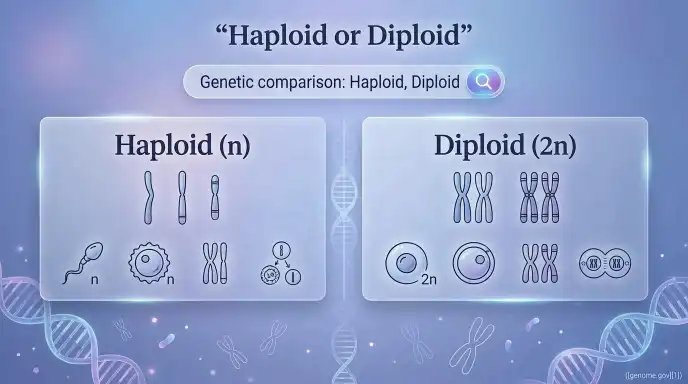
Haploid means having one complete set of chromosomes, while diploid means having two complete sets of chromosomes. This simple difference is the key to understanding the terms haploid or diploid in biology.
People often search for “haploid or diploid” because these terms sound similar and both describe the number of chromosome sets in a cell. The confusion is common when learning about human cells, meiosis, mitosis, fertilization, and reproduction. A quick example makes the difference clear.
A human egg cell is haploid because it has 23 chromosomes. A human sperm cell is also haploid. Most human body cells are diploid because they have 46 chromosomes arranged in 23 pairs.
The terms are not spelling alternatives. They describe two different biological conditions. Understanding this difference helps students read biology textbooks, answer exam questions, and explain how chromosome numbers change during reproduction.
In this guide, we will explain haploid and diploid in simple language. We will also cover their meanings, origins, spelling, common mistakes, examples, and modern usage.
Haploid or Diploid : Quick Answer
Haploid means a cell has one set of chromosomes. It is written as n.
Diploid means a cell has two sets of chromosomes. It is written as 2n.
In humans:
| Term | Chromosome sets | Human chromosome number | Example |
| Haploid | 1 set | 23 | Egg and sperm cells |
| Diploid | 2 sets | 46 | Most body cells |
A simple way to remember it is:
Haploid = one set.
Diploid = two sets.
During human reproduction, a haploid egg and a haploid sperm join during fertilization. Their chromosome sets combine to form a diploid zygote with 46 chromosomes.
Definition and Meaning of Haploid or Diploid
What Does Haploid Mean?
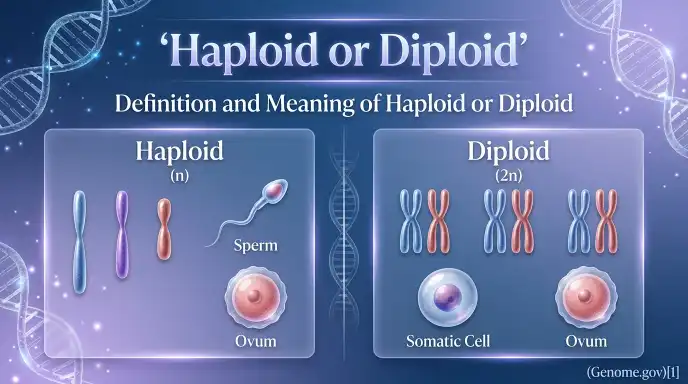
Haploid describes a cell or organism with one complete set of chromosomes.
The symbol for haploid is n.
In humans, haploid cells contain 23 chromosomes. The main examples are egg cells and sperm cells. These cells are also called gametes.
For example:
- A human egg is haploid.
- A human sperm is haploid.
- A human egg contains 23 chromosomes.
- A human sperm contains 23 chromosomes.
What Does Diploid Mean?
Diploid describes a cell or organism with two complete sets of chromosomes.
The symbol for diploid is 2n.
Most human body cells are diploid. They contain 46 chromosomes, arranged in 23 pairs. One chromosome in each pair comes from each parent.
For example:
- Skin cells are diploid.
- Muscle cells are diploid.
- Most other body cells are diploid.
- Human diploid cells contain 46 chromosomes.
Haploid vs Diploid in Simple Terms
Think of chromosomes as a set of books.
A haploid cell has one complete set.
A diploid cell has two complete sets.
This does not mean that every haploid cell has fewer genes or less DNA in every possible biological situation. The key point is the number of chromosome sets.
The Origin of Haploid or Diploid
The words haploid and diploid come from Greek roots.
Haploid comes from the Greek haploos, meaning single or simple. The scientific term entered biology through German usage in the early 20th century.
Diploid comes from Greek diploos, meaning double or twofold. It also entered scientific usage through German terminology around the same period.
The word parts help explain their meanings:
- haplo- = single
- diplo- = double
- -oid = resembling or having the form of
So, the words themselves give you a useful memory clue.
Haploid = single set.
Diploid = double set.
There is no spelling difference between British and American English for these terms. The difference is biological, not regional.
British English vs American English Spelling
Haploid and diploid are spelled the same in British English and American English.
Unlike words such as colour/color or organise/organize, these biology terms do not have a standard British-American spelling difference.
| Meaning | British English | American English |
| One chromosome set | haploid | haploid |
| Two chromosome sets | diploid | diploid |
| One-set cell | haploid cell | haploid cell |
| Two-set cell | diploid cell | diploid cell |
| Reproductive cell | gamete | gamete |
Examples
British English:
The human egg cell is haploid.
American English:
The human egg cell is haploid.
British English:
Most body cells are diploid.
American English:
Most body cells are diploid.
The spelling remains unchanged in both forms of English.
Which Spelling Should You Use?
There is no need to choose between British and American spelling here.
Use haploid when you mean one complete chromosome set.
Use diploid when you mean two complete chromosome sets.
For US Readers
Use haploid and diploid exactly as written.
These are standard scientific terms in American biology and genetics.
For UK and Commonwealth Readers
Use the same spellings:
- haploid
- diploid
British English does not normally change these spellings.
For International Readers
The same terms are widely used in biology education around the world.
If you are writing an essay, lab report, assignment, or scientific article, focus on using the correct biological meaning rather than looking for a regional spelling.
Common Mistakes with Haploid or Diploid
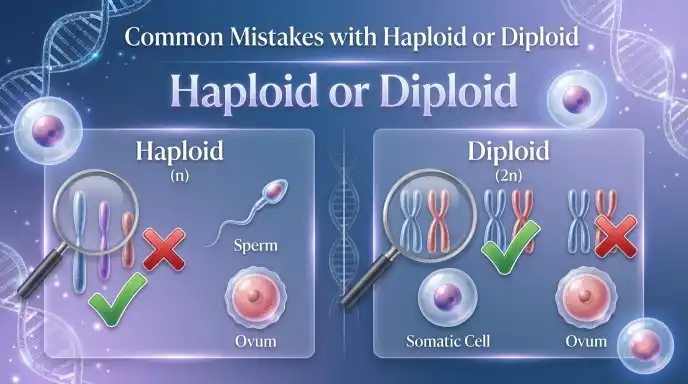
The most common errors involve confusing one set with two sets.
Calling Human Sperm Diploid
Incorrect: Human sperm cells are diploid.
Correct: Human sperm cells are haploid.
Why?
A human sperm cell has one set of chromosomes, or 23 chromosomes.
Calling Most Body Cells Haploid
Incorrect: Most human body cells are haploid.
Correct: Most human body cells are diploid.
Most human body cells have two chromosome sets, giving them 46 chromosomes.
Thinking Haploid Means “Half the DNA”
Incorrect: Haploid always means half the DNA of every diploid cell.
Better: Haploid means one chromosome set, while diploid means two chromosome sets.
The amount of DNA can vary during different stages of the cell cycle. Therefore, chromosome-set number is the better way to define these terms.
Thinking Haploid and Diploid Are Spelling Variants
Incorrect: Haploid is the British form and diploid is the American form.
Correct: They are different biological terms, not regional spelling forms.
Memory Tip
Remember:
Haploid = H = Half the chromosome sets.
Diploid = D = Double chromosome sets.
This shortcut can help when studying basic genetics.
Haploid or Diploid in Everyday Examples
The terms haploid and diploid appear often in biology, genetics, medicine, and science education. You may see them in textbooks, school assignments, research articles, and study notes.
In a Biology Class
A teacher may explain the topic with a simple example:
A human sperm cell is haploid.
This means it has one set of chromosomes.
In an Email
A student or teacher might write:
Please review the section about haploid cells and fertilization.
This sentence uses the term in a clear academic context.
In a School Assignment
A biology assignment may include a sentence like this:
Human gametes are haploid, while most body cells are diploid.
The example shows the main difference between the two terms.
In a News or Science Article
Science writers may use both terms when discussing genetics:
Researchers studied the differences between haploid and diploid cells.
This type of wording is common in articles about cells and reproduction.
In Formal Writing
Academic writing often uses these terms to explain meiosis:
During meiosis, a diploid cell produces haploid cells.
The sentence explains why chromosome numbers change during this process.
In Social Media
A short biology post might say:
Haploid = one chromosome set. Diploid = two chromosome sets.
This format makes the difference easy to remember.
In a Study Note
Students can use a simple memory guide:
Haploid (n) → 1 chromosome set
Diploid (2n) → 2 chromosome sets
These short notes can make biology revision faster and easier.
Haploid or Diploid : Google Trends & Usage Data
Google Trends measures relative search interest, not the exact number of searches. It can help show how interest in a term changes over time or differs between locations, but it should not be treated as a direct count of searches.
For haploid and diploid, search interest is closely connected to educational and scientific topics. People commonly encounter these terms while studying:
- Cell biology
- Genetics
- Chromosomes
- Meiosis
- Mitosis
- Fertilization
- Human reproduction
- Genetic inheritance
Search interest can also vary by country and by the academic calendar. Students may search these terms more often during biology lessons, examination periods, or when reviewing genetics topics.
It is important not to invent a country ranking or exact search volume without a specific Google Trends comparison and date range. Trends data is relative and can change over time.
For content planning, the strongest search intent around haploid or diploid is usually educational. Users often want a simple definition, a clear comparison, chromosome numbers, and examples.
Haploid vs Diploid Comparison Table
| Feature | Haploid | Diploid |
| Meaning | One chromosome set | Two chromosome sets |
| Symbol | n | 2n |
| Human chromosome number | 23 | 46 |
| Common human examples | Egg and sperm cells | Most body cells |
| Main role | Sexual reproduction | Growth and normal body functions |
| Chromosome sets | 1 | 2 |
| During fertilization | Combines with another haploid cell | Forms after haploid cells combine |
| Produced by meiosis | Yes | Parent cell starts diploid |
| Common memory clue | Single | Double |
The important distinction is the number of complete chromosome sets, not simply if a cell has “many” or “few” chromosomes.
In humans, meiosis produces haploid gametes. When a sperm and egg join, the resulting cell becomes diploid.
Why Are Haploid and Diploid Important?
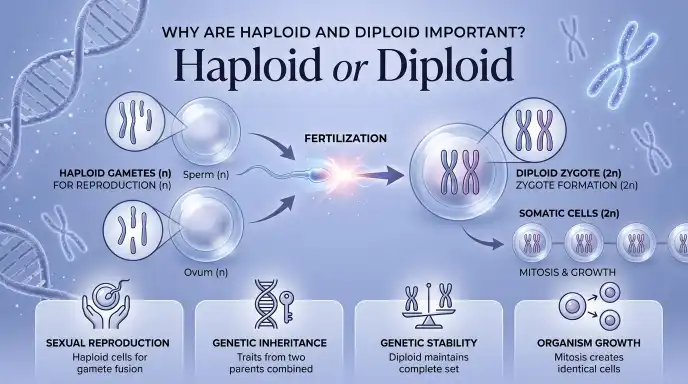
The difference matters because sexual reproduction depends on keeping chromosome numbers balanced.
Most human body cells are diploid. They contain two sets of chromosomes.
During meiosis, chromosome numbers are reduced so that sperm and egg cells become haploid. Each carries one chromosome set.
During fertilization, the sperm and egg combine. Their two haploid sets form a diploid cell.
The basic sequence is:
Diploid cell → Meiosis → Haploid gametes → Fertilization → Diploid zygote
This cycle helps maintain the chromosome number across generations in sexually reproducing organisms.
FAQs About Haploid or Diploid
Q1. What is the difference between haploid and diploid?
Haploid cells have one complete set of chromosomes. Diploid cells have two complete sets. In humans, that means 23 chromosomes in a haploid cell and 46 in a typical diploid cell.
Q2. Is a sperm cell haploid or diploid?
A human sperm cell is haploid. It contains 23 chromosomes, which is one complete chromosome set.
Q3. Is an egg cell haploid or diploid?
A human egg cell is haploid. It contains 23 chromosomes. When it joins with a sperm cell during fertilization, the resulting cell becomes diploid.
Q4. Are human body cells haploid or diploid?
Most human body cells are diploid. They contain 46 chromosomes, arranged in 23 pairs.
Q5. What does 2n mean in biology?
2n means that a cell has two complete sets of chromosomes. It is the standard notation for a diploid cell.
Q6. What does n mean in biology?
n means that a cell has one complete set of chromosomes. It is the standard notation for a haploid cell.
Q7. Is haploid a British spelling and diploid an American spelling?
No. Haploid and diploid are not British and American spelling variants. They are two different biological terms, and both are spelled the same in British and American English.
Conclusion:
Haploid and diploid are two important biology terms that describe the number of chromosome sets in a cell. A haploid cell has one complete chromosome set, while a diploid cell has two.
In humans, egg and sperm cells are haploid and normally contain 23 chromosomes. Most body cells are diploid and normally contain 46 chromosomes. During meiosis, diploid cells produce haploid gametes. During fertilization, two haploid cells combine and form a diploid cell.
The words also have useful origins. Haploid relates to the idea of being single, while diploid relates to being double. This makes their meanings easier to remember.
There is also no British-American spelling difference between the two terms. They are not alternative spellings. They describe different chromosome conditions.
For a quick memory trick, remember haploid = one set and diploid = two sets. This simple rule can help you understand genetics, cell division, and human reproduction.

I’m Nora Ellis, an English language writer passionate about making grammar, spelling, and confusing words easy to understand. I share clear explanations and practical examples to help readers improve their English and use words with confidence.






2 thoughts on “Haploid or Diploid: Meaning, Differences & Examples”