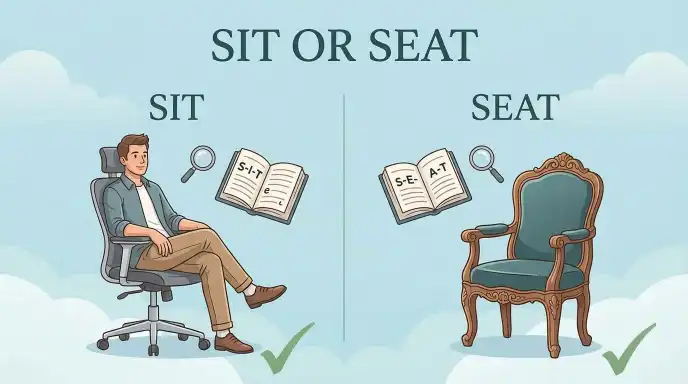
Sit and seat are different words: sit usually means to rest in a sitting position, while seat means a place to sit or to put someone in a seat. Many English learners confuse these words because they are closely related in meaning and pronunciation.
The confusion often appears in everyday sentences such as “Please sit here” and “Please seat the guests.” Both sentences are correct, but they describe different actions. Sit usually focuses on the person taking or being in a sitting position. Seat often focuses on the place or on someone helping another person sit down.
Understanding sit or seat is useful for students, ESL learners, writers, editors, and anyone who wants to use natural English. The two words also appear in common phrases such as sit down, take a seat, and be seated. Their forms can change in different grammatical contexts, but their basic difference stays clear.
Sit or Seat : Quick Answer
Sit is mainly a verb meaning to rest your body in a sitting position. Seat is mainly a noun meaning a place or object for sitting, but it can also be a verb meaning to place someone in a seat.
| Word | Main meaning | Example |
| Sit | To rest in a sitting position | Please sit here. |
| Seat | A place or object for sitting | Please take a seat. |
| Seat as a verb | To put someone in a seat | The usher seated the guests. |
Easy rule: You sit in a seat.
Definition and Meaning of Sit or Seat
What Does Sit Mean?
Sit is a verb. It means to rest your body on a chair, bench, floor, or another surface while your body is supported.
Examples:
- Please sit on the chair.
- She sat beside me.
- The children are sitting on the floor.
- We sat together during lunch.
The main forms are:
- Sit : present
- sat : past
- sat : past participle
- sitting : ing form
The word can also have other meanings. For example, a house can sit on a hill, or a person can sit for an examination. The examination meaning is especially common in British English.
What Does Seat Mean?
Seat can be a noun or a verb.
As a noun, it means a place designed for sitting.
Examples:
- I found an empty seat.
- This seat is comfortable.
- There are six seats in the car.
As a verb, seat means to place someone in a seat or provide enough seating space.
Examples:
- The waiter seated us near the window.
- The theater can seat 500 people.
- Please seat the guests.
Oxford also lists seat as a verb for having enough space for a certain number of people.
The Simple Difference
Think about the action:
You sit. A chair has a seat. Someone can seat you.
For example:
Please sit in your seat.
Both words are correct because they perform different grammatical jobs.
The Origin of Sit or Seat
Sit and seat are closely related words with a long Germanic history.
Sit comes from Old English sittan and Middle English sitten. It is related to words in several Germanic languages, including Old Norse and German. Its deeper Indo-European root is connected with the idea of sitting.
Seat developed from Middle English forms such as sete and is connected with Old Norse sæti, meaning a place or position for sitting. It also traces back to the same broad Indo-European root associated with sitting.
Over time, English developed separate uses for these related words. It became strongly associated with the action or state of being seated. Seat became associated with the place where someone sits and later developed a verb meaning to place someone in that position.
This explains why the words feel closely connected even though they are not interchangeable.
British English vs American English Spelling
There is no major British-versus-American spelling difference between sit and seat.
Both British and American English use:
- sit
- sat
- sitting
- seat
- seated
- seating
The main differences are usually related to usage, not spelling.
| Meaning or use | British English | American English |
| Rest in a sitting position | sit | sit |
| Place for sitting | seat | seat |
| Past of sit | sat | sat |
| Present participle | sitting | sitting |
| Put someone in a seat | seat | seat |
| Take an examination | sit an exam is common | take an exam is more common |
| Polite invitation | Take a seat | Take a seat |
One notable regional difference is the use of sit for taking an examination. Dictionaries identify this use as chiefly or mainly British.
Sit or Seat : Which Spelling Should You Use?
You do not need to choose a British or American spelling for sit or seat. Both forms are standard in both major varieties of English.
Choose the word based on its meaning and grammatical role.
For American English
Use sit for the action:
Please sit down.
Use seat for a place:
Your seat is near the front.
For British English
The same basic rule applies:
Please sit down.
Your seat is near the front.
British English also commonly uses sit when talking about examinations:
She will sit her final exam next month.
For International English
The safest approach is simple:
Sit = the action or position.
Seat = the place or the act of placing someone somewhere.
Common Mistakes with Sit or Seat
Many mistakes happen because learners treat sit and seat as interchangeable verbs.
| Incorrect | Correct | Why |
| Please seat here. | Please sit here. | The person is taking a sitting position. |
| Please sit the guests. | Please seat the guests. | You are placing the guests in seats. |
| I need a sit. | I need a seat. | A place to sit is a seat. |
| He sat on the chair. | He sat on the chair. | The subject performs the sitting action. |
| The waiter sat us at a table. | The waiter seated us at a table. | The waiter places the guests. |
| Take a sit. | Take a seat. | The fixed phrase is take a seat. |
A Common Grammar Trap
Do not confuse sit with seat when talking about another person.
Compare:
- I sat the child down.
- I seated the child.
Both can be grammatical, but seat clearly means to put or place someone in a seat. Sit is normally intransitive, although it has some transitive uses in informal or specialized contexts.
Sit or Seat in Everyday Examples
In Emails
Sit:
Please sit in the waiting area until your name is called.
Seat:
We will seat all guests before the presentation begins.
In News Writing
Sit:
The committee will sit again next week.
Seat:
The new theater can seat more than 1,000 people.
The verb sit can also describe a court or official body being in session.
On Social Media
Informal posts often use sit in expressions such as:
Just sitting here and enjoying the view.
Or:
I finally found a seat!
In Formal Writing
Formal English often uses be seated:
Please be seated before the ceremony begins.
You may also see:
The guests were seated according to the seating plan.
Oxford notes that being seated is a formal expression for being in a sitting position.
Sit or Seat : Google Trends & Usage Data
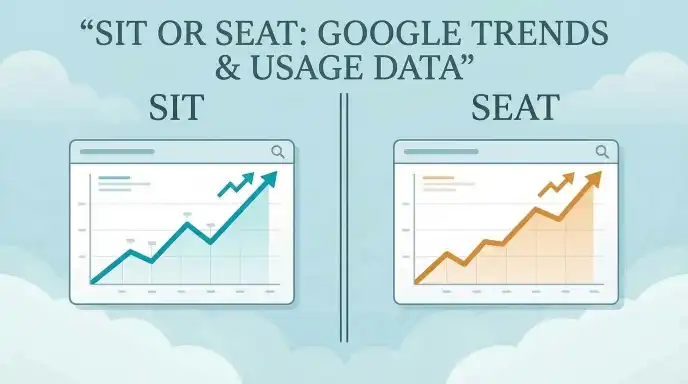
Google Trends can help compare search interest for sit and seat, but its results represent relative search interest, not the total number of times a word appears in English.
The two words have different grammatical roles, so a simple search comparison should also be interpreted carefully.
Sit has a much wider range of everyday and grammatical uses. It can describe a person sitting, an object being located somewhere, a court being in session, or someone taking an examination in British English.
Seat is strongly associated with places for sitting, seating capacity, positions, locations, and the action of placing people in seats.
Search interest can vary by country and by the exact Google Trends settings used. For that reason, it is better not to claim a fixed percentage or ranking without a specific, current Trends dataset.
For language learners, the more useful point is this:
Sit is an action or state. Seat is usually a place, object, or placement action.
Sit vs Seat: Comparison Table
| Feature | Sit | Seat |
| Main part of speech | Verb | Noun and verb |
| Basic meaning | Rest in a sitting position | A place for sitting |
| Verb meaning | Be in a sitting position | Put someone in a seat |
| Past form | sat | seated |
| -ing form | sitting | seating |
| Example | She sat down. | She took a seat. |
| Another use | sit an exam | seat 200 people |
| British/American spelling | Same | Same |
| Easy connection | You sit | You sit in a seat |
FAQs About Sit or Seat
Q1. What is the difference between sit and seat?
Sit usually means to rest in a sitting position. Seat usually means a place for sitting or the action of putting someone in a seat.
Q2. Is it correct to say “sit in a seat”?
Yes. Sitting in a seat is completely correct.
Example:
Please sit in your seat.
Q3. Is “take a sit” correct?
No, taking a sit is not the standard expression. The correct phrase is:
Take a seat.
It means to sit down.
Q4. Should I say “sit the guests” or “seat the guests”?
In standard usage, seating the guests is the clearer choice when you mean to place them in seats.
Example:
The host seated the guests.
Q5. What is the past tense of sit?
The past tense of sit is sat.
Example:
I sat near the window yesterday.
The past participle is also sat:
I have sat here for an hour.
Q6. Is “seated” the same as “sitting”?
They can describe a similar position, but they are not always used in the same way.
Sitting emphasizes the action or state:
She is sitting on the sofa.
Seated often sounds more formal:
She is seated near the entrance.
Q7. Do British and American English spell sit and seat differently?
No. Both varieties use sit and seat with the same spelling. However, some usages differ. For example, British English commonly uses sit an exam, while American English more often uses take an exam.
Conclusion:
Understanding sit or seat is easy once you focus on their roles. Sit is mainly a verb that describes the action or position of resting on a surface. Seat is mainly a noun that describes a place for sitting, but it can also be a verb meaning to put someone in a seat.
The easiest rule to remember is: you sit in a seat. For example, “Please sit here” describes the person’s action, while “Please take a seat” refers to the place where the person will sit. You can also say, “The host seated the guests,” when someone places people in seats.
There is no British or American spelling difference between these words. The main regional difference is usage, especially the British use of sit for taking an examination.
Once you understand this basic difference, choosing between sit and seat becomes much easier in everyday speech, emails, formal writing, and academic English.

I’m Nora Ellis, an English language writer passionate about making grammar, spelling, and confusing words easy to understand. I share clear explanations and practical examples to help readers improve their English and use words with confidence.





2 thoughts on “Sit or Seat: Meaning, Differences & Usage Guide ”