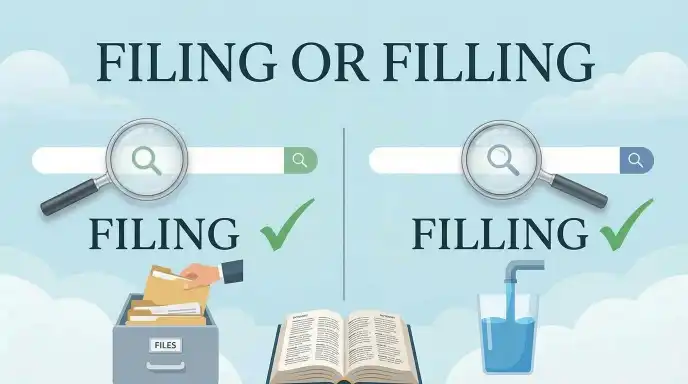
Filing and filling are both correct words, but they have different meanings and uses. Filing usually means putting documents or information into a file, or officially submitting a document. Filling means making something full or putting something inside an empty space.
These words confuse many English learners because they look and sound similar. The extra l in filling can make the spelling easy to miss, especially when writing quickly. The difference becomes clearer when you connect each word to its base verb: file → filing and fill → filling.
You may see filing in office, legal, business, and administrative writing. For example, a company may be filing a report. You may see filling when talking about containers, forms, food, teeth, jobs, or empty spaces. For example, someone may be filling out a form or filling a glass with water.
This guide explains the difference between filing or filling, their meanings, origins, common mistakes, and everyday uses.
Filing or Filling: Featured Snippet & AI Overview
Filing means putting documents or information into a file or officially submitting something. Filling means making something full or putting something into an empty space.
For example, “She is filing the reports” means organizing documents, while “She is filling the boxes” means putting things into the boxes. The words have different meanings and pronunciations.
Filing or Filling: Quick Answer
The simplest way to remember the difference is:
- Filing comes from file.
- Filling comes from fill.
- Filing relates to records, documents, official submissions, or using a file tool.
- Filling relates to making something full or putting something into an empty space.
Examples of Filing
“She is filing the customer records.”
This means she is organizing the records in files.
“The company is filing a tax return.”
This means the company is officially submitting the document.
“He is filing his nails.”
Here, filing means using a file to smooth or shape the nails.
Examples of Filling
“She is filling the bottle with water.”
She is putting water into the bottle.
“He is filling out the application.”
He is entering the required information on the application.
“They are filling the boxes with books.”
They are putting books into the boxes.
The key difference is file vs fill.
What Does Filing or Filling Mean?
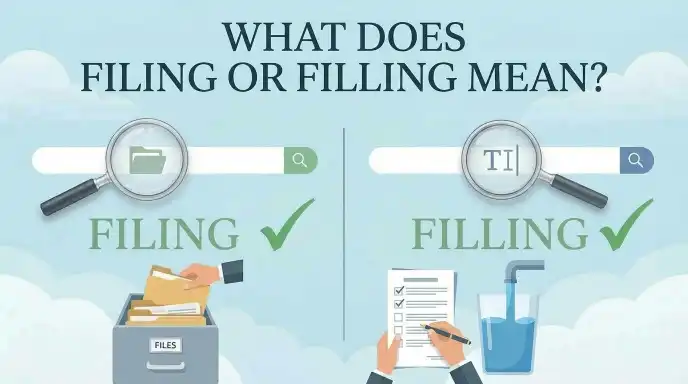
What Does Filing Mean?
Filing is the present participle or gerund form of file.
One common meaning is putting documents or information into an organized file. Cambridge Dictionary defines filing as the activity of putting documents or electronic information into files. It also uses filing for an official record, such as a bankruptcy filing.
For example:
“I spent the morning filing invoices.”
The invoices are being organized and stored.
Filing can also mean officially submitting a document.
“The company is filing a complaint.”
Here, the meaning is not simply putting paper into a folder. It means formally submitting the complaint to the appropriate authority.
Another meaning comes from the noun file, the rough tool used to smooth or shape a surface.
“She is filing her nails.”
Cambridge also lists this use of file as working on an object with a file to make it smooth or change its shape.
What Does Filling Mean?
Filling is the present participle or gerund form of fill.
The basic meaning is making something full or putting something into an empty space. Cambridge gives examples such as filling a bucket with water and filling cracks before painting.
For example:
“She is filling the glass with water.”
The glass is receiving water.
Filling can also be a noun.
It can mean material placed inside something, such as a pillow, sandwich, cake, or tooth.
Examples include:
- pillow filling
- sandwich filling
- pie filling
- tooth filling
It can also describe food that makes you feel full after eating.
“The soup is very filling.”
Filing and Filling Are Not Interchangeable
Consider these two sentences:
Consider these two examples:
“She is filing the forms.”
In this sentence, filing means organizing or submitting the forms.
“The employee is filling out the forms.”
Here, filling means entering information into the forms.
The small spelling change creates a different meaning. Filing relates to organizing or submitting documents, while filling out means adding information to them.
That small spelling difference changes the meaning.
The Origin of Filing or Filling
The two words come from different English verbs, so their histories are also different.
Origin of Filing
Filing comes from the verb file.
The verb file, meaning to arrange papers for future reference, developed through Old French filer, which referred to stringing documents on a thread or wire for preservation or reference. The idea was that documents could be kept together in an organized line. The English verb developed its record-keeping sense in the Middle English period.
The noun filing is recorded from around 1712 as a verbal noun from this sense of file.
Over time, filing methods changed. People moved from physical papers and filing cabinets to digital folders and databases, but the word filing remained useful.
Today, you can file:
- Documents
- Reports
- Tax returns
- Legal papers
- Applications
- Digital records
- Complaints
Origin of Filling
Filling comes from the verb fill.
The verb fill goes back to Old English fyllan, meaning to fill, make full, replenish, satisfy, or complete. It is related to the Proto-Germanic form associated with full.
The noun filling, meaning something that fills or fills up, dates to around 1400. The dental sense developed much later.
This history explains why filling has such a broad range of meanings today. You can fill a container, fill a form, fill a position, fill a space, or add a filling to food.
Filing or Filling : British English vs American English
There is no major British-American spelling difference between filing and filling.
Both varieties use:
- filing
- filling
- file
- fill
- filed
- filled
The difference is therefore not like color/colour or organize/organise. It is a difference in word choice and meaning, not regional spelling.
| British English | American English | Example |
| filing | filing | Filing the documents |
| filling | filling | Filling the bottle |
| filed | filed | Filed the report |
| filled | filled | Filled the form |
| file | file | File the records |
| fill | fill | Fill the container |
Cambridge gives the same basic meanings for filing and filling in both its British and American dictionary entries.
Why Do They Look So Similar?
The confusion comes from the verbs:
file + -ing = filing
fill + -ing = filling
The base verbs are different.
- The file has one l.
- Fill has two l’s.
That difference stays visible when the -ing ending is added.
Which Version Should You Use?
Unlike many spelling comparisons, you do not need to choose filing for American English and filling for British English.
Use the word that matches your meaning.
United States
Use filing when you mean organizing or officially submitting documents.
“The company is filing its annual report.”
Use filling when you mean making something full or entering information.
“She is filling out the application.”
United Kingdom
The same distinction applies.
“The solicitor is filing the documents.”
But:
“The employee is filling in the form.”
Canada
Canadian English uses both words with their normal meanings.
Choose filing for records or official submissions.
Choose filling for making something full or entering information.
Australia
Australian English also distinguishes the two words by meaning.
“He is filing the records.”
“She is filling the form.”
International Writing
For international readers, the safest approach is simple:
Choose based on meaning, not region.
Both forms are standard English words.
Academic Writing
Academic writers may use filing when discussing records, documents, or official submissions.
Filling may appear when discussing data collection, forms, spaces, or experimental procedures.
For example:
“Participants were responsible for filling in the questionnaire.”
Business Writing
Business writing often uses both words.
“The legal team is filing the documents.”
“Employees are filling out the required forms.”
Common Mistakes
The most common errors happen when writers use filing where filling is needed, or vice versa.
| Incorrect Example | Correct Example | Why? |
| She is filling out the documents. | She is filing the documents. | She is organizing the documents. |
| He is filling the bottle with water. | He is filling the bottle with water. | Water is being put into the bottle. |
| We are filing out the form. | We are filling out the form. | Information is being entered. |
| The lawyer is filing a lawsuit. | The lawyer is filing a lawsuit. | A legal action is being officially submitted. |
| She is filling the box with books. | She is filling the box with books. | Books are being put inside. |
Memory Tip
Think:
FILE = records
FILL = make full
So:
Filing = files
Filling = full
This simple connection can help you choose the right word quickly.
Another Useful Test
Ask yourself:
Am I organizing or officially submitting something?
If yes, use filing.
Am I putting something into a space or making something full?
If yes, use filling.
Filing or Filling in Everyday Examples
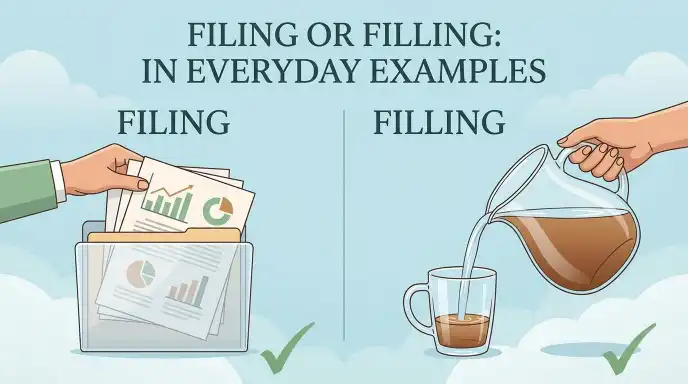
Emails
“I am filing the invoices in the correct folder.”
“Please finish filling out the form before Friday.”
Business Writing
“The company is filing its annual report.”
“We are filling the vacant position next month.”
News Headlines
“Company Files Complaint Against Competitor”
“Workers Begin Filing Claims”
Here, filing refers to official submissions or records.
Blogs
“Start by filling the container halfway with water.”
This describes putting something into a container.
Social Media
“Finally filling out my travel application!”
Here, filling means entering information.
A business post might say:
“Our team is busy filing this month’s reports.”
Academic Writing
“Students were asked to complete the survey by filling in each section.”
“The research team completed the filing of participant records.”
Daily Conversation
“Can you help me fill this box?”
“I need to spend the afternoon filing these papers.”
Legal Context
Legal writing often uses filing.
“The attorney is filing a motion.”
This means the motion is being formally submitted.
Using filling here would change the meaning and would usually be incorrect.
Google Trends & Modern Usage
Searches for filing or filling usually come from people who are unsure which word fits a sentence. The confusion is understandable because the words share several letters and differ by only one l.
Modern English uses filing heavily in office, business, legal, financial, and administrative contexts. Dictionaries also recognize filing as the organization of documents and as an official record or submission.
Filling has a much wider everyday range. People use it when talking about containers, food, forms, jobs, spaces, teeth, and other things that can be filled.
There is no reliable reason to claim that one word is universally more popular than the other. They serve different grammatical and semantic purposes.
Search interest can also depend on the phrase around the word. For example, people may search for:
- filing or filling out a form
- filing or filling a form
- filing vs filling
- filling documents or filing documents
- filing a report
- filling a position
- filing a complaint
- filling a bottle
The most useful way to understand modern usage is to look at the verb behind the word.
Quick Comparison Table
| Version | Meaning | Correct? | Region | Example |
| Filing | Organizing or submitting records | Yes | All major English varieties | Filing the reports |
| Filling | Making something full | Yes | All major English varieties | Filling the glass |
| Filing | Submitting an official document | Yes | All major English varieties | Filing a complaint |
| Filling | Entering information | Yes | All major English varieties | Filling out a form |
| Filing | Using a file tool | Yes | All major English varieties | Filing the nails |
| Filling | Material placed inside something | Yes | All major English varieties | Sandwich filling |
Key Takeaways
- Filing comes from the verb file.
- Filling comes from the verb fill.
- Filing commonly relates to documents, records, and official submissions.
- Filling commonly means making something full or putting something into a space.
- Filing and filling are both correct spellings.
- The difference is not mainly British vs American English.
- Filing a document means organizing or submitting it.
- Filling a document or form means entering information into it.
- A simple memory tip is file = records, fill = full.
FAQs
Q1. What is the difference between filing and filling?
Filing comes from file and usually means organizing documents or officially submitting something. Filling comes from fill and means making something full or putting something into an empty space. For example, you can file documents, but you fill a bottle with water.
Q2. Is it filing or filling out a form?
The standard expression is filling out a form. The verb fill means to enter the required information in the spaces provided. In British English, filling in a form is also very common.
Q3. Is it filing or filling a document?
The correct word depends on the meaning. Filing a document means storing it in an organized file or officially submitting it. Filling out a document means entering information into it.
Q4. Is it filing or filling a complaint?
The correct expression is filing a complaint when you mean officially submitting the complaint to an authority, organization, or court. Filling a complaint does not normally express this meaning.
Q5. Is it filing or filling a position?
The correct phrase is filling a position. Here, fill means providing someone to do a particular job. For example, “The company is filling the position next month.”
Q6. Is filing a British or American spelling?
Filing is used in both British and American English. It is not a regional spelling variant. The same is true of filling. The important difference is their meanings and the verbs from which they come.
Q7. Why does filling have two Ls but filing has one?
Filing comes from a file, which has one l. Filling comes from fill, which already has two l’s. Adding -ing gives filing and filling, so the spelling reflects the original verbs.
Q8. What is the difference between filing and filling in business English?
In business English, filing often refers to storing records or officially submitting documents. Filling can refer to entering information, making a position complete, or putting something into a container.
Q9. Is “filing out a form” correct?
Usually, no. The standard expression is filling out a form in American English. British English commonly uses filling in a form. Filing out a form is generally a mistaken combination of these expressions.
Q10. How can I remember filing vs filling?
Use the simple rule file = records and fill = full. If you are organizing or submitting documents, use filing. If you are making something full or entering information into spaces, use filling.
Conclusion:
Filing and filling are both correct English words, but they do very different jobs. Filing comes from file and commonly refers to organizing records, storing information, or officially submitting a document. Filling comes from fill and usually refers to making something full, putting something into an empty space, or entering information into a form.
The difference is not a British-versus-American spelling issue. Both filing and filling are used in British and American English. Your choice should depend on the meaning you want.
Remember the easiest rule: file means records, while fill means full. You file documents, file a complaint, and file a report. You fill a bottle, fill a position, and fill out a form.
If you are unsure, look at the base verb first. File → filing. Fill → filling. That small check can prevent many common spelling and grammar errors.
Memorable takeaway: File it when you record it, fill it when you make it full.

I’m Nora Ellis, an English language writer passionate about making grammar, spelling, and confusing words easy to understand. I share clear explanations and practical examples to help readers improve their English and use words with confidence.








2 thoughts on “Filing or Filling: Meaning, Differences, and Usage”