Dependant or dependent is a common spelling question, and the correct choice depends on where you write and how you use the word. Both spellings are correct, but they follow different patterns in British and American English.
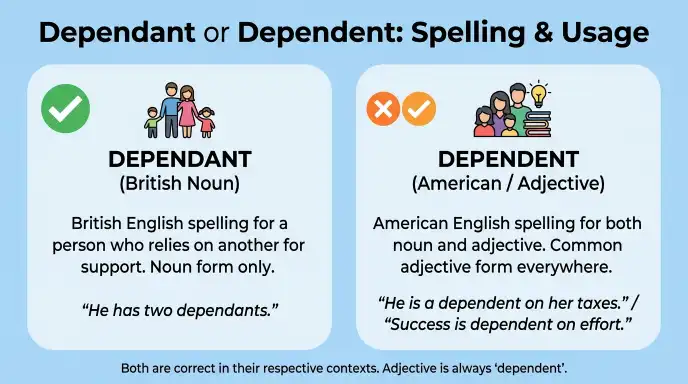
In British English, dependant is usually a noun, while dependent is an adjective. In American English, dependent is the standard spelling for both uses.
People often search for this difference when writing school assignments, work emails, official forms, or documents about family members and financial support. The two words look almost the same and share the same basic idea. However, choosing the wrong form can make your writing look less polished.
The good news is that the rule is simple. If you describe someone or something that relies on another person or thing, use dependent. If you name a person who relies on someone else, British English often uses dependant, while American English uses dependent.
This guide explains the meaning, origin, spelling rules, and everyday use of both words. You will also learn which spelling to choose for your audience and how to avoid common mistakes in formal and informal writing.
Dependant or Dependent: Quick Answer
Both dependant and dependent are correct spellings. The main difference is their use in British and American English.
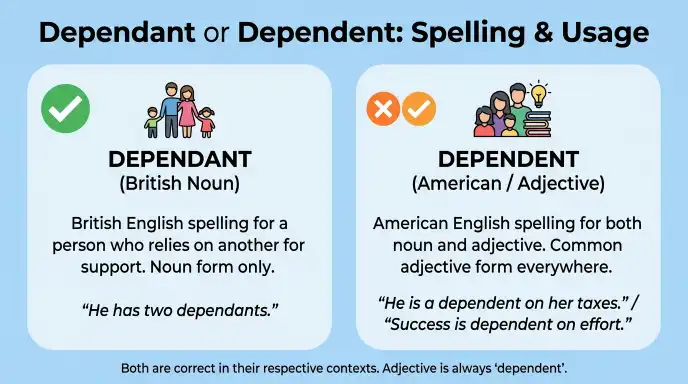
- Dependant: A noun in British English. It means a person who relies on someone else for money, care, or support.
- Dependent: An adjective in both British and American English. It describes someone or something that relies on another person or thing.
- Dependent: The standard noun spelling in American English. It can also be a noun in British English, though dependant is often preferred.
Examples:
- British English: His wife is his dependant.
- American English: His wife is his dependent.
- Both varieties: The child is dependent on her parents.
Quick tip: Use dependent for the adjective. For the noun, use dependant in British English and dependent in American English.
Definition and Meaning of Dependant or Dependent
The words dependant and dependent share the same core meaning. Both relate to a person or thing that relies on someone or something else.
What Does Dependant Mean?
Dependant is a noun used mainly in British English. It refers to a person who relies on another person for financial support, care, or other needs.
For example, a parent may support a child who cannot earn enough money to live independently. In this case, the child may be called a dependant.
Examples:
- She listed her son as a dependant on the form.
- He supports two dependants.
- The employee’s dependant may qualify for certain benefits.
In these examples, dependant names a person who receives support from someone else.
What Does Dependent Mean?
Dependent can be an adjective or a noun. As an adjective, it describes someone or something that relies on another person, thing, or condition.
As a noun, it refers to a person who relies on someone else for support.
Examples:
- The baby is dependent on its parents.
- The final result is dependent on the weather.
- She is financially dependent on her family.
- He claimed his daughter as a dependent on his tax return.
The first three examples use dependent as an adjective. The final example uses it as a noun.
Simple Meaning
In simple words, both forms describe the idea of relying on support.
- Dependant: A person who needs support, especially in British English.
- Dependent: Someone or something that relies on support, or a person who receives support in American English.
The main difference is grammatical use, not meaning.
Context and Usage
You may see these words in several settings.
Family and personal life
A child who relies on a parent for food, housing, and care may be a dependant or dependent.
Finance and taxes
Tax forms may ask you to list people who qualify for support-related benefits or tax treatment. The spelling depends on the country and the form’s official wording.
Employment and benefits
An employer may offer health coverage or other benefits to an employee’s dependants or dependents.
General writing
Use dependent when describing a relationship between two things.
Example: The success of the plan is dependent on good communication.
The Origin of Dependant or Dependent
The words dependant and dependent come from the same word family as depend.
The verb depend comes through French from Latin dependere, meaning to hang from. Over time, its meaning developed to include relying on someone or something for help, support, or a result.
The ending -ant or -ent appears in many English words. These endings often reflect how words entered English and how their forms developed over time. However, they do not always follow one simple spelling rule.
In British English, writers commonly distinguish the noun dependant from the adjective dependent. This helps readers identify the role of the word in a sentence.
American English generally uses dependent for both the noun and the adjective. This spelling became the usual form in American writing and is common in tax, legal, educational, and business contexts.
The difference is therefore a matter of spelling convention and grammar. Neither form is a modern misspelling when used according to the relevant variety of English.
Remember: The verb is always spelled depend, and the adjective is dependent in both British and American English.
British English vs American English Spelling
The key difference between dependant and dependent is how British and American English treat the noun.
British English often uses dependant for a person who relies on someone else. It uses dependent as an adjective.
American English normally uses dependent for both the noun and the adjective.
Comparison Table
| Feature | British English | American English |
| Noun | Dependant | Dependent |
| Adjective | Dependent | Dependent |
| Person receiving support | A dependant | A dependent |
| Describing reliance | Dependent on | Dependent on |
| Plural noun | Dependants | Dependents |
| Example | She has two dependants. | She has two dependents. |
British English Examples
- My older father is my dependant.
- The allowance supports the employee’s dependants.
- The outcome is dependent on the final decision.
- Children may be financially dependent on their parents.
American English Examples
- My older father is my dependant.
- The allowance supports the employee’s dependents.
- The outcome is dependent on the final decision.
- Children may be financially dependent on their parents.
Both varieties use dependent expressions such as dependent on, financially dependent, and dependent variable.
The noun spelling changes by variety, but the core meaning stays the same.
Which Spelling Should You Use?
The best spelling depends on your audience, location, and the type of document you are writing.
If You Write for a US Audience
Use dependent as both a noun and an adjective.
Examples:
- She has one dependent.
- He listed his children as dependents.
- The result is dependent on the evidence.
This is the standard choice for American readers and US tax or employment documents.
If You Write for a UK Audience
Use dependant as a noun and dependent as an adjective.
Examples:
- He has three dependants.
- His daughter is financially dependent on him.
- The payment supports eligible dependants.
This distinction is common in British English, although some British sources also use dependent as a noun.
If You Write for a Commonwealth Audience
Many Commonwealth countries follow British spelling traditions, but usage can vary by country, institution, and document type.
If your readers are in the UK, dependant is a useful choice for the noun. In countries such as Canada, Australia, and New Zealand, check the local style guide or official form when accuracy matters.
If You Write for an International Audience
Use dependent when you need a widely recognized spelling, especially if the word is an adjective.
For the noun, follow the spelling used by your target audience or the relevant official document. Consistency matters more than mixing styles.
If You Write Academic or Business Documents
Use the style guide required by your school, publisher, employer, or client.
For legal, tax, insurance, and immigration forms, copy the terminology used by the relevant authority. Do not change an official label just to match your preferred spelling.
Best advice: Choose the spelling that fits your readers, then use it consistently throughout the document.
Common Mistakes with Dependant or Dependent
Writers often confuse these words because they sound alike and have almost the same spelling. The following mistakes are easy to avoid.
Using Dependant as an Adjective
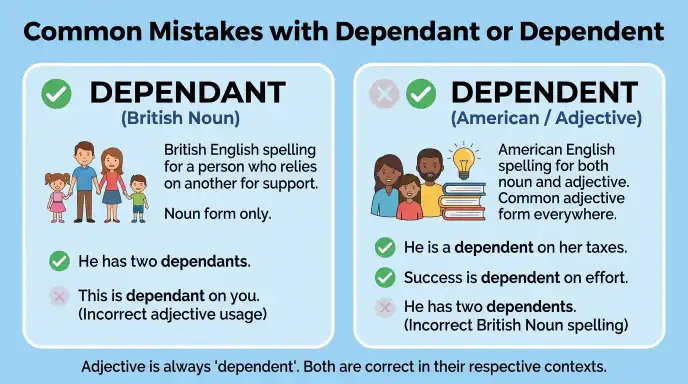
Incorrect: The child is dependant on her parents.
Correct: The child is dependent on her parents.
Why? Use dependent as an adjective in both British and American English.
Assuming Dependant Is Always Wrong
Incorrect assumption: Dependant is never correct.
Correct: His wife is his dependant. (British English)
Why? Dependant is a standard noun spelling in British English.
Using Dependant in American English
Less suitable for standard US writing: She has two dependants.
Preferred in American English: She has two dependents.
Why? American English normally uses dependent as both a noun and an adjective.
Mixing Spellings in One Document
Inconsistent: The employee has two dependants. His dependents qualify for coverage.
Better British English: The employee has two dependants. His dependants qualify for coverage.
Better American English: The employee has two dependents. His dependents qualify for coverage.
Why? Keep your spelling consistent unless you are quoting an official term.
Confusing Dependent with Independent
Incorrect: She is independent of her parents.
Correct: She is dependent on her parents.
Correct: She is independent of her parents.
Why? Dependent on means relying on someone or something. Independent means not relying on someone or something.
Misspelling the Plural
Incorrect: He supports three dependentes.
Correct in British English: He supports three dependants.
Correct in American English: He supports three dependents.
Why? Add -s to the correct noun form. Do not add an extra syllable or ending.
Dependant or Dependent in Everyday Examples
Seeing these words in real situations makes the spelling rule easier to remember.
In Emails
British English:
Subject: Update to Employee Benefits
Dear Team,
Please review your details and confirm that all your dependants are listed correctly. Contact the HR department if you need to update your information.
Kind regards,
Alex
American English:
Subject: Update to Employee Benefits
Dear Team,
Please review your details and confirm that all your dependents are listed correctly. Contact the HR department if you need to update your information.
Thank you,
Alex
In News Writing
- The new policy may affect families with several dependants. (British English)
- The new policy may affect families with several dependents. (American English)
- The final decision is dependent on the results of the review.
The noun spelling may change by region, but the adjective remains dependent.
On Social Media
- Being financially dependent on someone can make budgeting harder.
- I have two dependants, so family benefits are important to me. (British English)
- I have two dependents, so family benefits are important to me. (American English)
These examples show how the word appears in casual posts and personal discussions.
In Formal Writing
- The applicant must provide details of each eligible dependant. (British English)
- The applicant must provide details of each eligible dependent. (American English)
- The outcome is dependent on the information provided.
- The project is dependent upon approval from the review board.
Both dependent on and dependent upon are correct, though dependent on is often simpler and more natural.
In School or Academic Writing
- The experiment’s result is dependent on the temperature.
- A dependent variable changes in response to another variable.
- The student listed a parent as a dependant on the form. (British English)
- The student listed a parent as a dependent on the form. (American English)
In science and research, dependent variable is the standard term in both varieties of English.
Dependant or Dependent: Google Trends and Usage Data
People search for dependant or dependent because the words differ by only one letter but have different grammatical roles in some varieties of English.
Search interest can reflect several needs:
- Spelling checks: Writers want to know which form is correct.
- Grammar questions: Students need to identify nouns and adjectives.
- Tax and finance: People need to complete forms that ask about dependants or dependents.
- Employment and benefits: Workers may need to list family members who qualify for support.
- Regional spelling: Writers want to know if British or American English uses a particular form.
Usage by Country
| Country or Region | Common Noun Form | Adjective Form |
| United States | Dependent | Dependent |
| United Kingdom | Dependant is common | Dependent |
| Canada | Dependent is widely used; usage can vary | Dependent |
| Australia | Dependant is used; usage can vary | Dependent |
| New Zealand | Dependant may be used | Dependent |
| International English | Depends on the chosen style | Dependent |
These are general usage patterns, not fixed rules for every publisher or institution.
What Do Google Trends Data Show?
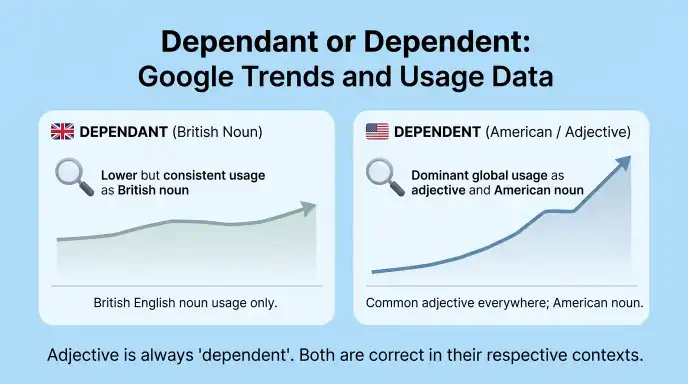
Google Trends can help compare search interest in dependant and dependent over time and across countries. However, it reports relative search interest rather than the total number of searches.
Without a current, verified Trends comparison, it would be misleading to claim that one spelling has a specific search volume or percentage advantage. Search interest may also change based on location, date range, and the selected search term.
For an accurate comparison, select both terms in Google Trends, choose the countries you want to study, and compare the same time period and search category.
Practical takeaway: Search popularity does not decide which spelling is correct. Grammar, regional usage, and the needs of your audience should guide your choice.
Dependant vs Dependent: Comparison Table
Use this table as a quick reference when editing your writing.
| Word or Phrase | Part of Speech | Meaning | Example |
| Dependant | Noun, mainly British English | A person who relies on someone else | She supports one dependant. |
| Dependent | Noun in American English | A person who relies on someone else | He has two dependents. |
| Dependent | Adjective | Relying on someone or something | The child is dependent on her parents. |
| Dependants | Plural noun, British English | People who receive support | His dependants live with him. |
| Dependents | Plural noun, American English | People who receive support | Her dependents qualify for coverage. |
| Dependent on | Adjective phrase | Relying on a person, thing, or condition | Success is dependent on teamwork. |
| Independent | Adjective | Not relying on someone or something | She is financially independent. |
The easiest rule is to remember that dependent works as an adjective in both varieties. The noun dependant is common in British English, while dependent is standard in American English.
FAQs About Dependant or Dependent
Q1. Is Dependant or Dependent Correct?
Both are correct. Dependant is commonly used as a noun in British English. Dependent is the standard noun spelling in American English and the adjective spelling in both varieties.
Q2. What Is the Difference Between Dependant and Dependent?
The main difference is grammatical use. British English often uses dependant as a noun for a person who receives support. Dependent is an adjective that describes reliance. American English generally uses dependent for both the noun and adjective.
Q3. Is Dependant British or American English?
Dependant is mainly associated with British English when used as a noun. American English usually spells the noun dependent.
Q4. Is Dependent Always an Adjective?
No. Dependent can be a noun or an adjective. For example, “The child is dependent on her parents” uses an adjective. “She claimed her son as a dependent” uses a noun.
Q5. Should I Write Dependants or Dependents?
Use dependants for the noun in standard British English when following that distinction. Use dependents in American English. For an official form, follow the spelling printed on the form.
Q6. Is It Dependant on or Dependent on?
The correct phrase is dependent on in both British and American English.
Example: The result is dependent on the quality of the data.
Do not use dependant on when you mean that something relies on a condition or person.
Q7. Which Spelling Is Best for Formal Writing?
Use dependent as an adjective in all varieties of English. For the noun, choose dependant for a British audience or dependent for an American audience. Follow any required style guide or official terminology.
Conclusion:
The choice between dependant or dependent is simple once you know the difference between British and American English. Both spellings are correct, but they are not always interchangeable in every sentence.
In British English, dependant is commonly used as a noun for a person who relies on someone else for support. The word dependent is used as an adjective to describe reliance. In American English, dependent is the standard spelling for both the noun and the adjective.
For example, a British writer may say, “She has two dependants,” while an American writer would usually write, “She has two dependents.” However, both writers would say, “The child is dependent on her parents.”
If you write for an international audience, focus on clear wording and consistent spelling. For tax forms, employment documents, and legal records, follow the terminology used by the relevant authority.
The easiest rule to remember is this: use dependent as an adjective, and choose dependant or dependent as a noun based on your audience. This simple rule will help you write with confidence in emails, schoolwork, business documents, and everyday communication.

I’m Nora Ellis, an English language writer passionate about making grammar, spelling, and confusing words easy to understand. I share clear explanations and practical examples to help readers improve their English and use words with confidence.