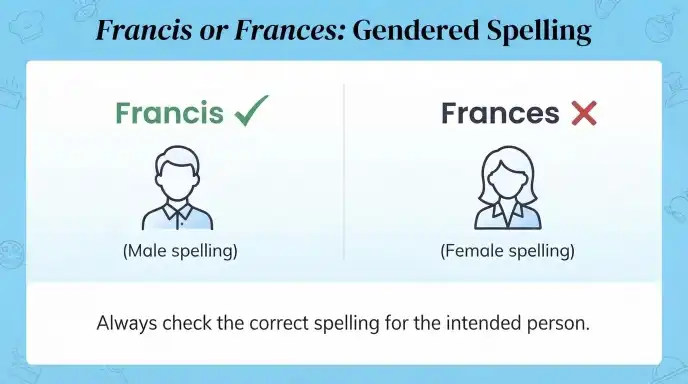
Francis and Frances are both correct spellings, but they are traditionally used for different genders and names. The name Francis is traditionally masculine, while Frances is traditionally feminine.
People often search for francis or frances because the names sound almost identical and differ by only one letter. This can make it hard to know which spelling belongs to a particular person. The confusion becomes even greater because both forms have a long history in English and share the same origin.
Choosing the right spelling matters when you write a person’s name in an email, invitation, school record, legal document, social media post, or formal letter. A person’s preferred spelling should always come first, even if it differs from traditional naming patterns.
In general, Francis is associated with males, while Frances is associated with females. However, names can cross traditional gender lines, so the individual person’s own spelling is the most important guide. This article explains the meanings, origins, spelling patterns, regional usage, common mistakes, and everyday examples of Francis and Frances.
Francis or Frances : Quick Answer
Francis and Frances are both correct names. Traditionally, Francis is the masculine form, while Frances is the feminine form.
Francis: Traditionally used as a male name.
Frances: Traditionally used as a female name.
For example:
Francis is my uncle.
Frances is my aunt.
However, these traditional patterns are not absolute. Some people may use either spelling regardless of gender. Therefore, when referring to a specific person, always use the spelling that person uses.
Definition and Meaning of Francis or Frances
Francis and Frances are given names with the same historical origin. Their traditional distinction is mainly based on gender.
Meaning of Francis
Francis is traditionally a masculine given name. It is associated with meanings such as Frenchman or free person, depending on the historical interpretation.
The name is widely recognized in English-speaking countries.
Example:
Francis joined the meeting this morning.
Meaning of Frances
Frances is traditionally the feminine form of Francis.
It has the same basic historical roots and is commonly used as a female given name.
Example:
Frances sent the invitation yesterday.
Francis as a Surname
Francis can also be a surname. In that case, it does not indicate gender.
For example:
Maria Francis spoke at the event.
This is important because the same spelling can appear as either a first name or a family name.
The Origin of Francis or Frances
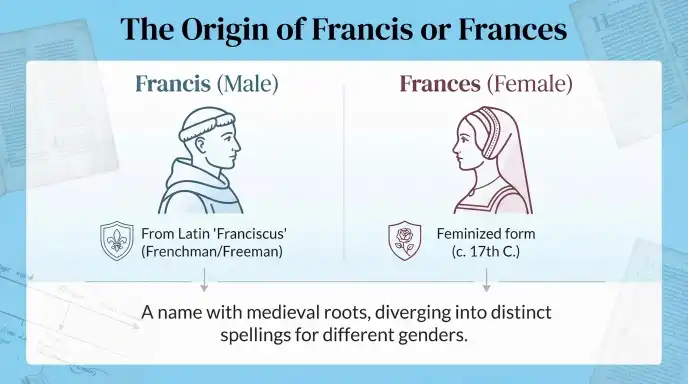
The names Francis and Frances have a shared historical origin. They are connected to the Latin name Franciscus, which means Frenchman or relates to the Franks.
The name became especially well known through Saint Francis of Assisi, an important medieval Christian figure. His name helped spread Francis throughout Europe and later into English-speaking countries.
Over time, English developed separate traditional spellings for masculine and feminine forms.
- Francis became the traditional masculine form.
- Frances became the traditional feminine form.
The difference is only one letter, but that letter can help distinguish the traditional forms.
The two names are also related to forms found in other languages. For example, French uses François for the masculine form and Françoise for the feminine form.
Today, both Francis and Frances remain established English names.
British English vs American English Spelling
There is no major British-American spelling difference between Francis and Frances. The same two forms are used in both varieties of English.
| English Variety | Traditional Male Form | Traditional Female Form |
| British English | Francis | Frances |
| American English | Francis | Frances |
| Canadian English | Francis | Frances |
| Australian English | Francis | Frances |
| International English | Francis | Frances |
The key difference is not regional. Instead, it is the traditional gender distinction between the two spellings.
For example:
British English:
Francis is my grandfather.
American English:
Frances is my grandmother.
Both sentences use the same standard spelling rules.
Which Spelling Should You Use?
The correct choice depends mainly on the person’s name.
For a Male Name
Traditionally, use Francis for a male first name.
Example:
Francis called me yesterday.
For a Female Name
Traditionally, use Frances for a female first name.
Example:
Frances works at the local library.
For a Specific Person
Most importantly, check the person’s preferred spelling. A person’s actual name takes priority over traditional naming rules.
If someone spells their name Frances, do not change it to Francis because you think another form is traditional.
For Surnames
Francis can be a surname for people of any gender.
For example:
Daniel Francis won the award.
Here, Francis is a family name, not necessarily a masculine first name.
For International Audiences
Both forms are widely recognized. Still, when writing about a particular person, always copy the spelling they use.
Common Mistakes with Francis or Frances
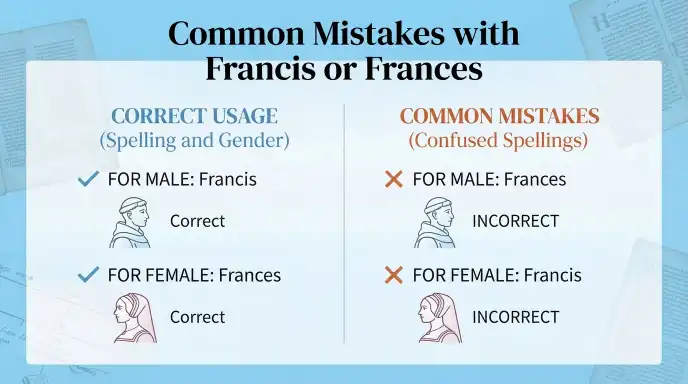
Because the names differ by only one letter, spelling mistakes are common.
| Incorrect Use | Correct Form | Explanation |
| Frances for a person named Francis | Francis | Use the person’s actual spelling. |
| Francis for a person named Frances | Frances | Use the person’s actual spelling. |
| Françis | Francis | This is not the standard English spelling. |
| Francess | Frances | The standard feminine form uses one final s after the e. |
| Francis’s name changed to Frances | Check the person’s name | Do not change a person’s chosen spelling. |
Assuming the Names Are Interchangeable
Although they are related, Francis and Frances are not automatically interchangeable.
For example:
Francis is visiting today.
Changing the name to Frances could refer to a different person.
Ignoring the Person’s Preferred Spelling
Traditional gender patterns can help when you are unsure, but they should not override someone’s actual name.
Therefore, always check the spelling when possible.
Confusing First Names and Surnames
Francis can be a first name or a surname. Its use as a surname does not tell you the person’s gender.
Francis or Frances in Everyday Examples
These names appear in many types of writing. The correct spelling depends on the individual person.
In Emails
Dear Frances,
Thank you for your message.
If the person’s name is Frances, keep the e before the final s.
In News Writing
Francis attended the ceremony on Tuesday.
News writers should use the person’s official or preferred spelling.
On Social Media
Happy birthday, Frances! Hope you have a wonderful day.
Personal names should always be spelled correctly in social media posts.
In Formal Writing
Francis was appointed to the committee in June.
Formal documents require careful attention to names.
In Invitations
Please join us to celebrate Frances’s birthday.
The possessive form depends on the spelling of the person’s name.
In Everyday Conversation
Have you spoken to Francis today?
Again, the spelling should match the person’s actual name.
Francis or Frances : Google Trends & Usage Data
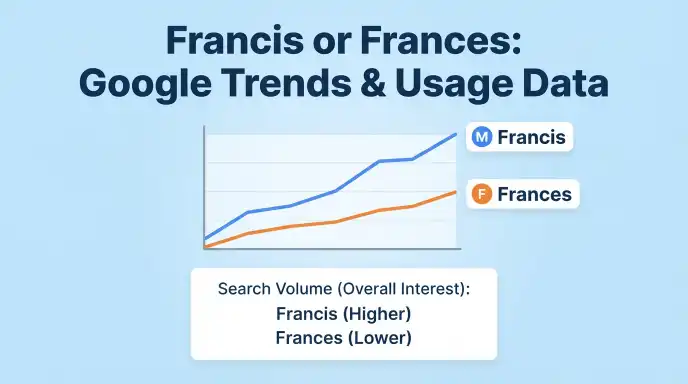
Searches for francis or frances usually come from people who want to know which spelling is correct. The question is especially common when someone hears the name but does not know if it ends with -is or -es.
Both forms have a long history in English. Their use can vary by country, generation, and personal preference.
Francis is traditionally the masculine form, while Frances is traditionally the feminine form. However, modern naming practices are more flexible than older naming conventions.
Search interest can also rise when people encounter famous individuals with these names. Historical figures, writers, religious figures, actors, politicians, and other public figures can make one spelling more familiar in a particular region or period.
Google Trends data can change over time and does not by itself determine if a name is correct. For a person’s name, the most reliable source is the person’s own spelling.
Francis vs Frances: Comparison Table
| Feature | Francis | Frances |
| Traditional gender | Masculine | Feminine |
| Correct spelling | Yes | Yes |
| Historical origin | Latin Franciscus | Latin Franciscus |
| Common use | First name and surname | Mainly first name |
| British English | Used | Used |
| American English | Used | Used |
| Main difference | Ends in -is | Ends in -es |
| Related meaning | Connected with the Franks/French | Connected with the Franks/French |
The easiest way to remember the traditional distinction is:
Francis = traditionally male
Frances = traditionally female
Still, a person’s own spelling is always the final authority.
FAQs About Francis or Frances
Q1. Is Francis or Frances correct?
Both Francis and Frances are correct spellings. Traditionally, Francis is masculine and Frances is feminine.
Q2. What is the difference between Francis and Frances?
The main traditional difference is gender. Francis is usually the masculine form, while Frances is usually the feminine form.
Q3. Is Frances a female name?
Yes. Frances is traditionally a feminine given name. However, individual naming preferences can vary.
Q4. Is Francis a male name?
Yes. Francis is traditionally a masculine given name. It can also be used as a surname for people of any gender.
Q5. Are Francis and Frances pronounced the same?
In many varieties of English, Francis and Frances are pronounced very similarly, and sometimes they sound identical. The spelling is therefore important when writing the name.
Q6. What does the name Francis mean?
Francis comes from the Latin Franciscus and is traditionally associated with the Franks or a Frenchman.
Q7. Can Frances be a man’s name?
Traditional English usage treats Frances as feminine and Francis as masculine. However, names can be used in different ways by different people, so an individual’s own spelling should always be respected.
Conclusion:
Francis and Frances are both correct names, but they have traditionally served different purposes. Francis is generally the masculine form, while Frances is traditionally the feminine form. Both names share the same historical roots and are connected to the Latin name Franciscus.
The easiest way to remember the difference is to associate Francis with the traditional male form and Frances with the traditional female form. However, this rule should not override a person’s actual name. If someone spells their name Frances, use Frances, even if you expected Francis.
The two forms are used in both British and American English, so there is no major regional spelling difference. Also, Francis can appear as a surname, which means the spelling does not always indicate gender.
When writing emails, invitations, news articles, social media posts, or formal documents, always check the person’s preferred spelling. In short, Francis and Frances are both valid, but the correct choice depends on the person and context.

I’m Nora Ellis, an English language writer passionate about making grammar, spelling, and confusing words easy to understand. I share clear explanations and practical examples to help readers improve their English and use words with confidence.