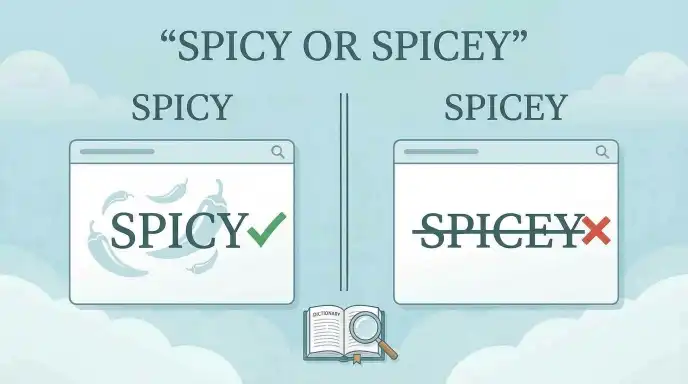
Spicy is the standard spelling, while spicey is a less common variant spelling that is not the usual choice in modern edited English.
If you have ever typed spicy and wondered if the extra e in spicey might be correct, you are not alone. The confusion comes from the base word spice, which naturally makes spicey look logical.
People search for spicy or spicey because both forms can appear in older texts, online writing, casual posts, and dictionary records. This makes the choice less obvious than it first seems. The key point is that spicy is the normal form you should use in modern everyday, academic, business, and professional writing.
The word also has more than one meaning. It can describe food with a strong or hot flavor, but it can also describe something lively, exciting, provocative, or slightly shocking.
This guide explains the correct spelling, meaning, history, British and American usage, common mistakes, and practical examples. It also shows when spicey may appear and which form is safest for your audience.
Spicy or Spicey : Featured Snippet & AI Overview
Spicy is the standard modern spelling for the adjective meaning “containing or having the flavor of spices.” Spicey is a recorded variant spelling, but spicy is the preferred form for normal modern writing. Use spicy food, spicy sauce, and spicy comments in most contexts.
Spicy or Spicey : Quick Answer
The short answer is simple:
- Spicy is the standard spelling.
- Spicey is a recorded variant, but it is much less common in modern standard writing.
- Use spicy for school, work, websites, recipes, menus, emails, and formal writing.
- Both forms are connected to the word spice.
Examples
Correct and preferred:
This curry is very spicy.
I ordered a spicy chicken sandwich.
That was a spicy comment.
Less common variant:
This curry is very spicey.
The last form may be found in some dictionaries or older material, but spicy is the safer and more familiar choice for modern readers.
Easy memory tip
Think:
SPICE → SPICY
The standard spelling drops the final e before adding -y.
What Does Spicy or Spicey Mean?
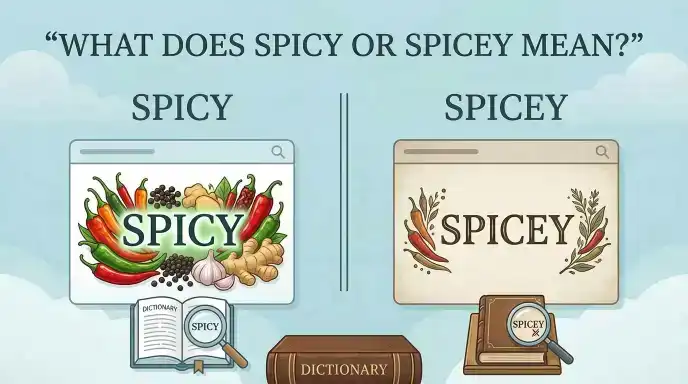
What Does Spicy Mean?
Spicy is an adjective. Its most common meaning is food that contains spices or has a strong, hot, or pungent flavor.
For example:
This soup is spicy.
She loves spicy noodles.
The restaurant serves spicy Indian food.
The word does not always mean extremely hot. Food can be mildly spicy, moderately spicy, or extremely spicy.
It can also describe a strong flavor or aroma.
The sauce has a spicy aroma.
Spicy Can Have a Figurative Meaning
Spicy can also describe something exciting, bold, surprising, or slightly shocking.
For example:
The article contains some spicy details.
That was a spicy debate.
She posted a spicy opinion online.
This meaning is common in informal English. The exact meaning depends on context.
In some situations, spicy can also suggest something risqué or sexually suggestive. Writers should therefore consider the audience before using it in a formal context.
What About Spicey?
Spicey has been recorded as a variant spelling of spicy. It carries essentially the same meaning when used as an adjective.
However, it is not the form most readers expect today.
For modern standard writing, spicy is the better choice.
The Origin of Spicy or Spicey
The story begins with the noun spice.
The English word spice entered Middle English from Old French forms such as espice. Its deeper history reaches back to Latin species, meaning “kind” or “sort.” Over time, the word developed its familiar connection with aromatic substances used to flavor food.
The adjective spicy developed from spice with the suffix -y. Historical records show the adjective in English from the sixteenth century.
The meaning also changed and expanded over time. Early uses connected spicy with the nature, smell, or presence of spices. Later uses developed figurative meanings such as lively, exciting, racy, or provocative.
This explains why modern English can use spicy for both food and non-food topics.
Why Does Spicey Look Correct?
The confusion comes from the spelling of the base word:
spice
It is natural to think:
spice + y = spicey
But the established modern spelling is:
spice → spicy
English spelling does not always follow one simple rule. Some words keep the final e before y, while others drop it.
Compare:
- spice → spicy
- ice → icy
- juice → juicy
- grease → greasy
But also:
- price → pricey
- dice → dicey
- space → spacey
This is why it is better to remember spicy as the established spelling rather than trying to apply one rule to every word ending in -ce.
Spicy or Spicey : British English vs American English
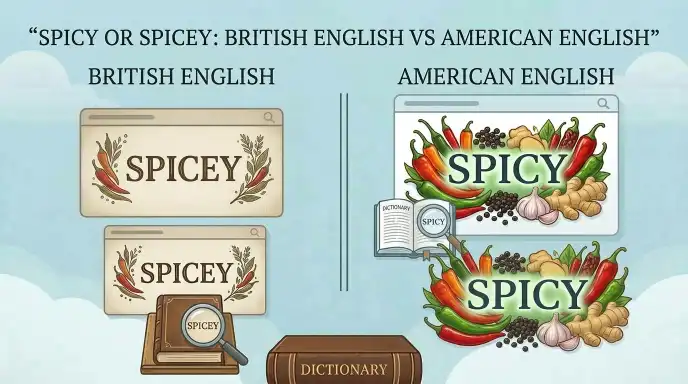
There is no British-versus-American spelling difference in the normal use of spicy.
Both British and American English use spicy as the standard form.
| Feature | British English | American English | Example |
| Standard spelling | spicy | spicy | Spicy food |
| Variant spelling | spicey may appear | spicey may appear | Rare variant |
| Food meaning | Strongly flavored or hot | Strongly flavored or hot | Spicy curry |
| Figurative meaning | Lively or provocative | Lively or provocative | A spicy debate |
| Comparative | spicier | spicier | This is spicier |
| Superlative | spiciest | spiciest | The spiciest dish |
Unlike words such as colour/color, favour/favor, or centre/center, spicy does not have a standard British and American spelling pair.
Pronunciation
The word is pronounced approximately:
SPY-see
The spelling spicey does not represent a different pronunciation that requires a different regional form.
Publishing Preferences
Professional editors normally prefer the familiar standard form spicy.
This is especially useful when writing:
- School assignments
- Academic papers
- Business documents
- News articles
- Recipes
- Menus
- Product descriptions
- Website content
- Marketing copy
If you are reproducing an old quotation, historical spelling, personal name, or exact title, you may need to preserve spicey when the original uses it.
Which Version Should You Use?
For almost all modern writing, choose spicy.
United States
Use spicy in everyday and professional American English.
This restaurant serves spicy Mexican food.
United Kingdom
Use spicy in British English as well.
The curry was too spicy for me.
Canada
Use spicy for standard Canadian writing.
Australia
Use spicy in Australian English.
International Writing
For a global audience, spicy is the clearest choice. Most readers will recognize it immediately.
Academic Writing
Use spicy when the word fits the subject.
For example:
The study examined consumer preferences for spicy foods.
In formal academic writing, avoid informal figurative uses unless they are relevant to the subject.
Business Writing
Use spicy when describing food, products, or a suitable informal idea.
For example:
The new product uses a spicy chili sauce.
For formal reports, choose precise wording if spicy could sound vague.
When Can You Keep Spicey?
Keep spicey if it is part of an exact name, quotation, historical source, username, title, or brand identity.
The important distinction is this:
Do not change a proper name simply because its spelling looks unusual.
But when you are writing your own sentence, spicy is the normal choice.
Common Mistakes with Spicy or Spicey
| Incorrect or less preferred | Correct or preferred | Explanation |
| The curry is spicey. | The curry is spicy. | Use the standard modern form. |
| I love spicey food. | I love spicy food. | Spicy is the normal adjective. |
| This sauce is very spicey. | This sauce is very spicy. | Drop the final e in the standard form. |
| The food became spicyer. | The food became spicier. | Change y to i before -er. |
| It was the spicyest dish. | It was the spiciest dish. | Use spiciest for the superlative. |
Keeping the E
A common mistake is:
spice + y = spicey
For standard modern writing, remember:
spice → spicy
Writing Spicyer
The comparative form is:
spicy → spicier
Not:
spicy → spicyer
Writing Spicyest
The superlative form is:
spiciest
Not:
spiciest
Memory Tip
Remember this simple family:
- spice
- spicy
- spicier
- spiciest
- spiciness
Once you remember spicy, the other forms become easier.
Spicy or Spicey in Everyday Examples
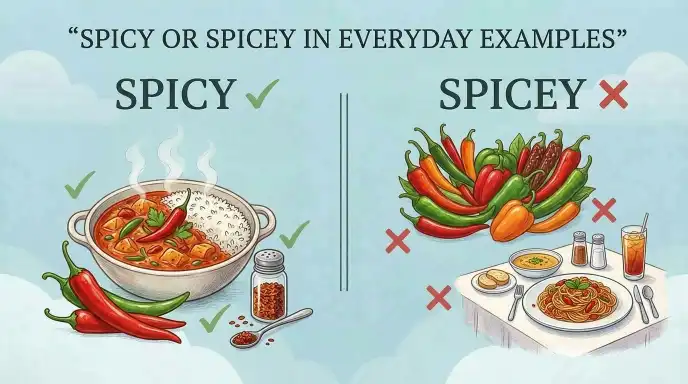
Emails
Please let me know if you would prefer a mild or spicy meal.
Business Writing
Our new product includes a spicy tomato sauce.
News Headlines
New Restaurant Offers Extra-Spicy Menu Options
Blogs
If you enjoy bold flavors, this spicy noodle recipe is worth trying.
Social Media
This might be the spiciest meal I have ever tried!
Academic Writing
The researchers examined consumer preferences for spicy foods.
Daily Conversation
Is this sauce spicy?
Yes, but it is not too hot.
Figurative Use
That was a spicy opinion.
Here, spicy does not describe food. It means the opinion was bold, provocative, or likely to attract attention.
Formal Use
The report includes several sensitive and potentially controversial details.
In very formal writing, a precise phrase may be better than a figurative word such as spicy.
Google Trends & Modern Usage
Searches for spicy or spicey are mainly driven by spelling uncertainty. People may encounter the word while writing about food, recipes, restaurant reviews, social media posts, or figurative topics.
The important point is that search interest does not determine if a spelling is standard. A misspelling can receive many searches simply because people are unsure which form is correct.
Modern dictionary evidence supports spicy as the main standard form. At the same time, spicey is not simply an invented sequence of letters. Some dictionaries record it as a variant.
Regional usage does not create a normal British-versus-American spelling split here. Writers in the United States, United Kingdom, Canada, Australia, and international English contexts can use spicy.
Why Do People Search for Spicey?
Common reasons include:
- The base word is spice.
- The extra e looks natural.
- Similar English words have different spelling patterns.
- People see variant or historical spellings online.
- Spell-check and search suggestions can make unusual forms more visible.
- Writers want to check the word before publishing.
Because exact Google Trends figures can change over time and depend on the selected country, date range, and search term settings, fixed popularity percentages should not be stated without current data.
For practical writing, the answer is much simpler:
Use spicy unless you are intentionally preserving a variant, historical, or proper-name spelling.
Quick Comparison Table
| Version | Meaning | Correct? | Region | Example |
| Spicy | Having the flavor or quality of spice | Yes, standard | US, UK, Canada, Australia, International | This curry is spicy. |
| Spicey | Variant spelling of spicy | Recorded variant | Not a standard regional alternative | The historical text used spicey. |
| Spicier | Comparative form of spicy | Yes | All major English varieties | This sauce is spicier. |
| Spiciest | Superlative form of spicy | Yes | All major English varieties | This is the spiciest dish. |
| Spiciness | The quality or degree of being spicy | Yes | All major English varieties | I like the spiciness. |
Key Takeaways
- Spicy is the standard modern spelling.
- Spicey is recorded as a variant spelling in some dictionaries.
- Use spicy for normal modern writing.
- Spicy is used in both British and American English.
- The word can describe food, flavor, aroma, or figurative ideas.
- The comparative form is spicier.
- The superlative form is spiciest.
- The noun form is spiciness.
- Do not change spicey when it appears as part of an exact name, title, quotation, or historical source.
- The easiest modern spelling to remember is spice → spicy.
FAQs About Spicy or Spicey
Q1. Is it spicy or spicey?
Spicy is the standard modern spelling. Spicey is recorded as a variant spelling, but it is not the usual choice in modern edited English. For recipes, school work, business writing, websites, and everyday communication, spicy is the safer and more familiar form.
Q2. Is spicey a correct word?
Spicey is recorded as a variant spelling in some dictionaries, so it is not accurate to say that it never appears in English. However, spicy is the standard form most writers should use today. If you are writing your own sentence, choose spicy.
Q3. Why is it spelled spicy and not spicey?
The established spelling is spicy, formed from spice with the suffix -y. The final e is not retained in the standard spelling. English has many different spelling patterns, so the best approach is to remember the established form: spice → spicy.
Q4. Is spicy an adjective?
Yes. Spicy is an adjective. It describes a noun by showing that something has a strong, hot, pungent, or spice-related quality. For example, spicy food, spicy sauce, and spicy chicken all use spicy as an adjective.
Q5. What is the noun form of spicy?
The related noun is spiciness, which means the quality or degree of being spicy. For example, you can say, “The spiciness of the sauce was perfect.” Spicy itself is an adjective, so it does not normally have a plural form.
Q6. What is the comparative form of spicy?
The comparative form is spicier. For example, “This curry is spicier than the soup.” Do not write spicyer in standard English. The superlative form is spiciest, as in “This is the spiciest dish on the menu.”
Q7. Is spicy spelled differently in British English?
No. British English is spicy, just like American English. There is no standard British spelling such as spicey. The same spelling works for British, American, Canadian, Australian, and international English.
Q8. What does spicy mean besides hot food?
Besides describing food, spicy can describe something exciting, bold, provocative, or slightly shocking. For example, a spicy debate can mean a lively or heated debate. This figurative meaning is usually informal, so consider your audience before using it in formal writing.
Q9. Can I use spicey in a formal article?
It is better to use spicy in a formal article unless spicey is part of a name, quotation, title, or historical source that you need to reproduce exactly. Using the standard form makes your writing clearer and more familiar to modern readers.
Q10. How can I remember the spelling of spicy?
Use this simple pattern: SPICE → SPICY. Think of the word as changing from the noun spice to the adjective spicy. Then remember the related forms spicier, spiciest, and spiciness. This makes the spelling family easier to recognize.
Conclusion:
The spicy or spicey question looks simple, but dictionary records add an important detail. Spicy is the standard modern spelling and the form you should normally choose in everyday, academic, business, and professional writing.
Spicey is also recorded as a variant spelling, so it is more accurate to describe it as a less common variant rather than claiming that it has never existed in English.
Spicy usually describes food with a strong or hot flavor, but it can also describe something lively, provocative, exciting, or slightly shocking. The word works in both British and American English, so you do not need a regional spelling choice.
For modern writing, the practical rule is easy: use spicy. Keep spicey only when you are preserving an exact name, quotation, title, or historical spelling.
If you are writing recipes, articles, school assignments, menus, or social posts, choosing the familiar standard form will make your writing clearer and easier to understand.
Remember: spice is the ingredient, but spicy is the standard adjective.

I’m Nora Ellis, an English language writer passionate about making grammar, spelling, and confusing words easy to understand. I share clear explanations and practical examples to help readers improve their English and use words with confidence.





2 thoughts on “Spicy or Spicey: Correct Spelling, Meaning & Usage”