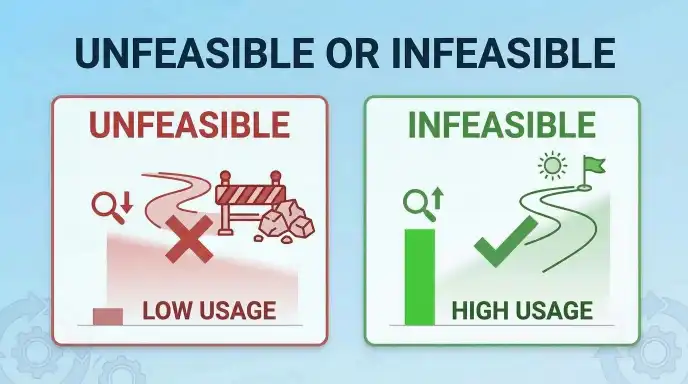
When choosing between unfeasible or infeasible, both are correct English words, and both mean not feasible or not possible to do. The main difference is not meaning but usage and preference.
This question often causes confusion because English uses several ways to make negative words. We have feasible, unfeasible, and infeasible, and all three appear in dictionaries. That can make it hard to know which form sounds natural in a sentence.
The good news is simple. Unfeasible and infeasible are both standard adjectives. You can use either one when you mean that something cannot reasonably be done, achieved, or carried out.
Infeasible is especially common in technical, academic, scientific, and American English contexts, while unfeasible is also well established and widely understood.
This guide explains the meaning, origin, British and American usage, common mistakes, everyday examples, and modern usage of unfeasible or infeasible. It also shows which form to choose for academic, business, and general writing.
Featured Snippet and AI Overview
Unfeasible and infeasible are both correct. They mean not feasible, practical, or possible to achieve. Infeasible is often preferred in technical and formal writing, while unfeasible is also standard English.
For most readers, either form is clear, but infeasible is a useful choice when you want a more technical tone.
Unfeasible or Infeasible : Quick Answer
Unfeasible and infeasible are both correct.
They both mean:
Not feasible, practical, workable, or possible to achieve.
Examples with unfeasible
- The plan is unfeasible because it costs too much.
- The project became unfeasible after the budget was reduced.
- Building the road in winter would be unfeasible.
Examples with infeasible
- The proposed system is infeasible with the current technology.
- The engineers considered the design infeasible.
- The plan is financially infeasible.
The choice often depends on style, context, and regional usage, rather than correctness.
The simple rule
Use unfeasible or infeasible when you mean:
“It cannot reasonably be done.”
If you want the most familiar alternative for general readers, you can also write not feasible.
What Does Unfeasible or Infeasible Mean?
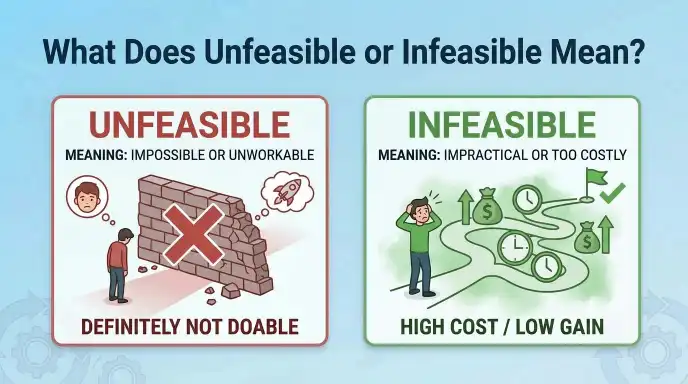
Both unfeasible and infeasible are adjectives.
They describe something that cannot be done, achieved, or carried out in a practical way.
Meaning of Unfeasible
Unfeasible means not feasible or not practical.
For example:
The original plan was unfeasible because there was not enough money.
The plan may sound good, but the available resources make it impossible or impractical.
Meaning of Infeasible
Infeasible has the same basic meaning.
The proposed solution is infeasible under the current conditions.
It means the solution cannot realistically work.
Feasible vs Unfeasible vs Infeasible
Understanding feasible makes the difference easier.
Feasible means something can be done successfully.
The plan is feasible.
Unfeasible means something is not feasible.
The plan is unfeasible.
Infeasible also means something is not feasible.
The plan is infeasible.
So the basic relationship is:
feasible → unfeasible / infeasible
When Are These Words Used?
Both words can describe:
- a plan
- a project
- an idea
- a solution
- a design
- a goal
- a method
- a proposal
- a system
- a schedule
- a business model
They are especially useful when something is limited by time, money, technology, resources, rules, or practical conditions.
Is “Impossible” the Same?
Not always.
Impossible can sound absolute.
It is impossible to finish the work today.
Unfeasible and infeasible often focus on practicality.
It is financially infeasible to finish the project today.
The second sentence suggests that the project may be theoretically possible but not practical under the current conditions.
The Origin of Unfeasible or Infeasible
The two words have different formations, even though their meanings are almost identical.
Origin of Unfeasible
Unfeasible is formed from:
un- + feasible
The prefix un- commonly means “not.”
The word feasible comes from French and ultimately traces back to Latin facere, meaning “to do” or “to make.”
So unfeasible developed as a straightforward negative form of feasible.
The word has a long history in English and has been used for centuries to describe something that cannot be done or achieved.
Origin of Infeasible
Infeasible is formed from:
in- + feasible
Here, in- acts as a negative prefix.
The word therefore has the same basic idea:
infeasible = not feasible
Both forms developed naturally in English. Their coexistence is one reason writers sometimes wonder if one is incorrect.
Why Are There Two Forms?
English often has more than one way to create a negative adjective.
For example:
- possible → impossible
- practical → impractical
- certain → uncertain
- feasible → infeasible / unfeasible
In the case of feasible, both un- and in- have been used.
Modern dictionaries recognize both unfeasible and infeasible as standard words.
The important point is that unfeasible is not simply a spelling mistake for infeasible. Both are legitimate English adjectives.
British English vs American English
There is no strict British-versus-American spelling rule that makes one form correct and the other incorrect.
Both unfeasible and infeasible can be found in British and American English.
However, usage patterns can differ by context. Infeasible is particularly common in technical, scientific, engineering, mathematical, and formal writing. Unfeasible is also widely used, especially in general writing.
| British English | American English | Example |
| unfeasible | unfeasible | The proposal is unfeasible. |
| infeasible | infeasible | The proposal is infeasible. |
| not feasible | not feasible | The proposal is not feasible. |
British English
British writers may use both forms.
The proposal was considered unfeasible.
or:
The proposal was considered infeasible.
Neither sentence has a spelling error.
American English
American English also uses both forms.
The project is infeasible at its current cost.
Infeasible is especially natural in technical and professional contexts.
Technical Writing
Technical writers often prefer infeasible.
For example:
The algorithm produces an infeasible solution under these constraints.
This style is common when discussing mathematics, optimization, engineering, computing, or systems.
General Writing
In everyday writing, not feasible can sound clearer.
Instead of:
The plan is infeasible.
you could write:
The plan is not feasible.
Both are correct. The second is simply more direct for a broad audience.
Unfeasible or Infeasible : Which Version Should You Use?
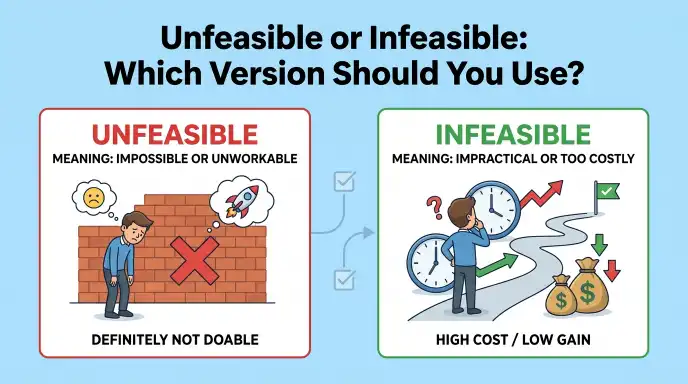
There is no single spelling that you must use in every situation.
Your choice should depend on audience, tone, and subject.
United States
For American readers, infeasible is a strong choice for technical and professional writing.
Unfeasible is also correct.
United Kingdom
British writers can use either unfeasible or infeasible.
Choose one and use it consistently within the same document.
Canada
Canadian English can use both forms.
For formal or technical material, infeasible is a clear option.
Australia
Australian English also recognizes both forms.
The best choice depends on the audience and subject.
International Writing
For an international audience, both forms are understandable.
If your readers include ESL learners or general readers, not feasible may be even clearer.
Academic Writing
Infeasible works well in academic and technical writing.
For example:
The researchers found the proposed method infeasible under the given conditions.
However, clarity matters more than choosing the longer or more formal-looking word.
Business Writing
Both forms work in business writing.
The proposed expansion is financially infeasible.
or:
The proposed expansion is not financially feasible.
The second option may be easier for a general business audience.
A Practical Recommendation
Use:
- Infeasible for technical or highly formal contexts.
- Unfeasible when it fits your normal writing style.
- Not feasible when maximum clarity is the goal.
Common Mistakes with Unfeasible or Infeasible
Because both words are correct, the biggest mistake is assuming that unfeasible is always wrong.
It is not.
Treating Unfeasible as Incorrect
Incorrect assumption:
“Unfeasible is a misspelling of infeasible.”
Correction:
Unfeasible is a valid English word.
Both words are not feasible.
Using “Infeasible” When You Mean “Impossible”
Sometimes infeasible may be too technical.
The plan is infeasible.
This is correct, but:
The plan is impossible.
may be clearer if the writer means that something cannot happen at all.
Confusing Feasible With Infeasible
Feasible means possible or practical.
Infeasible means not feasible.
Compare:
The project is feasible.
The project is infeasible.
The prefix changes the meaning completely.
Writing “Unfeasable”
Another spelling sometimes seen is:
❌ unfeasable
The standard spelling is:
unfeasible
The middle of the word contains -ible, not -asable.
Memory Tip
Remember:
FEASIBLE = can be done
INFEASIBLE = cannot be done practically
UNFEASIBLE = not feasible
If you remember feasible, both negative forms become easier to spell.
Everyday Examples of Unfeasible or Infeasible
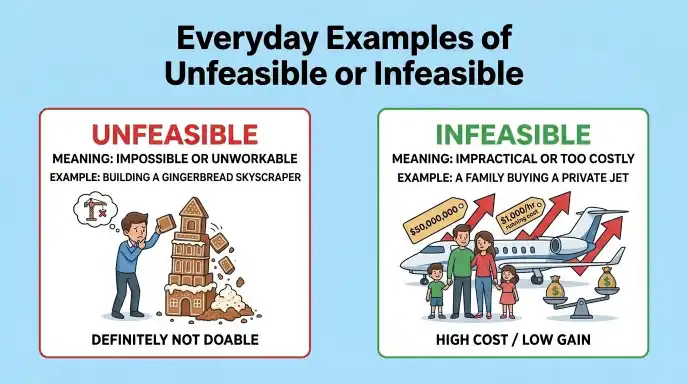
The words appear in many types of writing.
Emails
After reviewing the costs, we believe the proposed schedule is not feasible.
This version is polite and easy to understand.
Business Writing
The company determined that the expansion would be financially infeasible.
This sounds professional and fits business analysis.
News Headlines
Experts Say the Proposed Project Is Infeasible
A headline may use infeasible because it is concise and formal.
Blogs
At first, the idea seemed unfeasible, but new technology made it possible.
Unfeasible works naturally in general-interest writing.
Social Media
That plan sounds infeasible with only two days left.
A casual post could also use:
That plan just isn’t feasible.
Academic Writing
The researchers concluded that the proposed method was infeasible under the stated conditions.
This is a natural academic use.
Daily Conversation
In casual speech, people often choose simpler phrases.
Instead of:
That sounds infeasible.
a speaker might say:
That doesn’t seem possible.
Or:
That probably won’t work.
The more formal words are still correct, but they may sound less conversational.
Google Trends & Modern Usage
Searches for “unfeasible or infeasible” usually reflect a spelling and word-choice question rather than a difference in meaning.
People may encounter infeasible in technical documents and unfeasible in general writing. This can lead them to wonder if one form is British, American, formal, or incorrect.
Modern dictionaries treat both forms as valid. Cambridge lists unfeasible and identifies infeasible as an alternative, while Oxford lists unfeasible as meaning “not possible to do or achieve.” This confirms that unfeasible is not an error.
Usage also depends strongly on the subject area. Infeasibility is common in technical discussions of constraints, algorithms, engineering systems, mathematical problems, and optimization. Unfeasible is also used in general discussions about plans, costs, projects, and practical difficulties.
Exact Google Trends numbers should not be invented without checking a specific date range and country. Search interest can also reflect people checking a word they are unsure about, so search volume alone does not prove that one spelling is grammatically better.
For modern writing, the practical rule is simple:
Both are correct. Choose according to audience and context.
Quick Comparison Table
| Version | Meaning | Correct? | Region | Example |
| Unfeasible | Not feasible or practical | ✅ Yes | British, American, international | The plan is unfeasible. |
| Infeasible | Not feasible or practical | ✅ Yes | British, American, international | The plan is infeasible. |
| Not feasible | Cannot reasonably be done | ✅ Yes | All varieties | The plan is not feasible. |
| Feasible | Possible or practical | ✅ Yes | All varieties | The plan is feasible. |
| Unfeasable | Intended to mean unfeasible | ❌ No | All varieties | Use unfeasible instead. |
Key Takeaways
- Unfeasible and infeasible are both correct.
- Both mean not feasible, practical, or achievable.
- Unfeasible is formed with un- + feasible.
- Infeasible is formed with in- + feasible.
- Neither word is limited strictly to British or American English.
- Infeasible is especially useful in technical and academic writing.
- Not feasible is often the clearest choice for general readers.
- Do not assume unfeasible is a spelling mistake.
- Choose one form based on your audience and writing style.
- For a general audience, clarity matters more than sounding formal.
FAQs About Unfeasible or Infeasible
Q1. Is unfeasible or infeasible correct?
Both unfeasible and infeasible are correct English words. They both mean that something is not feasible, practical, or achievable. Infeasible is common in technical and formal contexts, while unfeasible is also standard and widely understood.
Q2. What is the difference between unfeasible and infeasible?
There is little difference in their basic meaning. Both describe something that cannot reasonably be done or achieved. Unfeasible uses the prefix un-, while infeasible uses in-. The choice often depends on context and writing style.
Q3. Is unfeasible a real word?
Yes. Unfeasible is a standard English adjective. It means not feasible, practical, or possible to achieve. Major dictionaries recognize the word, so it should not automatically be corrected to be infeasible.
Q4. Is infeasible more correct than unfeasible?
No. Infeasible is not more correct than unfeasible. Both are accepted English words. However, infeasible is often preferred in technical, scientific, academic, and engineering writing.
Q5. Which is better for academic writing, unfeasible or infeasible?
Infeasible is often a natural choice for academic and technical writing. It works well in phrases such as infeasible solution, infeasible model, and infeasible conditions. However, unfeasible is also grammatically correct.
Q6. Is it British or American English?
Unfeasible is used in both British and American English. It is not limited to British English. Infeasible is also used in both varieties, so there is no strict British-American spelling difference between the two.
Q7. Can I use “not feasible” instead?
Yes. Not feasible is often the clearest option, especially for general readers and ESL learners. For example, “The proposed schedule is not feasible” is simple and direct while keeping the same basic meaning.
Q8. What is the opposite of infeasible?
The opposite of infeasible is feasible. Something feasible can reasonably be done, achieved, or carried out. For example, “The original plan was infeasible, but the revised plan is feasible.”
Q9. Is “unfeasable” correct?
No. Unfeasable is not the standard spelling. The correct form is unfeasible. Another correct option is infeasible. Remember that both words retain the spelling of feasible.
Q10. Which word should I use in professional writing?
Both unfeasible and infeasible can be used in professional writing. Infeasible is often a good choice for technical or formal documents. For a general audience, not feasible may be easier to understand.
Conclusion:
When comparing unfeasible or infeasible, there is no simple “correct versus incorrect” answer. Both words are correct, and both mean that something is not feasible, practical, or achievable.
The main difference comes from word formation and usage. Unfeasible uses the negative prefix un-, while infeasible uses in-. Both forms have established use in English.
For technical, scientific, academic, and engineering writing, infeasibility is often a natural choice. It works well with phrases such as infeasible solution, infeasible model, and infeasible conditions. Unfeasible is also fully acceptable, especially in general discussions of plans, projects, costs, and practical problems.
If your audience is broad, not feasible can be the clearest option of all.
The most important point is this: do not treat unfeasible as a spelling mistake.
Choose the form that fits your audience, context, and style, and keep your usage consistent throughout the document.
Remember: feasible means it can work, while unfeasible and infeasible mean it cannot reasonably work.

I’m Nora Ellis, an English language writer passionate about making grammar, spelling, and confusing words easy to understand. I share clear explanations and practical examples to help readers improve their English and use words with confidence.