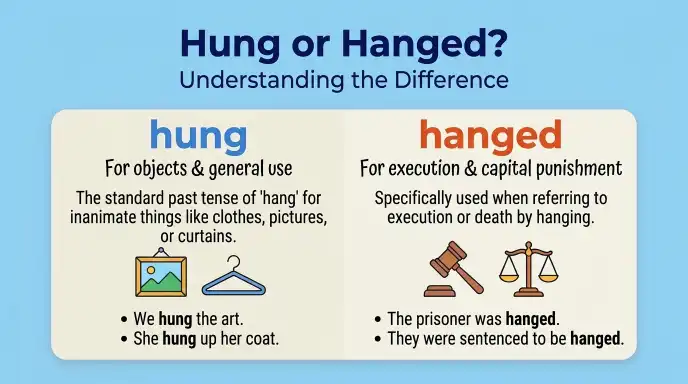
Hung and hanged are both correct, but you must use them in different situations. Use hung when you put something in a place where it can hang, such as a picture on a wall.
Use hanged when you talk about executing a person by hanging. Many people search for “hung or hanged” because both words come from the verb hang. Their similar forms often cause confusion in writing.
For example, you can say, “She hung her coat by the door.” However, when you describe an execution, you should say, “The court records state that officials hanged the prisoner.” The right word depends on the action you describe.
This difference matters in schoolwork, emails, news reports, and formal writing. Using the wrong form can confuse readers or make a sentence sound incorrect. In this guide, you will learn the meaning of hung and hanged, their origins, and their use in British and American English.
You will also find common mistakes, everyday examples, and answers to frequently asked questions. By the end, you will know how to choose the correct word with confidence.
Hung or Hanged: Quick Answer
Hung is the past tense and past participle of hang for most meanings. Use it when you put up a picture, hang clothes, or suspend an object.
- She hung the picture on the wall.
- He has hung his coat by the door.
Hanged describes execution by hanging.
- Officials hanged the prisoner after the trial.
Easy rule: Use hung for ordinary actions and hanged for execution by hanging.
Definition and Meaning of Hung or Hanged
What Does Hung Mean?
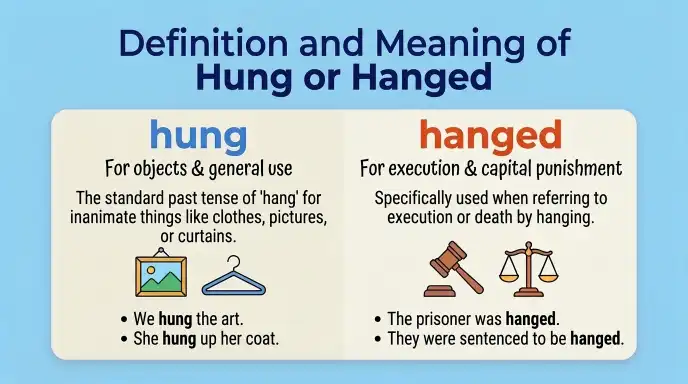
Hung is the past tense and past participle of hang in most situations. It describes an action in which someone suspends, displays, or attaches something.
It can also describe a situation that depends on something else or remains uncertain.
Examples:
- She hung the curtains in the bedroom.
- We hung our coats near the entrance.
- The team has hung a banner outside the building.
- The final decision hung on one important detail.
In these examples, hung describes an ordinary action or situation. It does not refer to execution.
What Does Hanged Mean?
Hanged is the past tense and past participle of hang when someone executes a person by hanging.
Examples:
- Officials hanged the prisoner for his crimes.
- Historical records say that authorities hanged the man in the 18th century.
Writers mainly use this form in historical, legal, and news contexts. Choosing the correct word matters because hung and hanged can change a sentence’s meaning.
Why Are There Two Forms?
English developed a special form for the act of execution. Over time, hung became the usual form for other meanings, while hanged remained the traditional form for execution by hanging.
This rule covers most common uses. Always check what the sentence means before you choose a form.
The Origin of Hung or Hanged
The verb hang comes from Old English hangian, which meant to hang or remain suspended. Like many old English verbs, it developed different forms over time.
Hung became the common past form for everyday actions, such as hanging clothes or putting a picture on a wall. Hanged remained in use for the specific meaning of executing someone by hanging.
English has several verbs with forms that depend on meaning or use. The distinction between hung and hanged remains important because each form can communicate a different action.
Today, both forms are standard when writers use them in the right context. Neither word is simply a misspelling of the other.
British English vs American English Spelling
British and American English follow the same general rule for hung and hanged. Both varieties use hung for most meanings of hang and hanged for execution by hanging.
| Context | British English | American English |
| Putting up a picture | She hung the picture. | She hung the picture. |
| Hanging clothes | He hung his coat. | He hung his coat. |
| Execution by hanging | Officials hanged the man. | Officials hanged the man. |
| Hanging a sign | They hung a sign. | They hung a sign. |
| Describing a historical execution | Authorities hanged the prisoner. | Authorities hanged the prisoner. |
You do not need to change the spelling for a British or American audience. The meaning of the sentence determines your choice.
Which Spelling Should You Use?
For American English
Use hung for everyday actions and hanged for execution by hanging.
Example: “The workers hung the new sign outside the shop.”
For a historical report, write: “Authorities hanged the prisoner.”
For British English
British English follows the same rule. Use hung for ordinary actions and hanged for execution.
Example: “She hung her jacket behind the door.”
For Canada and Australia
Canadian and Australian English generally follow this distinction too. Choose the form according to the meaning, not the country.
For Global and Academic Writing
If you write for an international audience, follow this simple guide:
- Hung: suspended, displayed, or placed so that something hangs.
- Hanged: executed by hanging.
In academic or historical writing, describe the event accurately. If you feel unsure, check if your sentence describes an everyday action or an execution.
Common Mistakes with Hung or Hanged
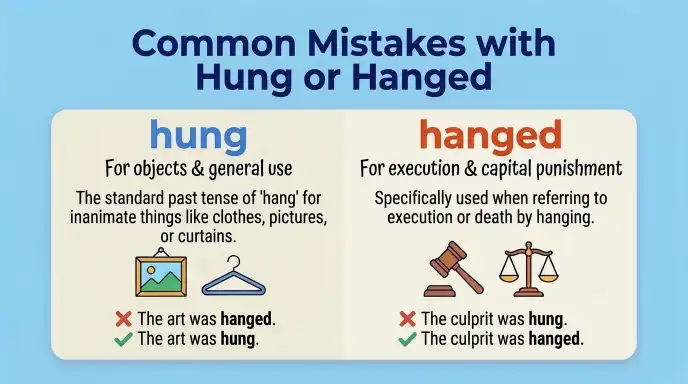
Writers sometimes use hung for every meaning of hang. That choice works for most everyday situations, but not for the traditional meaning of execution by hanging.
| Incorrect Sentence | Correct Sentence | Explanation |
| She hanged the picture on the wall. | She hung the picture on the wall. | Use hung for objects. |
| He hanged his coat by the door. | He hung his coat by the door. | This sentence describes an ordinary action. |
| Officials hung the prisoner after the trial. | Officials hanged the prisoner after the trial. | Use hanged for execution by hanging. |
| They have hanged the curtains. | They have hung the curtains. | Hung is the standard form here. |
| The workers hanged the sign outside. | The workers hung the sign outside. | The sentence describes an object. |
How to Avoid These Mistakes
- Use hung for pictures, clothes, signs, curtains, and other objects.
- Use hanged when describing execution by hanging.
- Read the full sentence before choosing a word.
- Do not assume that one form always works.
- Check a reliable dictionary when the meaning seems unclear.
Hung or Hanged in Everyday Examples
Emails and Workplace Writing
- “I hung the updated schedule near the staff entrance.”
- “The team has hung the new banner in the meeting room.”
- “I have hung the notice on the office board.”
These sentences describe everyday actions, so hung is correct.
News Reports
- “The museum has hung a new painting in its main gallery.”
- “Historical records say that authorities hanged the prisoner after the trial.”
News writers must choose the form that matches the event.
Social Media and Text Messages
- “I finally hung the pictures in my room!”
- “We hung some lights in the garden for the party.”
- “I have hung my new poster above my desk.”
These casual examples use hung because they describe objects.
Formal and Academic Writing
- “The curator hung the painting in a protected gallery.”
- “The historical account states that authorities hanged the convicted man.”
- “The staff had hung the decorations before the ceremony began.”
Formal writing follows the same rule as everyday writing. The meaning determines the correct form.
Hung or Hanged: Google Trends and Usage Data
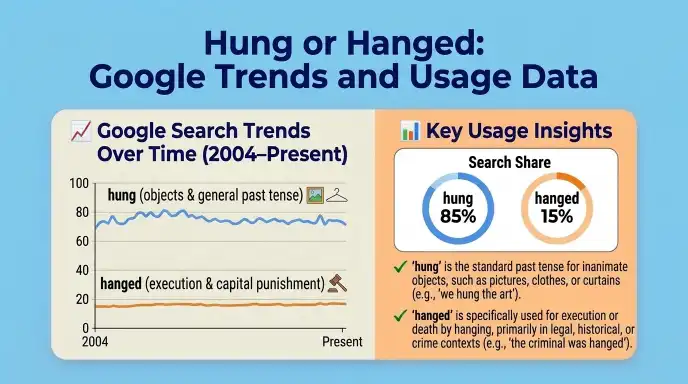
People search for hung or hanged because both forms come from the verb hang and look similar. Most people want to know which form fits a particular sentence.
English speakers in the United States, the United Kingdom, Canada, and Australia use both forms. However, the context matters more than the country.
Writers often use hung when they discuss pictures, clothes, decorations, signs, and other objects. They use hanged in historical, legal, and crime-related contexts that describe execution by hanging.
I have not included exact search volumes or country rankings because those figures require current Google Trends data. It would be misleading to invent popularity statistics.
For practical writing, remember this rule: use hung for most meanings and hanged for execution by hanging.
Hung vs. Hanged: Comparison Table
| Word | Main Use | Example |
| Hung | Past tense of hang for most meanings | She hung the picture. |
| Hung | Past participle for ordinary actions | He has hung his coat. |
| Hanged | Execution by hanging | Officials hanged the prisoner. |
| Hanged | Historical accounts of execution | Authorities hanged the man in the 1700s. |
Both words are correct, but they do not work in every situation. Hung suits most everyday actions, while hanged serves the traditional meaning of execution by hanging.
Frequently Asked Questions
Q1. Is it hung or hanged?
Both hung and hanged are correct, but they have different uses. Use hung for most meanings, such as putting up a picture or hanging clothes. Use hanged when you describe a person who died through execution by hanging.
Q2. Should I say “he was hung” or “he was hanged”?
When you describe an execution by hanging, the traditional and standard form is “he was hanged.” Use hung for ordinary actions, such as hanging a coat or picture. The correct form helps readers understand what happened.
Q3. Is hanged a real word?
Yes. Hanged is a correct form of the verb hang. Writers mainly use it when they describe execution by hanging. For other meanings, such as suspending an object or putting up a picture, they usually use hung.
Q4. Is hung grammatically correct?
Yes. Hung is the standard past tense and past participle of hang for most meanings. For example, “She hung the curtains yesterday” and “He has hung his coat” are both correct sentences.
Q5. Do British and American English use hung and hanged differently?
Generally, no. British and American English follow the same basic distinction. Both use hung for most meanings and hanged for execution by hanging. The context, rather than the region, determines the correct form.
Q6. Why do we say “hanged” instead of “hung” for execution?
English developed a special form, hanged, for execution by hanging. The form hung became standard for most other meanings of the verb. Modern English keeps this historical distinction.
Q7. What is the past tense of hang?
The past tense is usually hung, as in “I hung the picture yesterday.” However, when hang refers to execution by hanging, the past tense is hanged, as in “Authorities hanged the prisoner.” The intended meaning determines the correct form.
Conclusion:
When you choose between hung or hanged, remember that both words are correct, but they serve different purposes. Hung is the usual past tense and past participle of hang for everyday actions. You might use it when you put up a picture, hang curtains, display a sign, or place clothes on a hook.
Hanged describes execution by hanging. English has kept this special use in both British and American English, so you do not need a different form for each country.
To avoid mistakes, focus on the meaning of your sentence. If you talk about an object or an everyday action, hung is usually the right choice. If you describe a historical or legal execution by hanging, choose hanged.
This simple rule will help you write clearly in emails, school assignments, news reports, and formal documents. When you feel unsure, read the sentence again and ask yourself what action it describes.

I’m Nora Ellis, an English language writer passionate about making grammar, spelling, and confusing words easy to understand. I share clear explanations and practical examples to help readers improve their English and use words with confidence.