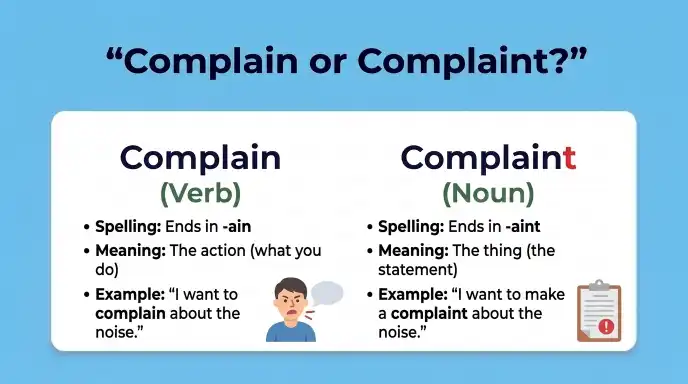
The correct choice between complain and complaint depends on how you use the word in a sentence. Complain is a verb that means to express dissatisfaction, while complaint is a noun that refers to a problem or an expression of dissatisfaction.
For example, you can complain about poor service, but you can also make a complaint about it.These words often confuse English learners because they look and sound similar. However, their grammatical roles are different. Using the wrong form can make a sentence sound unnatural, especially in emails, school assignments, business messages, and formal documents.
The easiest way to remember the difference is to focus on the action and the thing. When someone expresses dissatisfaction, they complain. In contrast, when someone reports a problem, they make or submit a complaint.
In this guide, you will learn the meanings of both words, their grammatical differences, common mistakes, and practical examples. In addition, you will discover how to use each word correctly in everyday conversations and formal writing.
Complain or Complaint: Quick Answer
Complain is a verb that means to express dissatisfaction, annoyance, or unhappiness about something. On the other hand, complaint is a noun that refers to an expression of dissatisfaction or a report about a problem.
Consider these examples:
- Correct: I want to complain about the poor service.
- Correct: I want to make a complaint about the poor service.
- Incorrect: I want to complaint about the poor service.
- Incorrect: I want to make a complain about the poor service.
Remember: You complain about a problem, but you make or file a complaint. Therefore, choosing the right word becomes easier when you understand its role in the sentence.
Definition and Meaning of Complain or Complaint
What Does Complain Mean?
Complain is a verb that describes the act of expressing dissatisfaction, discomfort, or annoyance. People use it when something does not meet their expectations or when they want someone to address a problem.
For example, a customer may complain about a damaged product. Similarly, an employee might complain about unfair working conditions.
Here are more examples:
- The customer complained about the damaged product.
- Please do not complain about every little thing.
- Several employees complained about the long working hours.
- She often complains about the noise next door.
In each sentence, complain describes an action. Its form changes according to the tense and subject. Common forms include complains, complained, and complaining.
What Does Complaint Mean?
Complaint is a noun that refers to an expression of dissatisfaction, a reported problem, or a formal statement about something considered wrong. A complaint may be spoken, written, or submitted through an official process.
For instance, a customer might submit a complaint about a late delivery. Likewise, a school may receive a complaint from a parent.
Consider these examples:
- The manager received a complaint about the service.
- I submitted a formal complaint to the company.
- The school investigated the parent’s complaint.
- We received several complaints about the noise.
Unlike complain, the word complaint names the concern or report itself. Its plural form is complaints, which you can use when referring to more than one concern.
The Main Difference Between Complain and Complaint
The main difference lies in their parts of speech. Although both words relate to dissatisfaction, they perform different functions in a sentence.
| Feature | Complain | Complaint |
| Part of speech | Verb | Noun |
| Meaning | To express dissatisfaction | An expression or report of dissatisfaction |
| Common phrases | Complain about, complain to | Make a complaint, file a complaint |
| Example | I complain about the delay. | I made a complaint about the delay. |
| Other forms | Complains, complained, complaining | Complaints |
In simple terms, complain describes an action, whereas complaint names a concern or report. Once you recognize this distinction, you can choose the correct word with confidence.
Origin of Complain and Complaint
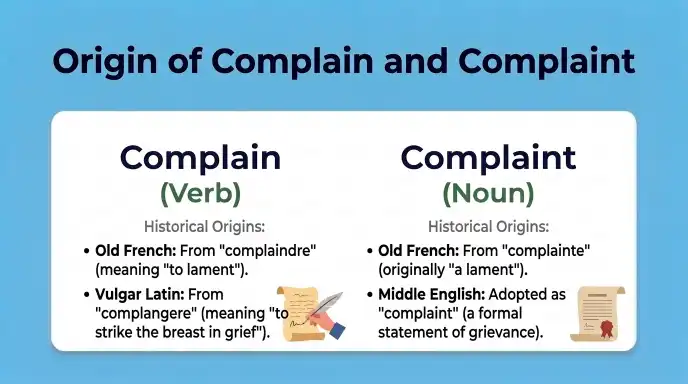
The words complain and complaint share a related history. Both entered English through French forms associated with expressing grief, sorrow, or dissatisfaction.
Over time, complain developed into a verb meaning to express unhappiness or report a problem. Meanwhile, complaint became a noun used for an expression of dissatisfaction, an accusation, or a formal report.
Their shared origin explains why the words look similar. However, English uses them differently today. Complain is a verb, while complaint is a noun. Understanding this grammatical difference is more useful for everyday writing than memorizing their history alone.
Complain vs. Complaint in British and American English
There is no major spelling difference between complain and complaint in British and American English. Both varieties use the same spellings and grammatical rules.
| Usage | American English | British English |
| Verb | Complain | Complain |
| Noun | Complaint | Complaint |
| Past tense | Complained | Complained |
| Plural noun | Complaints | Complaints |
| Example | I want to complain about the bill. | I want to complain about the bill. |
| Formal phrase | File a complaint | Make a complaint |
Similarly, these spellings are standard in Canada, Australia, and other English-speaking regions. Although some preferred expressions may vary by context, the distinction between the two words remains the same.
Therefore, your choice should depend on grammar rather than regional spelling. Use complain for an action and complaint for a concern or report.
Which Word Should You Use?
Choosing between complain and complaint becomes simple when you consider what your sentence needs.
Use Complain When Describing an Action
Use complain when someone expresses dissatisfaction or reports that something is wrong. The word often appears with about or to.
Examples include:
- I need to complain about my internet connection.
- The guests complained about the cold room.
- He keeps complaining about his workload.
- You should complain to the manager if the issue continues.
For a quick grammar check, look at the sentence structure. In “I want to complain,” the word after to is a verb. Likewise, “She is complaining” uses the correct verb form after is.
Use Complaint When Naming a Problem or Report
Choose a complaint when referring to a concern, statement, or report. It often follows words such as a, formal, customer, or written.
For example:
- I submitted a complaint about the internet service.
- The company received a customer complaint.
- She made a formal complaint to the principal.
- The office handles customer complaints.
Common expressions include make a complaint, file a complaint, and submit a complaint. These phrases are useful in both everyday and professional communication.
Use the Right Word in Emails and Formal Writing
Both words work well in professional messages, but the sentence structure changes their use.
- Verb: I am writing to complain about the delay in my order.
- Noun: I am writing to make a complaint about the delay in my order.
Both sentences are correct. However, the first emphasizes the action of expressing dissatisfaction, while the second focuses on the complaint being made.
Common Mistakes with Complain and Complaint
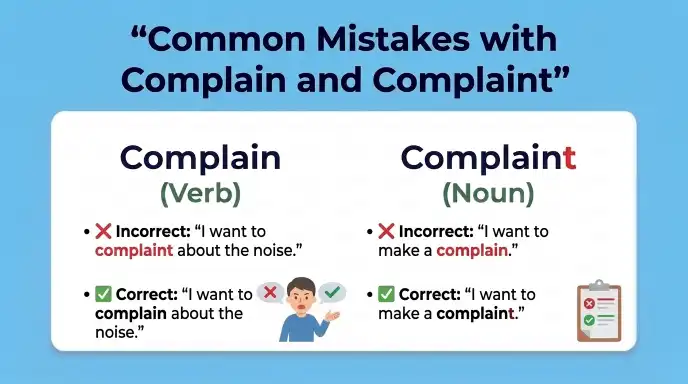
Writers often confuse these words because they have similar meanings. Fortunately, a few simple grammar rules can help you avoid the most common errors.
| Incorrect Sentence | Correct Sentence | Explanation |
| I want to complaint about the food. | I want to complain about the food. | Use the base verb after “want to.” |
| She made a complain to the manager. | She made a complaint to the manager. | Use the noun after “made a.” |
| He is complaint about the noise. | He is complaining about the noise. | Use the -ing verb form after “is.” |
| We received many complain. | We received many complaints. | Use the plural noun after “many.” |
| I filed a complain yesterday. | I filed a complaint yesterday. | “Filed a complaint” is the correct phrase. |
| They complaint every day. | They complain every day. | The sentence needs a verb. |
Easy Ways to Avoid These Mistakes
To use both words correctly, keep these tips in mind:
- First, remember that complaining is an action word.
- Next, use complaints when naming a concern or report.
- After “want to,” use the base verb, as in “I want to complain.”
- Similarly, after “make a,” use the noun, as in “make a complaint.”
- Finally, learn common combinations such as complain about a problem and making a complaint.
These patterns make it easier to recognize the correct form while writing.
Complain or Complaint in Everyday Examples
Real-life examples can help you understand how each word works in different situations. The following sentences show how to use both words naturally.
In Everyday Conversations
People often use complain when expressing frustration. In contrast, the complaint names the concern itself.
- Please stop complaining about the weather.
- I have a complaint about the food.
- She complained that the room was too cold.
- His main complaint was the long waiting time.
In Emails and Messages
When writing to a company, you can use either word depending on your sentence.
- I would like to complain about my recent order.
- I am contacting you to make a complaint about the service.
- We are sorry that you had a reason to complain.
- Your complaint has been forwarded to our support team.
For a more formal tone, the phrase “submit a complaint” is also appropriate.
In School and Academic Writing
Students and teachers may use these words when discussing concerns or reporting problems.
- The student complained about the difficult exam.
- The teacher received a complaint from a parent.
- The report explains why residents complain about traffic.
- The research discusses common customer complaints.
In academic writing, choose the word that accurately describes the action or the report.
In Business and Customer Service
Businesses often receive complaints about products, deliveries, and customer support. As a result, staff members may need to record and investigate these concerns.
- Customers may complain when a product arrives damaged.
- The company investigated the customer’s complaint.
- Please complain to the service desk if you need help.
- The business recorded every formal complaint.
In Formal and Legal Contexts
In official situations, a complaint may refer to a written report or formal allegation. The verb complain describes the act of raising the concern.
- The employee decided to complain to the relevant authority.
- The customer submitted a written complaint.
- The office reviewed the complaint before responding.
- Residents can complain about unsafe conditions.
Although the context changes, the grammar stays consistent: complain is the verb, and complaint is the noun.
Complain or Complaint: Google Trends and Modern Usage
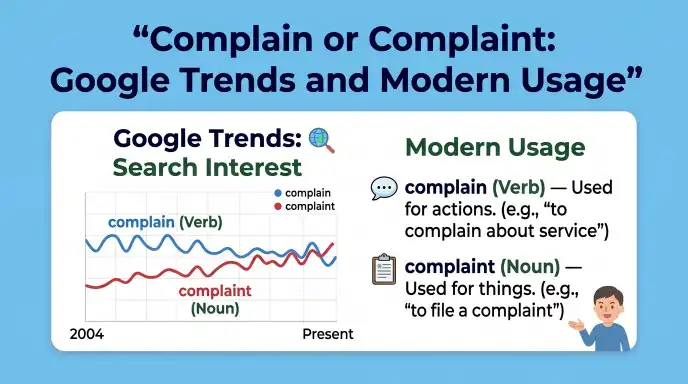
Both complain and complaint are established English words. People use them in everyday conversations, customer service, business communication, and formal writing.
Search interest may vary depending on the user’s needs. For example, someone learning English may search for complain to understand how to express dissatisfaction. Meanwhile, a customer preparing a formal report may search for complaint.
However, search popularity can change by region and over time. Without checking Google Trends for a specific location and period, it would be inaccurate to claim that one word is searched more often than the other.
For practical writing, search popularity is not the deciding factor. Instead, choose the form that fits the sentence. Use complain for an action and complaint for the concern or report.
Complain vs. Complaint: Quick Comparison
This table summarizes the main uses of both words.
| Sentence Purpose | Correct Word | Example |
| Express dissatisfaction | Complain | I want to complain about the noise. |
| Describe a past action | Complained | She complained about the delay. |
| Describe an ongoing action | Complaining | He is complaining about the cost. |
| Name a report | Complaint | I submitted a complaint. |
| Refer to several reports | Complaints | The office received three complaints. |
| Use a formal phrase | Complaint | Please file a complaint with the department. |
In short, use complain when the sentence describes what someone does. Conversely, use complaint when the sentence identifies a concern, statement, or report.
Key Takeaways
- Complain is a verb that means to express dissatisfaction.
- Complaint is a noun that names an expression or report of dissatisfaction.
- Say “I want to complain,” not “I want to complaint.”
- Similarly, say “I made a complaint,” not “I made a complain.”
- Use complain about something and complain to someone.
- Common noun phrases include make a complaint, file a complaint, and submit a complaint.
- British and American English use the same spellings for both words.
- Most importantly, choose the word that matches the grammar of your sentence.
Frequently Asked Questions
Q1. What is the difference between complain and complaint?
Complain is a verb that describes the action of expressing dissatisfaction. In contrast, complaint is a noun that names the concern, statement, or report. For example, “I want to complain about the service” describes an action, while “I made a complaint about the service” refers to the report itself.
Q2. Is complain a verb or a noun?
Complain is a verb. It describes expressing dissatisfaction or concern about something. For example, “Customers complain about long waiting times.” In addition, its other forms include complains, complained, and complaining. The related noun is complaint.
Q3. Is complaint a verb or a noun?
Complaint is a noun. It refers to a statement or report that expresses dissatisfaction. For instance, “The manager received a complaint from a customer.” Its plural form is complaints, which is used when referring to more than one concern.
Q4. Should I say “make a complaint” or “make a complain”?
The correct phrase is “make a complaint.” This is because complaint is a noun in this expression. For example, “I want to make a complaint about the damaged product.” You can also use “file a complaint” or “submit a complaint” in formal situations.
Q5. Is it correct to say “I want to complain”?
Yes, “I want to complain” is grammatically correct. The word complain follows “to” as the base form of a verb. For example, you can say, “I want to complain about the poor service.” By comparison, “I want to complaint” is incorrect.
Q6. How do I use complain in a sentence?
Use complain when someone expresses dissatisfaction. For example, “The passengers complained about the delay.” Similarly, you can say, “I will complain to the manager” or “She often complains about the noise.” The verb form changes according to the tense and subject.
Q7. How do I use complaint in a sentence?
Use complaint as a noun to identify a concern or report. For example, “The company received a complaint about the product.” Other common phrases include “file a complaint,” “make a complaint,” and “respond to a complaint.” These expressions are useful in both formal and everyday writing.
Q8. Is complaint the same as complaining?
No. Complaint is a noun, whereas complaining is the -ing form of the verb complain. For example, “Her complaint was about the noise” uses the noun. On the other hand, “She is complaining about the noise” describes an action happening now.
Q9. Do British and American English spell complain and complaint differently?
No. Complain and complaint are spelled the same way in British and American English. Both varieties use complain as a verb and complaint as a noun. Therefore, you do not need to change either spelling when writing for a British or American audience.
Q10. What is the easiest way to remember complain and complaint?
Remember this simple rule: you complain, but you make a complaint. Use complain for the action of expressing dissatisfaction. Meanwhile, use complaint for the concern or report itself. This distinction works in everyday conversations, professional emails, and formal writing.
Conclusion:
The difference between complain and complaint becomes clear once you understand their grammatical roles. Complain is a verb that describes the act of expressing dissatisfaction or reporting a problem. Meanwhile, complaint is a noun that refers to the concern, statement, or formal report itself.
For example, use “complain about the service” or “complain to the manager” when describing an action. In contrast, choose expressions such as “make a complaint,” “file a complaint,” and “submit a complaint” when referring to a report.
Both words are correct, and neither is a regional spelling variation of the other. Therefore, your choice should depend on the sentence’s meaning and structure. Once you remember that you complain but make a complaint, you can use both words confidently in conversations, emails, academic assignments, and professional communication.

I’m Nora Ellis, an English language writer passionate about making grammar, spelling, and confusing words easy to understand. I share clear explanations and practical examples to help readers improve their English and use words with confidence.