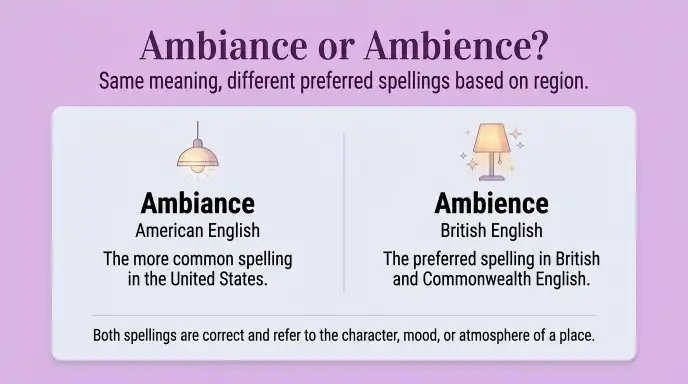
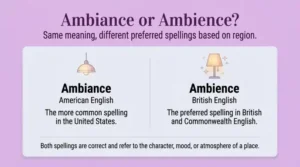
Ambiance and ambience are both correct spellings. They have the same meaning: the mood, feeling, or atmosphere of a place.
The main difference is regional preference. Ambiance is more common in American English, while ambience is widely used in British English. People often search for ambiance or ambience when writing about restaurants, hotels, homes, events, or other places where the atmosphere matters.
Both spellings can describe a room that feels warm and cozy, a restaurant with soft lighting, or a hotel with a calm and peaceful setting. The choice does not change the meaning of the sentence.
The confusion comes from the different spelling habits used across English-speaking countries. Some writers see the letter a in ambiance and assume that ambience is incorrect. Others prefer ambience because it matches British spelling conventions. In fact, both forms are accepted in standard English.
In this guide, you will learn the meaning of ambiance and ambience, their origins, regional spelling preferences, and common mistakes. You will also see practical examples for emails, business writing, social media, and academic work. By the end, you will know which spelling best suits your audience and how to use it with confidence.
Ambiance or Ambience: Quick Answer for Readers
Ambiance and ambience mean the same thing: the mood or atmosphere of a place. Both are correct, but ambiance is generally preferred in American English, while ambience is often preferred in British English.
Examples:
- The restaurant has a relaxing ambiance. (American English)
- The hotel is known for its peaceful ambience. (British English)
- Soft lights create a warm ambiance in the room.
Easy rule: Use ambiance for a US audience and ambience for a UK audience. For international writing, either spelling is acceptable. Choose one and use it consistently.
Ambiance or Ambience: Quick Answer
Both ambiance and ambience are correct nouns. They describe the character, mood, or feeling that a place creates.
- Ambiance: A common spelling in American English.
- Ambience: A common spelling in British English and other varieties of English.
- Meaning: The atmosphere or mood of a place.
For example, a café with gentle music, warm lights, and comfortable chairs may have a cozy ambiance or a cozy ambience. The meaning stays the same.
Neither spelling is universally wrong. Your choice should depend on your audience, publication style, or preferred spelling convention.
What Does Ambiance or Ambience Mean?
Ambiance and ambience refer to the atmosphere or feeling of a place. This feeling may come from lighting, sounds, colors, furniture, decoration, and the people in the space.
The words often appear in descriptions of restaurants, hotels, homes, shops, gardens, and events. They can also describe the mood of a setting in a book, film, or performance.
Definition of Ambiance
Ambiance means the mood or atmosphere that surrounds a person in a particular place. It often describes how a place feels rather than what it looks like.
Examples:
- The café has a friendly ambiance.
- The candles create a romantic ambiance.
- The hotel offers a calm and welcoming ambiance.
Definition of Ambience
Ambience has the same meaning as ambiance. It describes the overall feeling or character of an environment.
Examples:
- The garden has a peaceful ambience.
- The restaurant’s ambience makes it ideal for a quiet dinner.
- Soft music adds to the warm ambience of the room.
What Creates Ambiance or Ambience?
Several features can shape the atmosphere of a place:
- Lighting: Bright lights can feel lively, while soft lights can feel calm.
- Sound: Music, conversation, or silence can affect the mood.
- Colors: Warm colors may create a cozy feeling, while cool colors can feel fresh.
- Furniture: Comfortable seating can make a place feel welcoming.
- Scent: Flowers, candles, or fresh food can shape the experience.
- People: Friendly staff and relaxed guests can make a place feel inviting.
These features work together to create an overall impression.
Ambiance vs. Atmosphere
The words ambiance and atmosphere are close in meaning. In many sentences, you can use either one.
For example:
- The restaurant has a relaxed ambiance.
- The restaurant has a relaxed atmosphere.
Both sentences are correct. Ambiance often appears in descriptions of the mood and sensory qualities of a place, especially in hospitality, design, and lifestyle writing. Atmosphere is a broader and more common word that can also describe the mood of an event or situation.
The Origin of Ambiance or Ambience
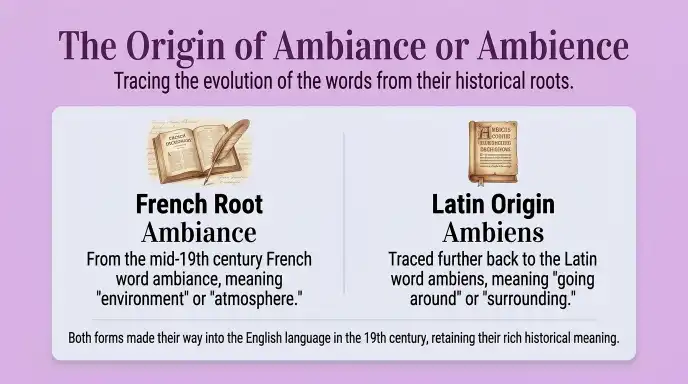
The words ambiance and ambience come from the French word ambiance, which refers to the surrounding atmosphere or environment.
The French word is linked to the idea of surrounding or encompassing something. English adopted the word to describe the general feeling or character of a place.
How Did the Two Spellings Develop?
English uses both ambiance and ambience. The spelling ambiance stays closer to the French form, while ambience developed as an alternative English spelling.
Over time, both forms became established in English dictionaries and general writing. Their meanings did not split into separate definitions. The difference is mainly a matter of spelling preference.
Why Are Both Spellings Correct?
English has many words with accepted spelling variants. Some variants are linked to regional habits, while others developed through historical use.
Ambiance and ambience are a good example. Neither spelling represents a different level of quality, mood, or meaning.
Examples:
- The restaurant’s ambiance feels elegant.
- The restaurant’s ambience feels elegant.
Both sentences communicate the same idea.
The key is to follow the spelling convention that suits your readers and keep it consistent throughout your writing.
British English vs American English
The main difference between ambiance and ambience is regional preference, not meaning. American English generally favors ambiance, while British English often uses ambience.
Both forms are understood in the United States, the United Kingdom, Canada, Australia, and other English-speaking regions.
Spelling Comparison Table
| British English | American English | Example |
| Ambience is often preferred | Ambiance is generally preferred | The hotel has a relaxing ambience/ambiance. |
| Ambience is accepted | Ambience is also accepted | The café has a peaceful ambience. |
| Ambiance is understood | Ambiance is understood | The room has a warm ambiance. |
Regional Differences
American English: Ambiance is the usual choice in many US publications, restaurant reviews, and lifestyle articles.
British English: Ambience is common in British writing, including descriptions of restaurants, hotels, and interior design. Ambiance is also understood and used.
Canadian English: Both spellings appear. The best choice depends on the publication’s style guide.
Australian English: Ambience is common, but ambiance is also understood. Follow the style used by the publisher or organization.
What Do Style Guides Recommend?
Style guides help writers keep spelling consistent across a document or publication. If a company or publisher has a preferred spelling list, follow it.
For example, a US publication may choose ambiance throughout its content. A UK publication may prefer ambience. Neither choice changes the word’s meaning.
Important: Do not treat one spelling as correct worldwide and the other as a spelling mistake. Both are accepted forms.
Which Version Should You Use?
Choosing between ambiance and ambience is simple once you know your audience. Both forms are correct, so the best choice depends on regional preference and house style.
For the United States
Use ambiance as your first choice for a US audience.
Example: The restaurant’s ambiance makes it perfect for a romantic dinner.
For the United Kingdom
Use ambience if you want to follow a common British English preference.
Example: The hotel’s ambience is calm and welcoming.
For Canada
Either spelling can work. Check the style guide used by your employer, publisher, or school.
Example: The café’s ambiance creates a warm and friendly mood.
For Australia
Both spellings are understood. Ambience is a suitable choice when following British-style spelling preferences, but consistency matters most.
Example: The gallery has a quiet ambience.
For International Writing
If your readers come from different countries, choose either spelling and use it consistently. You do not need to change the word from one sentence to another.
For Academic Writing
Follow your university’s or journal’s style guide. If no preference is given, choose the spelling that fits your main audience and use it throughout the paper.
For Business Writing
Use the spelling that matches your organization’s preferred English variety. Consistent spelling makes reports, website copy, brochures, and customer communications look more professional.
Best advice: Know your audience, choose one form, and use it consistently.
Common Mistakes with Ambiance or Ambience
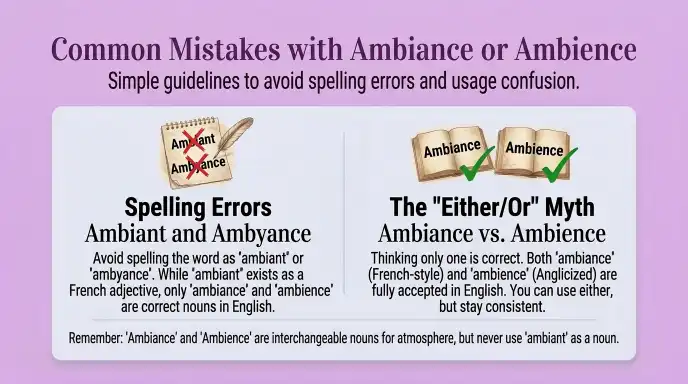
Although both spellings are correct, writers can still make mistakes when choosing between them or using them in sentences.
Calling Ambience Incorrect
Incorrect: Ambience is always a spelling mistake.
Correct: Ambience is an accepted spelling, especially common in British English.
Why? Both ambiance and ambience are standard English forms.
Calling Ambiance Incorrect
Incorrect: Ambiance is not a real English word.
Correct: Ambiance is a standard spelling, widely used in American English.
Why? The spelling is accepted in English and retains the same meaning as ambience.
Using Both Spellings Without a Reason
Less consistent: The hotel has a peaceful ambience. Its warm ambiance attracts visitors.
Better: The hotel has a peaceful ambience. Its welcoming ambience attracts visitors.
Why? Mixing spelling variants in the same piece can look inconsistent. Choose one form unless you are quoting a source or following a specific name.
Confusing Ambiance with Ambitious
Incorrect: The restaurant has an ambitious atmosphere.
Correct: The restaurant has a pleasant ambiance.
Why? Ambitious describes someone who wants to achieve something. Ambiance describes the mood or atmosphere of a place.
Using Ambiance When Atmosphere Is Clearer
Awkward: The ambiance at the meeting was tense because everyone disagreed.
Clearer: The atmosphere at the meeting was tense because everyone disagreed.
Why? Ambiance can describe a room or setting, but atmosphere may sound more natural when describing a tense situation or social event.
Memory Tip
Remember this simple rule:
- Ambiance: Often preferred in American English.
- Ambience: Often preferred in British English.
- Meaning: The same in both cases.
Neither spelling is wrong. Your goal is to match your audience and maintain consistency.
Ambiance or Ambience in Everyday Examples
Both words appear in daily communication, business writing, reviews, and creative work. Here are examples that show how to use them naturally.
In Emails
Use ambiance or ambience when discussing the feel of a venue or workplace.
Examples:
- The venue has a warm ambiance that suits our event.
- I enjoyed the peaceful ambience of the hotel.
- We should consider lighting to improve the room’s ambiance.
In Business Writing
Businesses often use these words when describing customer experiences, hotels, restaurants, shops, and event spaces.
Examples:
- The restaurant’s ambiance supports its premium dining experience.
- The hotel offers a calm ambience for business travelers.
- Comfortable seating helps create a welcoming ambiance.
In News Headlines
These words can appear in lifestyle, travel, food, and entertainment stories.
Example headlines:
- “New Café Brings a Relaxed Ambiance to the City”
- “Historic Hotel Preserves Its Traditional Ambience”
- “Restaurant Combines Local Food with a Warm Ambiance”
These are sample headlines, not claims about published news reports.
In Blog Posts
Writers often use ambiance or ambience in articles about home design, travel, restaurants, and events.
Examples:
- Choose soft lighting to create a cozy ambiance at home.
- A garden can have a peaceful ambience with flowers and quiet paths.
- Music can change the ambiance of a dinner party.
On Social Media
Both spellings work in captions and short posts.
Examples:
- “Love the cozy ambiance of this little café!”
- “The peaceful ambience made our evening special.”
- “Warm lights, good food, and the perfect ambiance.”
In Academic Writing
Use either form when discussing how an environment affects people’s experiences. Follow your academic style guide.
Examples:
- The study examined how room lighting influenced the perceived ambiance.
- Participants described the setting’s ambience as calm and inviting.
If the research uses a specific definition of ambiance or ambience, explain it clearly.
In Daily Conversation
These words can describe how a place feels.
Examples:
- “I love the ambiance in this restaurant.”
- “The room has a relaxing ambience.”
- “Candles give the space a romantic ambiance.”
In casual speech, many people may not notice the spelling difference because both words are pronounced in similar ways.
Ambiance or Ambience: Google Trends and Modern Usage
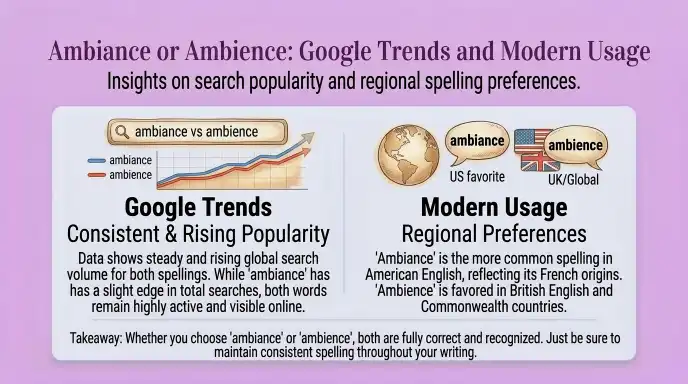
People search for ambiance or ambience because they want to know which spelling is correct, which one suits their country, or if the words have different meanings.
The general usage pattern is clear: ambiance is often favored in American English, while ambience is common in British English and other regions that follow British-style spelling preferences.
Why Do People Search for These Words?
Common reasons include:
- Spelling questions: Writers want to choose the accepted form.
- Restaurant reviews: People describe the mood and setting of a venue.
- Travel content: Hotels and destinations are often described by their atmosphere.
- Interior design: Writers discuss lighting, color, and room design.
- English learning: Students want to understand regional spelling differences.
Which Spelling Is More Popular?
Popularity can vary by country, publication, and topic. Without checking current Google Trends data, it would not be accurate to provide exact search volumes or claim a specific percentage for either spelling.
A useful comparison would examine both terms over the same period and in the same region. It would also help to compare search phrases such as “ambiance meaning,” “ambience meaning,” and “ambiance vs ambience.”
Ambiance or Ambience: Quick Comparison Table
| Version | Meaning | Correct? | Region | Example |
| Ambiance | Mood or atmosphere | Yes | Common in US English | The café has a cozy ambiance. |
| Ambience | Mood or atmosphere | Yes | Common in UK English | The café has a cozy ambience. |
| Atmosphere | General mood or feeling | Yes | All major English varieties | The café has a cozy atmosphere. |
The table shows that ambiance and ambience have the same meaning. Atmosphere is a useful synonym when you want a more familiar or general word.
Key Takeaways
- Ambiance and ambience are both correct spellings.
- Both words mean the mood, feeling, or atmosphere of a place.
- Ambiance is generally preferred in American English.
- Ambience is often preferred in British English.
- Neither spelling is universally wrong.
- Use your organization’s or publisher’s style guide when one exists.
- Choose one spelling and use it consistently throughout your writing.
FAQs About Ambiance or Ambience
Q1. Is ambiance or ambience correct?
Both ambiance and ambience are correct spellings. They have the same meaning: the mood or atmosphere of a place. Ambiance is more common in American English, while ambience is often preferred in British English.
Q2. What is the difference between ambiance and ambience?
There is no difference in meaning. Both words describe the atmosphere, mood, or character of a place. The main difference is regional spelling preference. Ambiance is common in American English, while ambience is widely used in British English.
Q3. Is ambiance American or British English?
Ambiance is generally associated with American English. However, British writers also use it. The alternative spelling, ambience, is often preferred in British English. Both forms are accepted in standard English.
Q4. Is ambience British English?
Ambience is widely used in British English and is often the preferred form in British-style writing. However, ambiance is also accepted in the United Kingdom. Follow your publisher’s style guide when choosing between them.
Q5. What does ambiance mean?
Ambiance means the mood or atmosphere of a place. Lighting, sounds, colors, furniture, and scents can all affect it. For example, soft lighting and gentle music can create a relaxing ambiance in a restaurant.
Q6. Can I use ambiance and ambience interchangeably?
Yes. You can use ambiance and ambience interchangeably because they have the same meaning. However, choose one spelling and use it consistently throughout your article, report, or website to keep your writing clear and professional.
Q7. Is ambiance more common than ambience?
It depends on the region and type of writing. Ambiance is common in American English, while ambience is widely used in British English. Current search data would be needed to compare their popularity accurately.
Q8. What is another word for ambiance?
Atmosphere is a close synonym for ambiance. Other alternatives include mood, feeling, and character, depending on the sentence. For example, “The restaurant has a peaceful ambiance” can also be written as “The restaurant has a peaceful atmosphere.”
Conclusion: Ambiance or Ambience
The choice between ambiance and ambience is simple once you understand their meaning. Both words describe the mood, feeling, or atmosphere of a place. They can refer to a cozy restaurant, a peaceful hotel, a romantic room, or a lively event. Neither spelling is universally incorrect.
The main difference is regional preference. Ambiance is generally more common in American English, while ambience is widely used in British English. Both forms are understood across English-speaking countries, including Canada and Australia.
For the best results, think about your readers before choosing a spelling. Follow your publisher’s or organization’s style guide when one exists. If you are writing for an international audience, choose either form and use it consistently throughout your article, email, or report.
You can also use atmosphere when you want a familiar alternative. It often fits the same sentences and can make your writing sound natural.
The most important lesson is that ambiance and ambience share the same meaning. Choose the form that suits your audience, keep your spelling consistent, and focus on making your message clear.
Remember: Different spelling, same atmosphere.

I’m Nora Ellis, an English language writer passionate about making grammar, spelling, and confusing words easy to understand. I share clear explanations and practical examples to help readers improve their English and use words with confidence.




1 thought on “Ambiance or Ambience: How to Pick the Right Spelling ”