Afterwards or afterward both mean “later” or “after something happens.” Later, subsequently, and after that are useful synonyms; afterward is more common in American English, while afterwards is common in British English.
Both words mean “later” or “after something has happened.” Many people search for “afterwards or afterward” because the two words have the same meaning but end differently. This can make it hard to know which spelling to use in an essay, email, or professional document.
The good news is that you can use either word to talk about something that happens later. The main difference comes from regional preference, not meaning. For instance, an American writer might say, “We went home afterward,” while a British writer might write, “We went home afterwards.”
In this guide, you will learn the meaning of both words, their origins, and how writers use them in different English-speaking countries. You will also see common mistakes, everyday examples, and answers to frequently asked questions. By the end, you will know which form suits your audience and how to use it clearly in your writing.
Afterwards or Afterward: Quick Answer
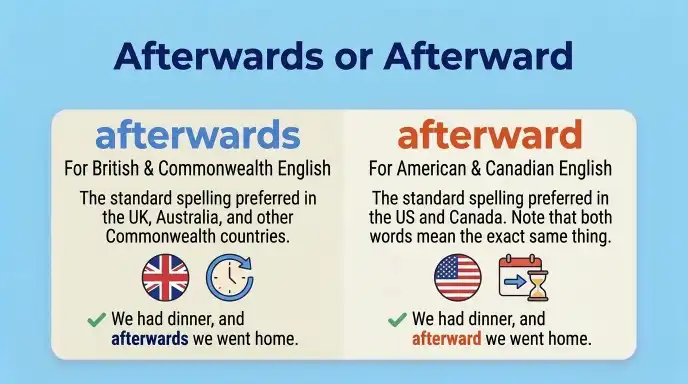
Both afterwards and afterward are correct. They mean later or after an event.
- Afterward: More common in American English.
- Afterwards: More common in British English and other varieties of English.
Example: “We had dinner and went for a walk afterward.”
Example: “We had dinner and went for a walk afterwards.”
Both sentences are correct and have the same meaning. Choose the form that best matches your audience and use it consistently.
Definition and Meaning of Afterwards or Afterward
What Does Afterward Mean?
Afterward is an adverb that means later or after something has happened. It tells readers when an action takes place.
Writers often use it to describe the next event in a series.
Example: “She finished her homework and watched TV afterward.”
In this sentence, afterward tells us that she watched TV after finishing her homework.
Other examples include:
- We talked about the meeting afterward.
- He apologized afterward.
- The team celebrated afterward.
What Does Afterwards Mean?
Afterwards has the same meaning as afterward. It also means later or after an event.
Writers use it to show that one action follows another.
Example: “She finished her homework and watched TV afterwards.”
Other examples include:
- We visited the museum and had lunch afterwards.
- They discussed the results afterwards.
- I felt much better afterwards.
Is There a Difference in Meaning?
No. Afterwards and afterward have the same basic meaning. The difference lies mainly in regional usage.
American writers often prefer afterward, while British writers often prefer afterwards. Neither spelling is wrong when used in the right context.
Both words work in casual conversations, emails, essays, and formal writing.
The Origin of Afterwards or Afterward
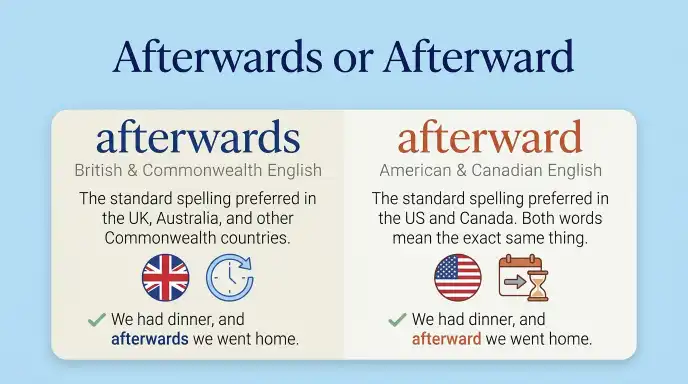
The word afterward comes from older English forms built from after and -ward. The ending -ward expresses direction or movement toward a point in time or place. In this word, it refers to a later time.
The form afterwards adds the adverbial ending -s, which appears in several English words, including towards, backwards, and forwards.
Over time, both forms became established in English. American English generally favored the shorter form, afterward, while British English commonly retained afterwards.
This difference follows a wider pattern in English. Some words have shorter forms that Americans often prefer and longer forms that remain common in British English. However, this pattern does not apply to every word.
Today, both forms are standard. The spelling you choose usually reflects your regional preference or the style you want to follow.
British English vs American English Spelling
British and American English both accept afterwards and afterward. The main difference is how often people use each form.
| Feature | British English | American English |
| Common spelling | Afterwards | Afterward |
| Alternative spelling | Afterward | Afterwards |
| Meaning | Later; after an event | Later; after an event |
| Grammar | Adverb | Adverb |
| Formal writing | Both forms are acceptable | Both forms are acceptable |
| Typical preference | Afterwards | Afterward |
Example in British English: “We went shopping and had lunch afterwards.”
Example in American English: “We went shopping and had lunch afterward.”
Both sentences are grammatically correct. The difference reflects common regional preference, not a change in meaning.
Which Spelling Should You Use?
For American English
If you write for an American audience, afterward is usually the best choice. It is common in American books, articles, emails, and everyday writing.
Example: “We finished the presentation and answered questions afterward.”
For British English
If your readers are mainly in the United Kingdom, afterwards is a natural choice. British writers commonly use this form in both casual and formal writing.
Example: “We finished the presentation and answered questions afterwards.”
For Canada and Australia
Both forms appear in Canadian and Australian English. Regional preferences can vary, so follow the spelling style used by your organization or publication.
If you do not have a specific style guide, choose one form and use it consistently.
For International Writing
For an international audience, either spelling works. Afterward may suit American-focused content, while afterwards may suit British-focused content.
The most important point is consistency. Avoid switching between the two forms without a reason.
For Academic and Business Writing
Both forms are acceptable in academic and business writing. Check your institution’s or company’s style guide if it specifies a preference.
Example: “The researchers reviewed the results afterward.”
Example: “The researchers reviewed the results afterwards.”
Both sentences express the same idea.
Common Mistakes with Afterwards or Afterward
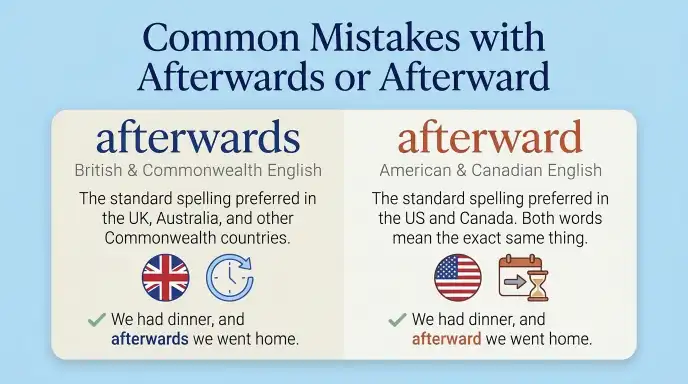
Writers sometimes think one spelling is wrong. In fact, both forms are correct. Most mistakes happen when writers misunderstand the regional difference or use the word in an awkward place.
| Incorrect or Confusing Usage | Better Usage | Explanation |
| Afterwards is always wrong in American English. | Both forms are correct, but Americans often prefer afterward. | Regional preference does not make the other form incorrect. |
| Afterward is always wrong in British English. | Both forms are accepted, but afterwards is common in Britain. | British writers can use either form. |
| We afterward went home. | We went home afterward. | Placing the word at the end often sounds more natural. |
| I will call you afterwards. | I will call you afterward. | The revised sentence sounds clearer in everyday English. |
| We used afterward in one paragraph and afterwards in the next without a reason. | Choose one form and use it consistently. | Consistency improves the flow of your writing. |
How to Avoid These Mistakes
- Remember that afterwards and afterward mean the same thing.
- Prefer afterward for American-focused writing.
- Prefer afterwards for British-focused writing.
- Use one form consistently throughout a document.
- Read the sentence aloud to check if the word fits naturally.
Afterwards or Afterward in Everyday Examples
Emails and Workplace Writing
Both forms work well in emails and professional messages.
Example: “I will send you the meeting notes afterward.”
Example: “We can discuss the next steps afterwards.”
Example: “Please review the report and share your feedback afterward.”
Choose the form that matches your audience or company style.
News and Articles
News writers use both forms to describe events that happen later.
Example: “The mayor spoke to reporters afterward.”
Example: “The team held a short meeting afterwards.”
Both sentences show that one event followed another.
Social Media and Text Messages
In casual writing, either form sounds natural.
Example: “Let’s grab coffee and go shopping afterward!”
Example: “We watched the movie and got pizza afterwards.”
The choice does not change the meaning.
Academic and Formal Writing
Both forms are suitable for academic and formal writing.
Example: “The researchers analyzed the data afterward.”
Example: “The students completed the test and discussed their answers afterwards.”
Always follow any style guide that your school, journal, or workplace provides.
Everyday Conversation
People use these words to explain the order of events.
Example: “I went to the gym and rested afterward.”
Example: “We visited our friends and ate dinner afterwards.”
In both cases, the word tells the reader what happened later.
Afterwards or Afterward: Google Trends and Usage Data
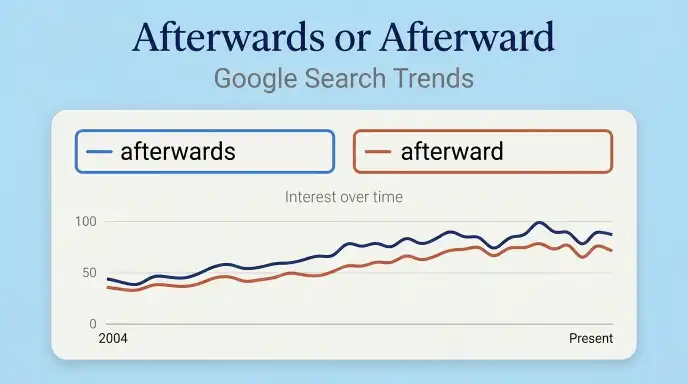
People search for afterwards or afterward because both spellings are correct and have the same meaning. They often want to know which form suits their country, audience, or writing style.
In general, afterward is more common in American English, while afterwards is more common in British English. Both forms also appear in other English-speaking countries.
The words have the same grammatical role and meaning. Writers use them in personal messages, news articles, academic work, and professional documents to describe something that happens later.
Exact search volumes and country rankings can change over time. Without checking current Google Trends data, it would not be accurate to provide exact numbers or claim that one spelling has a specific search advantage.
For practical writing, choose the form that fits your audience. If you write for American readers, afterward is a natural choice. If you write for British readers, afterwards is also a natural choice. Use the same form throughout your article to keep your style consistent.
Afterwards vs Afterward: Comparison Table
| Feature | Afterwards | Afterward |
| Meaning | Later; after an event | Later; after an event |
| Part of speech | Adverb | Adverb |
| British English | Common preference | Also accepted |
| American English | Also accepted | Common preference |
| Formal writing | Correct | Correct |
| Example | We talked afterwards. | We talked afterward. |
The key difference is regional preference, not meaning or grammar. Both spellings are correct.
Frequently Asked Questions
Q1. Is it afterwards or afterward?
Both afterwards and afterward are correct. They mean “later” or “after something has happened.” American English usually favors afterward, while British English commonly favors afterwards. Choose the form that suits your audience and use it consistently.
Q2. Is afterward more common in American English?
Yes. Afterward is generally more common in American English. Writers use it in everyday conversations, emails, news articles, and formal documents. However, afterwards is also accepted in American English and is not grammatically wrong.
Q3. Is afterwards correct in British English?
Yes. Afterwards is common in British English and is a standard spelling. British writers also use afterward, so neither form is incorrect. The choice usually depends on personal preference, regional habits, or a publication’s style guide.
Q4. Do afterwards and afterward mean the same thing?
Yes. Both words mean later or after an event. For instance, “We ate dinner afterward” and “We ate dinner afterwards” communicate the same idea. The difference comes from spelling preference rather than meaning.
Q5. Can I use afterward in formal writing?
Yes. Afterward is suitable for formal writing, including academic papers, reports, and business emails. It is especially common in American English. If your institution or publisher follows a style guide, use the form that guide recommends.
Q6. Can I use it afterwards in American English?
Yes. Afterwards is grammatically correct in American English, even though many American writers prefer afterward. You do not need to change it unless your style guide or audience requires a particular form. Consistency matters more than choosing one form over the other.
Q7. Which spelling should I use for an international audience?
Both spellings work for an international audience. Choose afterward if your content follows American English or afterwards if it follows British English. If you have no regional preference, pick one form and use it consistently throughout your writing.
Conclusion:
When choosing between afterwards or afterward, remember that both spellings are correct and carry the same meaning. They describe something that happens later or after another event. The main difference is regional preference: afterward is more common in American English, while afterwards is more common in British English.
You can use either form in everyday conversations, emails, social media posts, school assignments, and professional documents. Neither spelling is automatically wrong because of the country where you use it. However, your audience and style guide can help you make the best choice.
For American-focused writing, afterward is usually a natural option. For British-focused writing, afterwards is equally natural. For international content, either spelling works well. The most important rule is to remain consistent throughout your document.
Once you understand this simple difference, you can use both words with confidence. Focus on clear meaning, natural sentences, and a consistent writing style. That approach will help readers understand your message without getting distracted by a spelling difference.

I’m Nora Ellis, an English language writer passionate about making grammar, spelling, and confusing words easy to understand. I share clear explanations and practical examples to help readers improve their English and use words with confidence.