Payer and payor are both correct spellings, but payer is more common in general English, while payor often appears in legal, insurance, and financial documents. Both words describe a person or organization that pays money.
People often search for “payer or payor” because the two spellings look almost the same and can appear in similar situations. Choosing the right form depends on your audience, the type of document, and any rules your organization follows.
For example, a person who pays a bill is a payer. In some legal agreements and insurance records, writers use payor to identify the person or organization responsible for making a payment. The meaning usually stays the same, even when the spelling changes.
This guide explains the definitions, origins, and uses of payer and payor. You will learn if British and American English treat them differently, which spelling suits different audiences, and how to avoid common mistakes. You will also find practical examples for emails, business documents, insurance forms, and everyday writing. By the end, you will know which spelling to choose for clear and professional communication.
Payer or Payor: Quick Answer
Payer and payor both mean a person or organization that pays money.
- Payer is the more common spelling in general English.
- Payor often appears in legal, insurance, healthcare, and financial contexts.
Example: “The payer must settle the bill by Friday.”
Example: “The contract identifies the payor responsible for monthly payments.”
Both spellings can be correct. When a legal document, insurer, or employer specifies one spelling, follow that requirement.
Definition and Meaning of Payer or Payor
What Does Payer Mean?
Payer is a noun that describes a person, company, or organization that pays money for something. The payment may cover a bill, service, debt, insurance premium, or other financial obligation.
Writers use payer in everyday conversations and professional settings. It appears in banking, healthcare, business, and billing.
Example: “The payer received a receipt after completing the transaction.”
Example: “The company listed the customer as the primary payer.”
In simple terms, a payer is the person or organization that makes a payment.
What Does Payor Mean?
Payor is another noun for a person or organization that pays money. Writers often use it in legal, financial, insurance, and healthcare documents.
Some contracts use payor to identify the party responsible for a payment. Certain insurance and healthcare systems also use this spelling when they discuss the organization that pays for services.
Example: “The agreement names the payor responsible for the monthly fee.”
Example: “The healthcare provider contacted the insurance payor about the claim.”
In most situations, payor carries the same basic meaning as payer. The difference usually concerns spelling conventions and professional usage rather than meaning.
Is There a Difference in Meaning?
In ordinary usage, payer and payor usually mean the same thing. Both identify the person or organization that pays.
However, a specific industry or document may define these terms in its own way. A contract, insurance policy, or billing system might use one spelling consistently for a particular role.
Always check the document’s definitions when the distinction matters legally or financially.
The Origin of Payer or Payor
The word payer comes from the verb pay with the suffix -er, which commonly identifies a person or thing that performs an action. A payer is therefore someone who pays.
The spelling payor developed as an alternative form. The ending -or appears in many English words that describe people or parties who perform an action, especially in legal and formal language.
Over time, payer became the more familiar spelling in general English. Payor remained common in certain professional settings, including legal documents, insurance, and finance.
English often contains alternative spellings that share the same meaning. In this case, the two forms usually refer to the same role, but different organizations may prefer different spellings.
British English vs American English Spelling
Payer is widely used in both British and American English. Payor also appears in both, especially in specialized legal and financial contexts.
The distinction is not a simple rule that makes one spelling British and the other American. Instead, professional conventions and the type of document often influence the choice.
| Feature | Payer | Payor |
| General English | More common | Less common |
| British English | Common | Used in specialized contexts |
| American English | Common | Often appears in legal and financial contexts |
| Insurance documents | Common | Also used |
| Legal agreements | Common | Often used |
| Basic meaning | Person or organization that pays | Person or organization that pays |
Which Spelling Is More Common?
Payer is generally the safer choice for everyday writing because readers widely recognize it. Payor may fit better when a legal agreement, insurance form, or industry standard already uses that spelling.
Neither form belongs exclusively to British or American English. Check the style guide or terminology used by your intended audience.
Which Spelling Should You Use?
For American English
Use payer in general writing, emails, reports, and everyday financial discussions. Choose payor when a contract, insurance provider, healthcare system, or company specifically uses that spelling.
Example: “The payer must submit the invoice by the due date.”
For British English
Payer is also a suitable choice for general British English. In specialist documents, follow the spelling used by the organization or legal form.
Example: “The payer must confirm the payment details.”
For Canada and Australia
For general communication, payer is a clear and familiar option. In legal, insurance, and financial documents, follow the relevant local terminology and the wording of the document.
For Global and Professional Writing
If you write for an international audience, use payer unless a specific document or organization requires payor.
Keep the spelling consistent throughout the same document. If a contract defines a party as the “Payor,” use that term consistently when referring to the defined party.
Common Mistakes with Payer or Payor
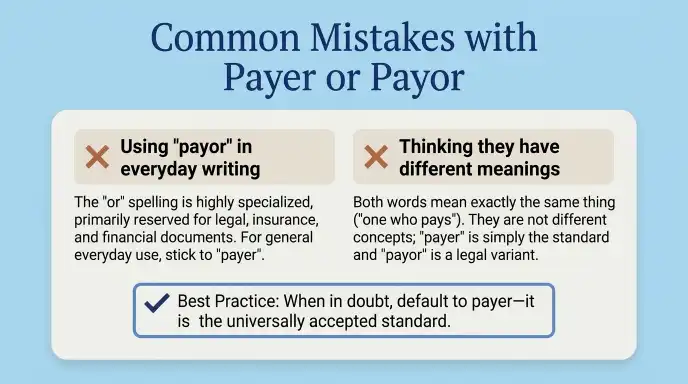
Writers sometimes assume that payer and payor have completely different meanings. In most contexts, they do not. Both describe someone who pays, although professional documents may favor one form.
| Common Mistake | Better Usage | Explanation |
| Treating payor as a spelling error in every context | Recognize both payer and payor | Both forms are accepted. |
| Using different spellings throughout one report | Choose one form and stay consistent | Consistency improves clarity. |
| Assuming payer is only British English | Use payer in general English | It is common in British and American English. |
| Assuming payor is always required in American English | Check the document’s terminology | Payor is a specialized alternative, not a universal requirement. |
| Changing a contract’s defined term without checking | Keep the original defined term | Legal wording may depend on consistent terminology. |
How to Avoid These Mistakes
- Use payer for general English unless you have a reason to choose payor.
- Follow the wording of contracts, forms, and industry style guides.
- Keep one spelling throughout the same document.
- Check how the intended organization uses the term.
- Do not assume that the spelling alone changes the legal meaning.
Payer or Payor in Everyday Examples
News and Reports
Example: “The report identified the payer responsible for the outstanding balance.”
Example: “The insurer acted as the payor for the covered medical service.”
News writers should choose the term that accurately reflects the source or organization they describe.
Social Media and Text Messages
Example: “Who is the payer for this group booking?”
Example: “I need to confirm the payor before submitting the form.”
Payer is usually the simpler choice in casual messages. Payor may appear when people discuss a particular form or payment system.
Insurance and Healthcare
Example: “The insurance payer reviewed the claim.”
Example: “The healthcare provider contacted the payor about the unpaid claim.”
Both spellings appear in healthcare and insurance settings. Follow the terminology used by the insurer, provider, or software system.
Legal and Financial Writing
Example: “The agreement identifies the payor responsible for the scheduled payments.”
Example: “The payer must meet the payment obligations stated in the contract.”
Legal and financial documents may favor one form for consistency. When a contract defines a term, follow its wording instead of changing the spelling without a reason.
Payer or Payor: Google Trends and Usage Data
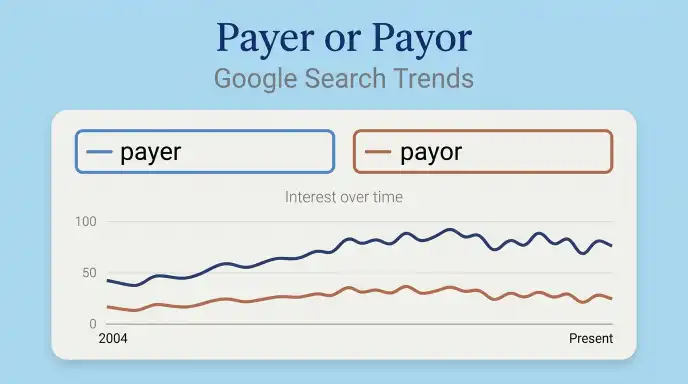
People search for payer or payor because both spellings refer to someone who pays money. The question often arises when someone fills out an insurance form, prepares a legal agreement, reviews a bill, or writes a financial report.
Payer has broad use in general English. Readers commonly see it in billing, banking, business, and everyday financial discussions.
Payor appears frequently in specialized terminology, including some legal, insurance, healthcare, and financial documents. Its use may reflect an organization’s preferred wording rather than a different meaning.
Search interest can vary by country, industry, and document type. However, exact country rankings and search volumes require current Google Trends data. Without checking live data, it would not be accurate to claim that one spelling has a specific percentage advantage in a particular country.
For practical writing, use payer as your default and use payor when your industry, organization, or document calls for it.
Payer vs Payor: Comparison Table
| Category | Payer | Payor |
| Part of speech | Noun | Noun |
| Basic meaning | Person or organization that pays | Person or organization that pays |
| General writing | Preferred default | Less common |
| Legal writing | Accepted | Often used in some documents |
| Insurance and healthcare | Common | Also used |
| Best use | Everyday and general professional writing | When a document or industry prefers this form |
The main difference concerns spelling preference and context. In most cases, payer and payor describe the same role.
Frequently Asked Questions
Q1. Is it payer or payor?
Both payer and payor are correct. Payer is more common in general English, while payor often appears in legal, insurance, healthcare, and financial documents. Choose the spelling that suits your audience or follows the terminology of your organization.
Q2. What does payer mean?
A payer is a person, company, or organization that pays money. The payment may cover a bill, service, debt, or other financial obligation. For instance, a customer who pays an invoice acts as the payer.
Q3. What does payor mean?
A payor is a person or organization that makes a payment. Writers often use this spelling in legal agreements, insurance documents, and financial records. In most situations, payor has the same basic meaning as payer.
Q4. Is payer more common than payor?
Payer is generally more common in everyday English and general professional writing. Payor remains in use in specialized fields. The best choice for a particular document depends on the audience, industry conventions, and any required terminology.
Q5. Is payor correct in American English?
Yes. Payor appears in American legal, insurance, healthcare, and financial writing. However, payer is also correct and widely used in the United States. American English does not require writers to use payor in every payment-related context.
Q6. Should I use payer or payor in a legal document?
Follow the terminology in the contract, legal form, or relevant style guide. Some documents use payor, while others use payer. If the document defines a party using one spelling, keep that spelling consistent throughout the text.
Q7. Does payer mean the same as payor?
In most contexts, yes. Both words describe a person or organization that pays money. Some industries or documents may assign a specific role to one term, so check the relevant definitions when legal or financial accuracy matters.
Conclusion:
When choosing between payer or payor, remember that both spellings are correct and usually share the same meaning. Each word describes a person, company, or organization that pays money. However, payer is more common in general English, making it the best default for most everyday and professional writing.
Payor often appears in legal, insurance, healthcare, and financial documents. Some organizations prefer it as part of their established terminology. That preference does not mean every American or legal document must use payor, nor does it make payer incorrect.
For clear writing, think about your audience and the document’s purpose. Use payer for general communication unless a company, contract, form, or style guide specifies payor. If a document defines a person or organization using one spelling, keep that form consistent throughout the text.
This simple approach helps you avoid unnecessary confusion in emails, reports, invoices, insurance claims, and legal agreements. In short, payer is the safest general choice, while payor is a valid alternative when the context calls for it.

I’m Nora Ellis, an English language writer passionate about making grammar, spelling, and confusing words easy to understand. I share clear explanations and practical examples to help readers improve their English and use words with confidence.