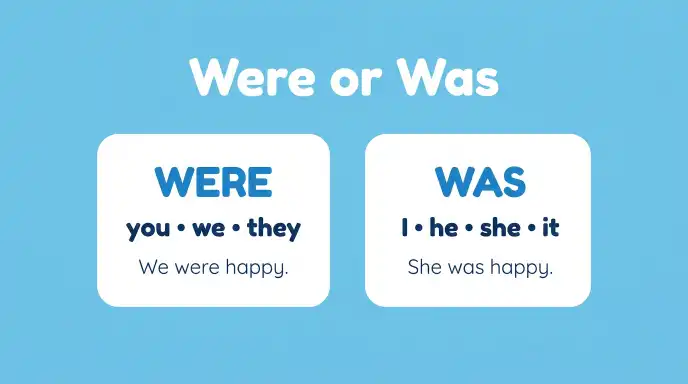
Was and were are both correct, but the right choice depends on the subject and the sentence. Use was with I, he, she, and it in most past-tense statements. Use were with you, we, and they.
Many people search for “were or was” because these two words describe the past, yet they do not fit the same subjects in every sentence.
For Example, you would write “She was happy yesterday” and “They were happy yesterday.” The first sentence uses was because the subject is she. The second uses were because the subject is they.
However, English has an important exception. Writers often use were with singular subjects in unreal or imaginary situations, as in “If I were rich, I would travel the world.” This form can confuse learners who know the basic subject rules.
In this guide, you will learn the meanings of was and were, their grammar rules, and their use in British and American English. You will also see common mistakes, everyday sentences, and answers to frequently asked questions.
Were or Was: Quick Answer
Use was with I, he, she, and it in most simple past-tense statements.
Example: She was tired after work.
Use were with you, we, and they.
Example: They were ready for the meeting.
Use were for unreal or imaginary situations, even with a singular subject.
Example: If I were taller, I could reach the shelf.
The basic rule is simple: choose was or were based on the subject and the meaning of the sentence.
Definition and Meaning of Were or Was
What Does Was Mean?
Was is the past-tense form of the verb be. It usually goes with the singular subjects I, he, she, and it. It can describe a past feeling, condition, place, or action in progress.
Examples:
- I was at home last night.
- She was happy with the result.
- He was a good student.
- It was cold yesterday.
- The child was sleeping when I arrived.
In these sentences, was connects the subject to a past condition or describes something that happened in the past.
What Does Were Mean?
Were is also a past-tense form of be. It usually goes with you, we, and they, as well as plural nouns. It can describe past feelings, conditions, places, and actions in progress.
Examples:
- You were right about the answer.
- We were at the park yesterday.
- They were excited about the trip.
- The children were playing outside.
- My friends were ready to leave.
In each sentence, were agree with the subject.
When Can Were Go with a Singular Subject?
English also uses were in certain unreal, imaginary, or hypothetical statements. This form often appears with if and wish.
Examples:
- If I were rich, I would buy a house.
- I wish she were here.
- If he were more careful, he would make fewer mistakes.
These sentences describe situations that are not real or may not be true. In formal English, were often works best in this type of sentence, even when the subject is singular.
The Origin of Were or Was
The words was and were come from old forms of the English verb be. This verb has an unusual history because English developed several forms for different subjects and tenses.
Over time, was became the usual past form with I, he, she, and it. Were became the usual past form with you, we, and they.
English keeps these different forms because the verb changes according to its subject. Other English verbs often use the same form for different subjects in the past, but work differently.
The special use of were in imaginary situations also comes from an older grammatical pattern. Today, writers still use it in sentences such as “If I were you.” This form helps readers understand that the speaker is imagining a situation rather than describing a simple past fact.
Were or Was: British English vs American English Spelling
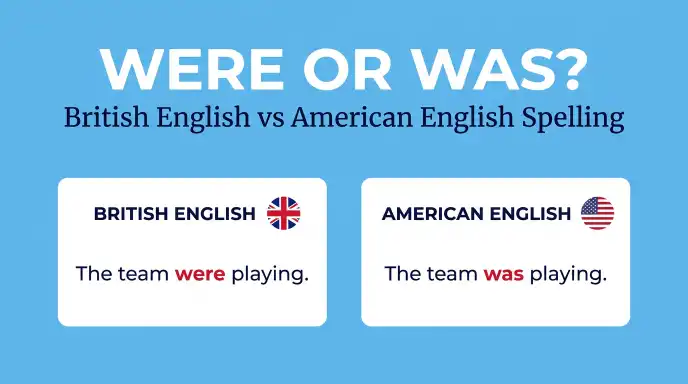
British and American English follow the same basic rules for was and were. Neither country uses a different spelling for these words. The correct choice depends on the subject and the type of sentence.
| Sentence Type | British English | American English |
| Singular subject | She was happy. | She was happy. |
| Plural subject | They were happy. | They were happy. |
| Subject “you” | You were right. | You were right. |
| Unreal condition | If I were rich, I would travel. | If I were rich, I would travel. |
| Past state | It was cold. | It was cold. |
Both varieties are used in the same way in standard English. Some speakers use different forms in casual speech or regional dialects, but formal writing generally follows these rules.
Which Spelling Should You Use?
For American English
Use was with I, he, she, and it in ordinary past-tense statements. Use were with you, we, and they.
Example: “I was busy, but my friends were free.”
For imaginary situations, use were in standard formal English.
Example: “If I were the manager, I would change the schedule.”
For British English
British English follows the same subject rules. Use was for most singular subjects and were for plural subjects and you.
Example: “She was at school, and her classmates were in the library.”
For Canadian and Australian English
Canadian and Australian English generally follow the same standard grammar rules as British and American English.
Example: “The weather was warm, and the children were outside.”
For Global and Academic Writing
If you write for an international audience, follow the standard subject rules. Use was with I, he, she, and it in ordinary statements. We were with you, we, and they.
In hypothetical sentences, were often provided the most suitable choice in formal writing.
Example: “If the results were different, the team would review its plan.”
Always consider the sentence’s meaning before selecting the verb.
Common Mistakes with Were or Was
Writers often confuse was and were because both describe the past. The easiest way to avoid mistakes is to identify the subject first.
| Incorrect Sentence | Correct Sentence | Explanation |
| They was happy. | They were happy. | We were with them. |
| She were late. | She was late. | Use was with she in a normal past statement. |
| We was at home. | We were at home. | We were with each other. |
| I were tired yesterday. | I was tired yesterday. | Use was for a normal past statement with I. |
| If I was rich, I would travel the world. | If I were rich, I would travel the world. | Where is the standard formal choice for this unreal condition. |
| You were correct. | You were correct. | We were with you. |
How to Avoid These Mistakes
- Find the subject before choosing the verb.
- Use was with I, he, she, and it in ordinary past statements.
- We were with you, we, and they.
- Uses were in formal unreal conditions such as “If I were you.”
- Read the sentence aloud to check if the subject and verb agree.
Were or Was in Everyday Examples
Emails and Workplace Writing
- “I was in a meeting when you called.”
- “We were pleased with your presentation.”
- “The files were ready before the deadline.”
- “She was responsible for the final report.”
These sentences use was and were according to their subjects.
News Reports
- “The roads were busy during the morning rush.”
- “The mayor was present at the event.”
- “Several buildings were damaged by the storm.”
- “The final result was announced on Monday.”
News writers use these forms to describe past events and conditions.
Social Media and Text Messages
- “I was so tired last night!”
- “We were happy to see everyone.”
- “Where were you yesterday?”
- “It was such a fun day.”
These examples show how and were appear in everyday conversation.
Formal and Academic Writing
- “The study was completed in June.”
- “The participants were asked to answer five questions.”
- “The main findings were consistent with earlier research.”
- “If the sample were larger, the results might be more reliable.”
Formal writing follows the same basic grammar rules. The writer must also consider if a sentence describes a fact or an unreal condition.
Were or Was: Google Trends and Usage Data
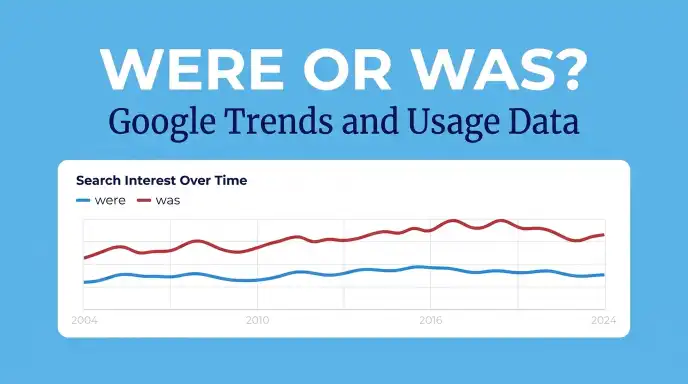
People search for were or was because English learners and native speakers sometimes struggle with subject-verb agreement. The words have similar meanings, but grammar determines which one fits a sentence.
Both words appear in writing and speech across the United States, the United Kingdom, Canada, Australia, and other English-speaking regions. Their use depends mainly on the subject and the sentence structure, not on regional spelling differences.
Was often appears with singular subjects in past-tense statements. Were often appears with plural subjects, the pronoun you, and unreal conditions such as “If I were you.”
Search interest can change by country, season, and learning context. Without checking current Google Trends data, it would not be accurate to provide exact search volumes or country rankings. The most useful approach is to learn the grammar rule and practise it with real sentences.
Were vs. Was: Comparison Table
| Feature | Was | Were |
| Main use | Past form of be with many singular subjects | Past form of be with plural subjects and you |
| Common subjects | I, he, she, it | You, we, they |
| Singular noun | The dog was hungry. | Usually not used in ordinary statements |
| Plural noun | Usually not used in ordinary statements | The dogs were hungry. |
| Unreal condition | If I was there, I do not remember. | If I were there, I would help. |
| Question | Was she ready? | Were they ready? |
| Negative form | Was not / wasn’t | Were not / weren’t |
The key difference is subject agreement. However, hypothetical sentences can use were with a singular subject because the sentence expresses an unreal or imagined situation.
Frequently Asked Questions
Q1. Is it were or was?
Both were and was are correct, but they fit different subjects and sentence types. Use was with I, he, she, and it in ordinary past statements. We were with you, we, and they. For unreal conditions, writers often use were, as in “If I were you.”
Q2. Should I say “I was” or “I were”?
Use “I was” when you describe a real past situation.
Example: “I was tired yesterday.”
Use “I were” in certain unreal or hypothetical statements.
Example: “If I were rich, I would travel the world.”
The correct choice depends on if you describe a past fact or imagine a different situation.
Q3. Is “if I were” grammatically correct?
Yes. “If I were” is the standard form for many unreal or hypothetical situations. It appears in sentences such as “If I were you, I would apologise.” The sentence describes an imagined situation, not a real past event.
Q4. Do we use was or were with you?
Use were with you, if you address one person or several people.
Example: “You were right.”
In standard English, you do not normally say “You was” in formal writing. The rule stays the same even when you speak to only one person.
Q5. Do British and American English use was and were differently?
No major difference exists in standard British and American English. Both varieties use was and were according to the subject and sentence meaning. Regional dialects may use different forms in casual speech, but formal writing generally follows standard subject-verb agreement.
Q6. Which is correct: “they was” or “they were”?
“They were” is correct in standard English. The pronoun they took were in the past tense.
Example: “They were happy to see their friends.”
Use were in schoolwork, professional emails, formal writing, and other situations that require standard grammar.
Q7. Can I use were with a singular subject?
Yes. You can use were with a singular subject in many unreal or hypothetical statements.
Example: “If she were here, she would help us.”
In ordinary past statements, however, use was with she. The sentence’s meaning determines which form fits.
Conclusion:
Choosing between were or was becomes easier when you identify the subject and understand the sentence’s meaning. Use was with I, he, she, and it in ordinary past-tense statements. Use were with you, we, and they. These rules apply in standard British, American, Canadian, and Australian English.
Remember that English is also used in many unreal or hypothetical statements. For instance, “If I were you” is the standard form when you imagine being in another person’s situation. This use differs from a normal past statement such as “I was at home yesterday.”
To avoid errors, check the subject before you choose the verb. Then ask yourself if the sentence describes a real past event or an imagined situation. This simple habit can improve your writing in school assignments, emails, reports, and everyday messages. With practice, you will learn to use was and were correctly and express past events more clearly.

I’m Nora Ellis, an English language writer passionate about making grammar, spelling, and confusing words easy to understand. I share clear explanations and practical examples to help readers improve their English and use words with confidence.