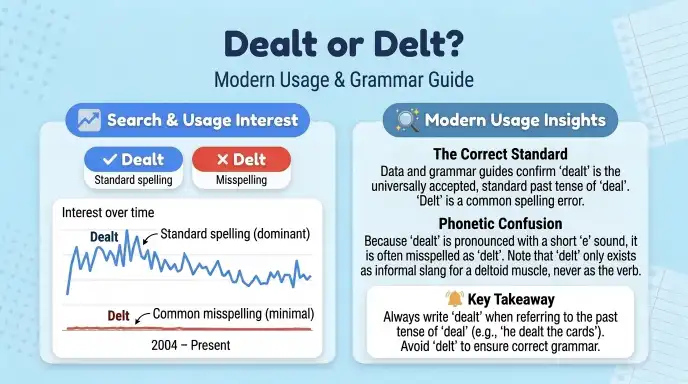
Dealt is the correct spelling, while delt is a common misspelling. Dealt is the past tense and past participle of the verb deal, which means to handle, manage, give, or distribute something.
For example, you can say, “She dealt with the problem quickly.” The word delt is not a standard spelling of this verb in modern English. Many people search for dealt or delt because these words sound similar in casual speech. They may also be unsure how to spell the past tense of deal.
English has many irregular verbs, and their past forms do not always follow a simple rule. Deal becomes dealt, just as feel becomes felt and mean becomes meant. Knowing the difference helps you write more clearly in school assignments, emails, business reports, and everyday messages.
If you are describing a difficult situation, explaining how someone handled a task, or talking about a card game, dealt is the form you should use. In this guide, you will learn the meanings, origins, grammar rules, common mistakes, and practical examples of dealt and delt.
Dealt or Delt : Quick Answer
Dealt is the correct spelling in standard English. Delt is generally a misspelling when used as the past tense of deal.
- Dealt: The past tense and past participle of deal.
- Delt: A nonstandard spelling that should usually be avoided.
Examples:
- Correct: She dealt with the complaint.
- Incorrect: She delt with the complaint.
- Correct: He dealt the cards to each player.
- Incorrect: He delt the cards to each player.
Easy rule: Always use dealt when writing about the past actions of the verb deal.
Definition and Meaning of Dealt or Delt
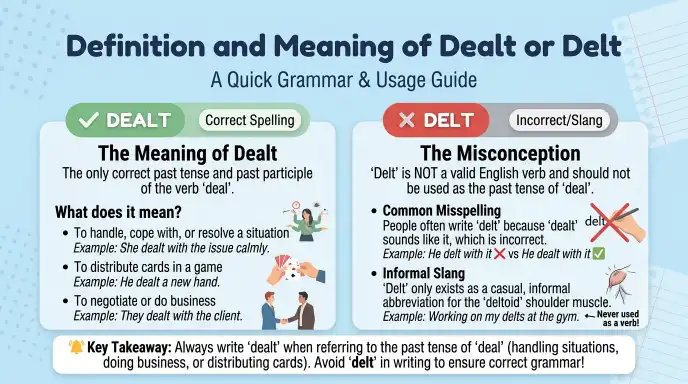
Understanding the meanings of these words will help you choose the correct spelling in different situations.
What Does Dealt Mean?
Dealt is the past tense and past participle of deal. It has several meanings, depending on the sentence.
To handle or manage something
Use dealt when someone handled a problem, task, or situation.
Examples:
- She dealt with the issue calmly.
- The manager dealt with the complaint.
- He dealt with the challenge professionally.
To distribute or give something
Dealt can describe giving something to people or distributing items.
Examples:
- The teacher dealt out the worksheets.
- The dealer dealt five cards to each player.
- The charity dealt supplies to the families.
To do business or trade
Deal can also mean to buy, sell, or trade goods. Its past form is dealt.
Examples:
- The company dealt in used cars.
- They dealt with several local suppliers.
- The shop dealt in rare books.
To cause or deliver an effect
Dealt can also describe delivering a result, blow, or impact.
Examples:
- The news dealt a heavy blow to the team.
- The storm dealt serious damage to the area.
- His decision dealt a setback to the project.
What Does Delt Mean?
Delt is not the standard past tense of deal. In ordinary English writing, it is considered a spelling mistake.
For example:
- Incorrect: She delt with the problem.
- Correct: She dealt with the problem.
Although delt may appear in informal messages, usernames, or specialized contexts, it should not replace dealt in standard writing.
Dealt vs Delt: Meaning at a Glance
| Word | Meaning | Correct usage |
| Dealt | Past tense of deal | She dealt with the issue. |
| Delt | Nonstandard spelling of dealt | Avoid it in standard writing. |
Remember: If you mean that someone handled, distributed, or traded something in the past, write dealt.
The Origin of Dealt or Delt
The word dealt has a long history in the English language. Its spelling comes from the development of the verb deal and its irregular past-tense form.
Origin of Deal and Dealt
The verb deal comes from Old English dǣlan, which meant to divide, share, or distribute. Over time, its meaning expanded to include handling situations, conducting business, and distributing cards.
The past-tense form developed as dealt. English has kept this irregular form for centuries.
Examples include:
- She dealt the cards.
- He dealt with the problem.
- They dealt fairly with their customers.
Why Is Dealt Spelled with a T?
English has many irregular verbs whose past forms do not follow the usual pattern of adding -ed.
For example:
- Feel becomes felt.
- Keep becomes kept.
- Mean becomes meant.
- Deal becomes dealt.
These forms developed through historical changes in English. They must be learned as standard verb forms.
Why Do People Write Delt?
People may write delt because they hear a short sound at the end of dealt. Others may assume that the word follows a simpler spelling pattern.
However, standard English uses dealt, not delt, for the past tense and past participle of deal.
British English vs American English Spelling
British English and American English both use dealt. There is no regional spelling difference between these forms.
The correct spelling remains the same if you are writing for readers in the United States, the United Kingdom, Canada, or Australia.
British English Examples
- She dealt with the matter quickly.
- The shop dealt in household goods.
- He dealt the cards to the players.
American English Examples
- He dealt with the problem directly.
- The company dealt with several suppliers.
- She dealt the cards before the game began.
Both varieties follow the same spelling and grammar rules.
British vs American English Comparison Table
| Feature | British English | American English |
| Correct spelling | Dealt | Dealt |
| Incorrect spelling | Delt | Delt |
| Present tense | Deal | Deal |
| Past tense | Dealt | Dealt |
| Past participle | Dealt | Dealt |
| Regional difference | None | None |
Which spelling should you use? Use dealt in both British and American English. Avoid delt in formal and professional writing.
Dealt or Delt: Which Spelling Should You Use?
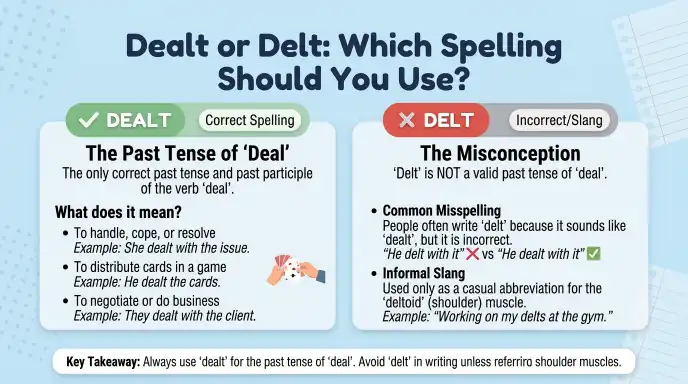
The correct choice is dealt, regardless of your audience or location. Your writing purpose may change the tone of your sentence, but it does not change the standard spelling.
For American English
Use dealt in schoolwork, emails, reports, and everyday writing.
Examples:
- The team dealt with the problem.
- She dealt the cards to her friends.
For British English and Commonwealth Countries
The same spelling applies in the United Kingdom, Canada, Australia, and other English-speaking regions.
Examples:
- He dealt with the request.
- The business dealt in imported goods.
For International Readers
If you write for a global audience, choose dealt because it is the accepted spelling across standard varieties of English.
Example:
- The company dealt with the complaint fairly.
For Academic and Professional Writing
Always use dealt in essays, reports, formal emails, and business documents.
Incorrect: The manager delt with the issue.
Correct: The manager dealt with the issue.
Professional tip: When checking your work, look for delt and replace it with dealt if you mean the past tense of deal.
Common Mistakes with Dealt or Delt
Writers sometimes misspell dealt because they are unsure about irregular verbs. These examples show common errors and their corrections.
Writing Delt Instead of Dealt
Incorrect: She delt with the customer complaint.
Correct: She dealt with the customer complaint.
Why? Dealt is the standard past tense of deal.
Using Delt in Formal Writing
Incorrect: The company delt with the problem quickly.
Correct: The company dealt with the problem quickly.
Why? Formal writing requires the accepted spelling.
Confusing Deal and Dealt
Incorrect: Yesterday, he deal with the problem.
Correct: Yesterday, he dealt with the problem.
Why? The word yesterday shows that the action happened in the past.
Using Dealed Instead of Dealt
Incorrect: She dealed the cards to the players.
Correct: She dealt the cards to the players.
Why? Deal is an irregular verb. Its past tense is dealt, not dealed.
Using the Wrong Form After Has or Have
Incorrect: She has deal with the issue.
Correct: She has dealt with the issue.
Why? The present perfect tense uses has or have with the past participle. The past participle of deal is dealt.
Common Errors and Corrections Table
| Incorrect form | Correct form | Reason |
| Delt with the problem | Dealt with the problem | Standard spelling |
| He deal yesterday | He dealt yesterday | Past tense required |
| Dealed the cards | Dealt the cards | Irregular verb |
| Has deal with it | Has dealt with it | Past participle required |
| They delt fairly | They dealt fairly | Correct spelling |
Easy memory trick: Remember the pattern deal, dealt, dealt. Learning all three forms together will help you avoid spelling errors.
Dealt or Delt in Everyday Examples
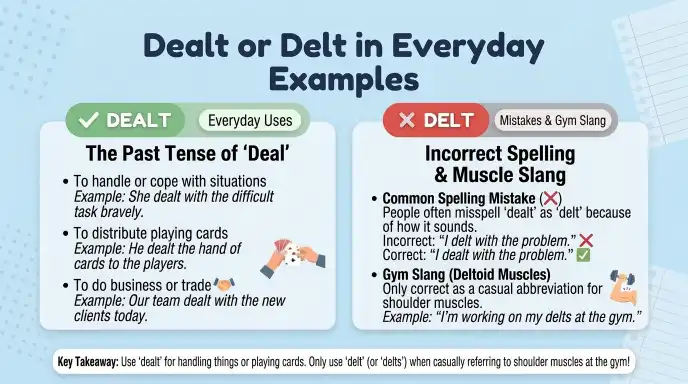
The word dealt appears in many types of writing. It can describe handling a problem, distributing items, trading goods, or delivering an effect.
In Emails
Use dealt when describing a completed task or a problem that someone handled.
Examples:
- I have dealt with your request.
- The team dealt with the issue this morning.
- She dealt with the customer complaint professionally.
These examples work well in business communication.
In News Writing
News reports often use dealt to explain how a person, group, or event affected a situation.
Examples:
- The court dealt with the case on Monday.
- The storm dealt a serious blow to local farms.
- Officials dealt with the emergency during the night.
On Social Media
In casual posts, dealt can describe challenges, experiences, and games.
Examples:
- “I dealt with a tough day, but I kept going.”
- “The cards were dealt, and the game began.”
- “She dealt with the situation like a pro.”
Even in informal writing, dealt remains the correct spelling.
In Formal Writing
In reports and academic work, dealt often describe how a subject or issue was handled.
Examples:
- The committee dealt with each complaint separately.
- The study dealt with several key questions.
- The organization dealt fairly with its employees.
In Everyday Conversation
Here are a few natural examples:
- He dealt with the problem himself.
- She dealt the cards before dinner.
- They dealt with the changes calmly.
- The news dealt a major blow to the team.
Everyday Usage Comparison Table
| Context | Example |
| Home | She dealt with the broken appliance. |
| Office | The manager dealt with the complaint. |
| School | The teacher dealt with the question. |
| Card games | He dealt five cards to each player. |
| News | The storm dealt serious damage to the region. |
| Business | The company dealt in imported goods. |
Dealt or Delt : Google Trends and Usage Data
People search for dealt or delt when they want to confirm the correct spelling or learn the past tense of deal. This is mainly a spelling and grammar question.
Search interest may vary by country, time, and context. Without current Google Trends data, it would be misleading to claim exact search volumes or rank countries by popularity.
Why Do People Search for Dealt or Delt?
Common reasons include:
- Spelling checks: Writers want to know if dealt or delt is correct.
- Grammar learning: Students study irregular verbs and past-tense forms.
- School assignments: Learners want to avoid spelling mistakes.
- Professional writing: Workers need accurate language in emails and reports.
- English learning: Non-native speakers may find irregular verb forms confusing.
Usage Across English-Speaking Countries
The accepted spelling is the same across major English-speaking regions.
| Country or region | Standard spelling |
| United States | Dealt |
| United Kingdom | Dealt |
| Canada | Dealt |
| Australia | Dealt |
| International English | Dealt |
Which Word Is Correct in Modern English?
Dealt is the standard spelling of the past tense and past participle of deal. Delt is generally an error when used with this meaning.
For example:
- Correct: We dealt with the issue.
- Incorrect: We delt with the issue.
How to Check Google Trends
To explore search interest, compare “dealt or delt,” “deal past tense,” and “dealt meaning” over the same time period and in the same country.
Google Trends shows relative search interest rather than exact search volume. It can help you understand what people search for, but it does not determine which spelling is correct.
Dealt or Delt: Final Comparison Table
Use this table for a quick review of the spelling, meaning, and grammar.
| Feature | Dealt | Delt |
| Standard spelling | Yes | No |
| Past tense of deal | Yes | No |
| Past participle of deal | Yes | No |
| Suitable for formal writing | Yes | No |
| Example | She dealt with the problem. | She delt with the problem. |
| Recommendation | Use this form | Avoid this form |
Final rule: Write dealt whenever you mean the past tense or past participle of deal.
FAQs About Dealt or Delt
Q1. Is dealt or delt correct?
Dealt is correct in standard English. It is the past tense and past participle of deal. Delt is generally a misspelling when used with this meaning.
Example: She dealt with the problem quickly.
Q2. What does dealt mean?
Dealt means handled, managed, distributed, or traded something, depending on the context. It is the past form of deal.
Example: He dealt with the complaint professionally.
Q3. Is delt a real word?
Delt may appear in names or specialized contexts, but it is not the standard past tense of deal. In ordinary English writing, use dealt.
Q4. What is the past tense of deal?
The past tense of deal is dealt.
Example: “Yesterday, we dealt with several problems.”
The past participle is also dealt with, as in “We have dealt with the problem.”
Q5. Why is dealt spelled with a T?
English has irregular verbs whose past forms do not follow the usual pattern of adding -ed. Deal becomes dealt, just as feel becomes felt and keep becomes kept.
Q6. Is dealt correct in British and American English?
Yes. Both British English and American English use dealt. There is no standard regional spelling difference between the two varieties.
Q7. Is it dealt with or delt with?
The correct phrase is dealt with.
Example: “The manager dealt with the complaint.”
Use dealt with when describing how someone handled a person, issue, or situation.
Q8. How can I remember dealt or delt?
Remember the three verb forms: deal, dealt, dealt. The same spelling is used for both the past tense and past participle. If you are writing about a past action involving a deal, choose dealt.
Conclusion: Dealt or Delt
The difference between dealt and delt is simple: dealt is the correct spelling in standard English, while delt is generally a misspelling of the past tense of deal. Dealt can mean handling a problem, distributing something, trading goods, or delivering an effect. The intended meaning depends on the sentence.
Remember the verb forms deal, dealt, dealt. Use dealt when describing a completed action, such as “She dealt with the complaint” or “He dealt the cards.” You can also use dealt with has or have to form the present perfect, as in “They have dealt with the issue.”
British English and American English follow the same spelling rule. You should use dealt in school assignments, business emails, formal reports, social media posts, and everyday communication.
If you are unsure, check if you mean the past action of dealing with or distributing something. If you do, dealt is the word to use. Learning this simple irregular verb form will help you avoid common mistakes and make your writing clearer, more accurate, and more professional.

I’m Nora Ellis, an English language writer passionate about making grammar, spelling, and confusing words easy to understand. I share clear explanations and practical examples to help readers improve their English and use words with confidence.





3 thoughts on “Dealt or Delt: Meaning, Usage, and Examples in English”