Won’t is the correct spelling when you mean “will not,” while wont is a real word with a different meaning. People often search for “wont or won’t” because the two forms look almost the same.
The apostrophe changes the meaning, so choosing the right form matters in everyday writing. For example, you might write, “I won’t forget your birthday.” This means you will not forget it. However, in a sentence such as “She is wont to wake up early,” wont means that she is used to doing something. This use is less common in modern English.
Both forms are valid, but they do not work in the same situations. Writers often leave out the apostrophe by mistake when typing quickly, texting, or writing online. Others may not know that wont has a separate meaning.
This guide explains the definitions, origins, spelling rules, common mistakes, and everyday uses of wont and won’t. You will also learn which form to choose in American, British, and international English.
Wont or Won’t: Quick Answer
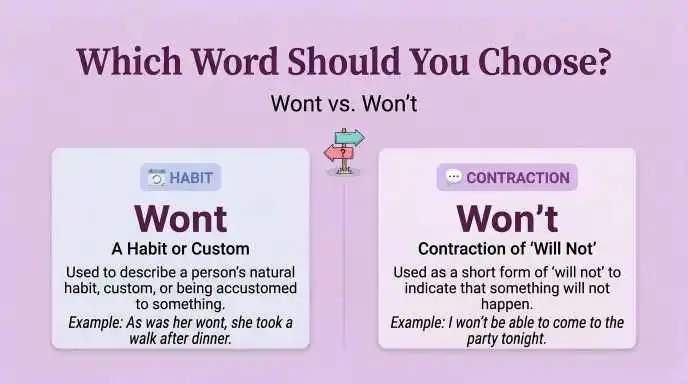
Won’t is a contraction of will not.
Example: I won’t be late for the meeting.
Wont means accustomed to something or describes a usual habit. This word appears mostly in formal or literary writing.
Example: She wants to take a walk every morning.
Quick rule: Use won’t when you mean “will not.” Use wont when you mean accustomed to a habit or action.
Definition and Meaning of Wont or Won’t
What Does Won’t Mean?
Won’t is the contraction of will not. Writers use it to make a negative statement about the future, a refusal, or something a person does not expect to happen.
Examples:
- I won’t attend the meeting tomorrow.
- He won’t answer my calls.
- They won’t change their plans.
- The car won’t start.
In each sentence, won’t means “will not.” The apostrophe replaces the missing letters in the contraction.
What Does Wont Mean?
Wont means accustomed to something or likely to do something as a habit. It often appears in the phrase “be wont to.” Modern writers use it less often than common words such as used to or usually.
Examples:
- She wants to arrive early.
- He wanted to share stories after dinner.
- The writer wanted to use simple language.
These sentences describe habits or regular behavior. They do not express the future negative meaning of won’t.
The Main Difference Between Wont and Won’t
The main difference is meaning and punctuation. Won’t means “will not,” while wont refers to a habit or something familiar.
The apostrophe is important because it helps readers understand your message. In most everyday writing, you will need won’t far more often than wont.
The Origin of Wont and Won’t
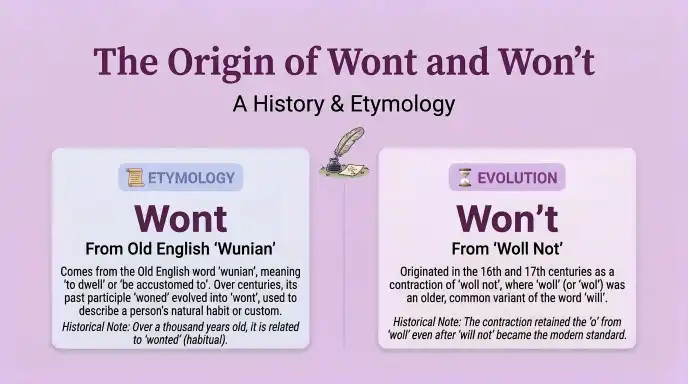
The word wont comes from an older English word related to being accustomed to doing something. English speakers used it to describe habits, customs, and familiar actions. Although the word still exists, modern writers often choose simpler phrases such as “used to” or “usually.”
Won’t developed as a shortened form of will not. English often combines words into contractions to make speech and writing more natural. In won’t, the apostrophe marks the letters left out of the full phrase.
The spelling may seem unusual because won’t does not look like a simple shortening of will not. However, it became the standard contraction over time.
Today, the two forms have different jobs. Wont refers to a habit or custom, while won’t expresses refusal or a negative future action.
British English vs American English Spelling
British and American English use wont and won’t in the same way. Neither variety removes the apostrophe from won’t when the writer means “will not.”
| Context | British English | American English |
| Negative future statement | I won’t go. | I won’t go. |
| Refusal | She won’t help. | She won’t help. |
| Habit or custom | He doesn’t want to complain. | He doesn’t want to complain. |
| Informal message | We won’t be late. | We won’t be late. |
There is no regional spelling difference between British and American English for these words. The apostrophe and the sentence’s meaning determine the correct choice.
Which Spelling Should You Use?
For American English
Use won’t when you mean “will not.” It is common in conversation, emails, messages, and everyday writing.
Example: “I won’t be available after 5 p.m.”
Use wont only when you mean a habit or customary behavior.
For British English
British English follows the same rule. Write won’t for the contraction and wont for the less common word about habits.
Example: “We won’t need extra chairs.”
For Canada and Australia
Canadian and Australian English also use won’t and wont in the same way. You do not need to change the spelling for these audiences.
For Global and Formal Writing
For an international audience, choose won’t when you mean “will not.” In very formal writing, you may prefer not because it sounds more formal and direct.
Use wont only when its meaning fits the sentence. Since many readers rarely see this word, accustomed to or usually may communicate your idea more clearly.
Common Mistakes with Wont or Won’t
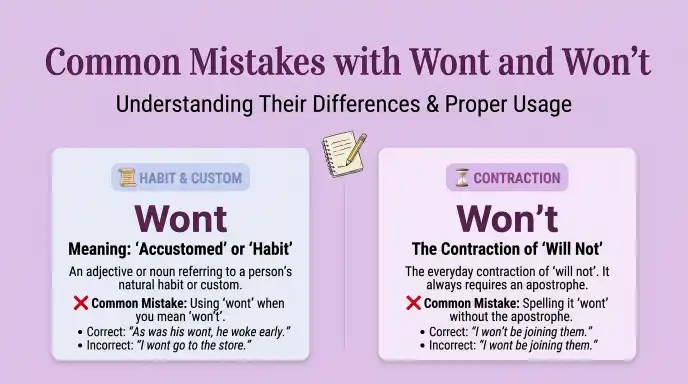
Writers often leave out the apostrophe in won’t. Others use wont when they want to express a future negative action. These mistakes can change the meaning of a sentence.
| Incorrect or Confusing Sentence | Correct Sentence | Explanation |
| I wont go to school tomorrow. | I won’t go to school tomorrow. | Won’t means “will not.” |
| She wont answer the phone. | She won’t answer the phone. | The apostrophe is required in the contraction. |
| He won’t wake up early. | He is wont to wake up early. | Wont describes a habit and needs the correct sentence structure. |
| They wont be attending. | They won’t be attending. | Won’t make the statement negative. |
| I wont forget your help. | I won’t forget your help. | Use won’t for a future negative action. |
How to Avoid These Mistakes
- Use won’t when you can replace it with will not.
- Use wont only when you mean accustomed to a habit or custom.
- Check your apostrophes before publishing or sending a message.
- In everyday writing, consider using usually or accustomed to instead of the less familiar wont.
- Read the sentence aloud to check its meaning.
Wont or Won’t in Everyday Examples
Emails and Workplace Writing
- “I won’t be able to attend today’s meeting.”
- “We won’t approve the request until we receive the final report.”
- “I won’t forget to send the updated file.”
These examples use won’t to express a future action that will not happen.
News and Reports
- “The company says it won’t raise prices this month.”
- “The team won’t release the results until Friday.”
- “The report notes that the author was wont to question old methods.”
News writers usually use won’t for negative statements. They may use wont in formal or historical descriptions of habits.
Social Media and Text Messages
- “I won’t miss this concert!”
- “She won’t believe what happened.”
- “I won’t be online tonight.”
Won’t fits casual messages because it sounds natural and direct.
Formal and Academic Writing
- “The study won’t include data from the final week.”
- “The author was wont to challenge common assumptions.”
- “The committee will not publish its decision until it completes the review.”
In highly formal writing, will not may suit your tone better than won’t. Use wont only when its older meaning fits the sentence.
Wont or Won’t: Google Trends and Usage Data
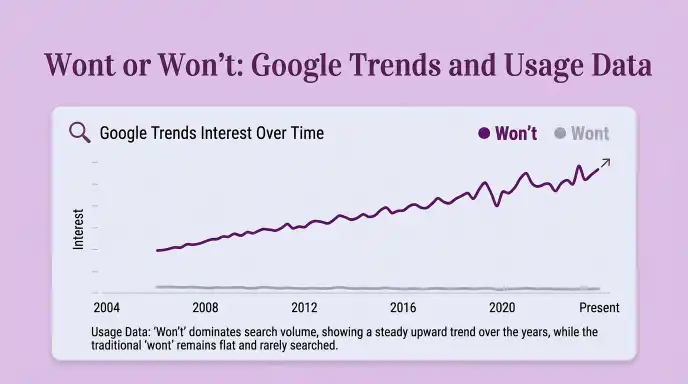
People search for wont or won’t because they want to know if the apostrophe changes the spelling or meaning. The question often comes up when people type quickly, edit a document, or check a sentence.
Won’t appear much more often in everyday English because speakers use it to mean “will not.” It occurs in conversations, emails, news reports, schoolwork, and social media posts.
Wont appears less often in modern writing. Readers are more likely to find it in literary works, older texts, or formal descriptions of habits and customs.
Both forms appear in British, American, Canadian, and Australian English. The main difference comes from meaning rather than location.
Exact search volumes and country rankings require current Google Trends data. Without checking that data, it would not be accurate to provide specific numbers or claim that one country searches for the term more than another.
Wont vs. Won’t: Comparison Table
| Word | Meaning | Common Use | Example |
| Won’t | Will not | Everyday writing and speech | I won’t leave early. |
| Wont | Accustomed to a habit or custom | Formal or literary writing | She wants to read at night. |
| Will not | Full form of won’t | Formal statements | I will not attend the event. |
| Usually | Happening in most cases | Everyday descriptions of habits | He usually walks to work. |
The most important distinction is simple: won’t express a negative action, while wont describe a habit or customary behavior.
Frequently Asked Questions
Q1. Is it wont or won’t?
Both spellings are correct, but they have different meanings. Won’t means “will not,” while wont means accustomed to a habit or custom. In everyday writing, you will usually need to.
Q2. What does won’t mean?
Won’t is the contraction of will not. It expresses a future negative action, a refusal, or something that will not happen. Example: “I won’t attend the meeting” means “I will not attend the meeting.”
Q3. What does wont mean without an apostrophe?
Wont means accustomed to something or likely to follow a habit. It often appears in the phrase “be wont to.” Example: “He wants to arrive early” means he is accustomed to arriving early.
Q4. Is wont a real word?
Yes. Wont is a real English word, although people use it less often today. It describes a habit or custom. Many modern writers prefer clearer alternatives such as usually, accustomed to, or used to.
Q5. Do British and American English use wont and won’t differently?
No. British and American English follow the same spelling and meaning rules. Both use won’t for “will not” and wont for a habit or custom. The choice does not depend on the country.
Q6. Why does won’t it have an apostrophe?
The apostrophe marks letters left out of the full phrase will not. Contractions use apostrophes to show missing letters. In won’t, the apostrophe is part of the standard spelling, so writers should not leave it out when they mean “will not.”
Q7. Can I use won’t in formal writing?
Yes. Won’t is grammatically correct in formal writing, but some academic or highly formal styles prefer will not. Follow the style guide for your work. Use wont only when you mean a habit or customary behavior.
Conclusion:
When choosing between wont or won’t, focus on the meaning of your sentence. Won’t is the correct choice when you mean “will not.” It is common in everyday conversation, emails, news reports, social media, and many types of professional writing. Remember the apostrophe because it forms part of the standard contraction.
Wont is also correct, but it has a different and less common meaning. It describes something that a person is accustomed to doing or a habit they often follow. You may see it in literary writing or formal descriptions, but many readers find words such as usually and accustomed to easier to understand.
British, American, Canadian, and Australian English follow the same basic rules. You do not need to change either spelling for a regional audience. If you can replace the word with “will not,” choose won’t. If you mean a habit or custom, wont may fit. This simple check will help you choose the correct form and make your writing clear.

I’m Nora Ellis, an English language writer passionate about making grammar, spelling, and confusing words easy to understand. I share clear explanations and practical examples to help readers improve their English and use words with confidence.