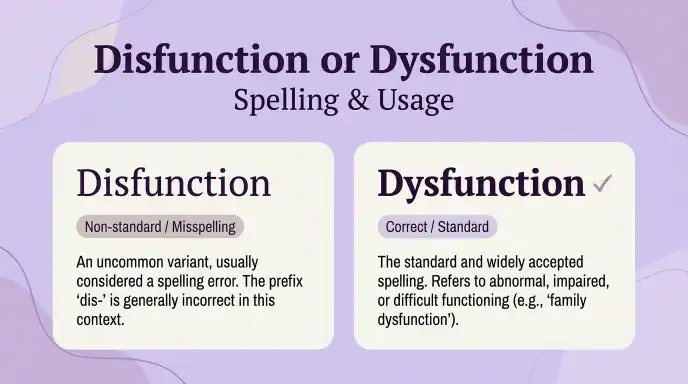
The correct spelling is dysfunction, not disfunction. The word dysfunction describes a problem with how something works, such as a body organ, a relationship, a machine, or an organization.
Although some people write disfunction, this spelling is considered nonstandard in modern English. people search for disfunction or dysfunction because both spellings seem possible. English uses the prefix dys- in words related to difficulty, abnormality, or poor functioning. Examples include dyslexia, dyspepsia, and dysregulation. However, writers sometimes confuse dys- with dis-, another common English prefix.
Choosing the right spelling matters in school assignments, professional emails, medical writing, and everyday communication. Using the standard form helps readers understand your message without distraction. It also makes your writing look more accurate and professional.
In this guide, you will learn the difference between disfunction and dysfunction, their meanings, their origins, and how to use the correct word in real sentences. You will also find common mistakes, practical examples, and answers to frequently asked questions. By the end, you will know which spelling to choose and why dysfunction is the recommended form.
Disfunction or Dysfunction: Quick Answer
Dysfunction is the correct and standard spelling in modern English. Disfunction is a nonstandard variant that you should generally avoid in formal and professional writing.
The word dysfunction means that a person, system, organ, or relationship does not work properly.
Example: The team struggled because of poor communication and dysfunction.
Remember this simple rule: use dysfunction when describing something that does not work as it should. This spelling is appropriate for academic writing, medical discussions, workplace communication, and everyday use.
Definition and Meaning of Disfunction or Dysfunction
What Does Dysfunction Mean?
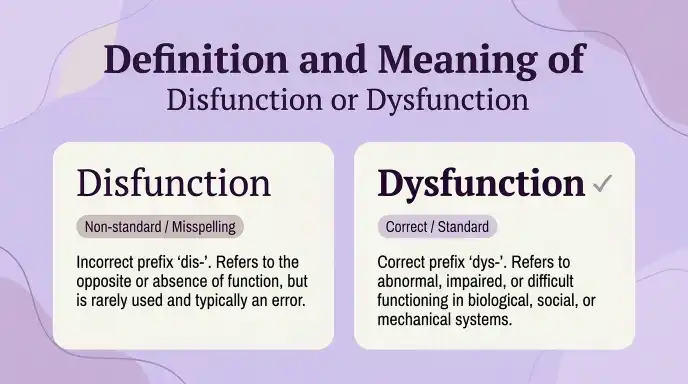
Dysfunction is a noun that describes impaired, abnormal, or ineffective functioning. It can refer to physical problems, emotional difficulties, relationship issues, or systems that fail to work properly.
The meaning depends on the context. In medicine, dysfunction may describe an organ or body system that does not function normally. In a family or workplace, it can describe unhealthy behavior, poor communication, or ineffective cooperation.
Example: The manager addressed the team’s dysfunction by improving communication and setting clear goals.
In this sentence, dysfunction refers to problems that prevent the team from working effectively.
What Does Disfunction Mean?
Disfunction is sometimes used as an alternative spelling of dysfunction, but it is not the standard choice in modern English. Readers may understand what the writer means, yet the spelling can look incorrect in formal documents.
For clear and professional writing, choose dysfunction instead. This is the form commonly used in established English terminology.
Example: The report discussed the department’s dysfunction and suggested ways to improve teamwork.
Using the standard spelling helps you communicate your meaning clearly and avoid unnecessary spelling errors.
The Origin of Disfunction and Dysfunction
The word dysfunction combines the prefix dys- with the word function.
The prefix dys- comes from Greek and conveys a sense of difficulty, impairment, or something being abnormal. The word function refers to the way something works or the purpose it serves.
Together, these parts create dysfunction, meaning impaired or abnormal functioning.
English uses the same prefix in several other words. For example, dyslexia refers to a learning difference that affects reading and related language skills. Dysregulation describes difficulty regulating a process, response, or system.
The spelling disfunction likely arises from confusion with the familiar prefix dis-. That prefix appears in words such as disagree, disorder, and discomfort. However, the spelling of one word does not automatically determine the spelling of another.
For this reason, remember the established spelling: dysfunction.
Disfunction or Dysfunction in British English vs. American English
The standard spelling is dysfunction in both British English and American English. Unlike words such as colour/color or organise/organize, this word does not have a regular British-American spelling difference.
| English Variety | Standard Spelling | Nonstandard Form |
| American English | Dysfunction | Disfunction |
| British English | Dysfunction | Disfunction |
| Canadian English | Dysfunction | Disfunction |
| Australian English | Dysfunction | Disfunction |
| International English | Dysfunction | Disfunction |
Writers in different English-speaking countries should use dysfunction. The spelling remains the same in medical, academic, business, and general writing.
Example: The research paper examined family dysfunction in both British and American communities.
No regional spelling change is needed. Simply use dysfunction regardless of your intended audience.
Disfunction or Dysfunction: Which Spelling Should You Use?
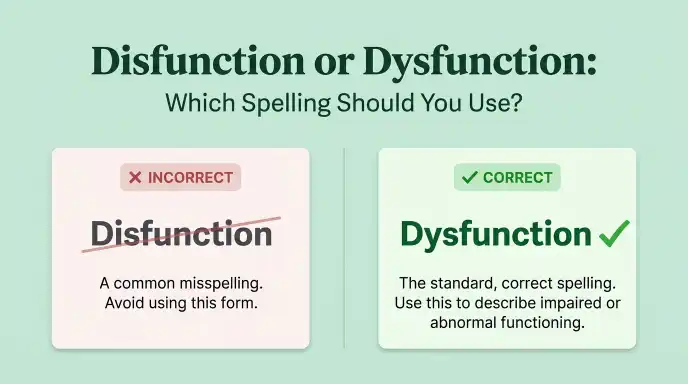
Choose dysfunction in almost every situation. It is the recognized standard form and works in both formal and informal contexts.
In American English
American writers should use dysfunction in schoolwork, reports, emails, and professional documents.
Example: The doctor explained that the symptoms might indicate a problem with thyroid dysfunction.
In British English
British English also uses dysfunction. There is no standard British alternative spelled disfunction.
Example: The article explored how family dysfunction can affect children’s well-being.
In Academic Writing
Academic writing requires consistent spelling and clear terminology. Use dysfunction in essays, research papers, presentations, and assignments.
Example: The study investigated the relationship between sleep dysfunction and daytime concentration.
In Business and Workplace Writing
In the workplace, dysfunction can describe poor teamwork, unclear responsibilities, or ineffective processes. Use the standard spelling in reports and workplace communication.
Example: The supervisor identified communication dysfunction as a major obstacle to completing the project.
In Everyday Communication
You can also use dysfunction when talking about relationships, organizations, or systems that do not work well.
Example: Their ongoing disagreements created dysfunction within the group.
The key point is simple: dysfunction is the preferred spelling for all these situations.
Common Mistakes with Disfunction or Dysfunction
Writers often confuse disfunction and dysfunction because the prefixes dis- and dys- look similar. However, the correct spelling of this word is dysfunction.
| Common Mistake | Correct Form | Explanation |
| disfunction | dysfunction | The standard spelling uses dys-. |
| disfunctional | dysfunctional | The adjective also uses dys-. |
| disfunctioning | dysfunctioning | Use the established spelling when this form is appropriate. |
| dysfunctional relationship | dysfunctional relationship | This phrase describes an unhealthy or ineffective relationship. |
| family disfunction | family dysfunction | The standard noun is dysfunction. |
Mistake: Using Disfunction in Formal Writing
Some writers choose disfunction because it looks logical. However, dysfunction is the standard spelling recognized in modern English.
Example: The counselor helped the family address its dysfunction.
Mistake: Spelling Dysfunctional Incorrectly
The related adjective is dysfunctional, not disfunctional. It describes something that does not function properly or operates in an unhealthy way.
Example: The team changed its dysfunctional working habits to improve cooperation.
Mistake: Assuming British and American English Use Different Spellings
Some English words have regional spelling variations, but dysfunction is not one of them. Both British and American writers use the same spelling.
Example: The British report and the American report both used the term dysfunction.
To avoid these errors, remember that the noun is dysfunction and the adjective is dysfunctional.
Dysfunction in Everyday Examples
The word dysfunction appears in many settings, including healthcare, family life, workplaces, education, and technology. These examples show how to use it naturally.
Examples in Everyday Conversation
People may use dysfunction when discussing a situation that does not work well.
- Example: The family tried to overcome years of dysfunction.
- Example: Poor planning created dysfunction within the group.
- Example: Everyone noticed the dysfunction in their working relationship.
Examples in Emails and Workplace Writing
In professional communication, the word can describe problems with teamwork or business processes.
- Example: We need to address the team’s dysfunction before starting the next project.
- Example: The meeting focused on reducing dysfunction between departments.
- Example: Clearer responsibilities may help resolve the current dysfunction.
Examples in News and Academic Writing
News reports and academic discussions may use dysfunction to explain broader social, political, or organizational problems.
- Example: The report examined political dysfunction and its effect on public services.
- Example: Researchers studied the impact of family dysfunction on children’s development.
- Example: The article described how institutional dysfunction delayed important decisions.
Examples in Medical Contexts
In healthcare, dysfunction can refer to a problem affecting the normal operation of a body part or system. The exact meaning depends on the medical context.
- Example: The specialist evaluated the patient’s kidney dysfunction.
- Example: The doctor explained the possible causes of thyroid dysfunction.
- Example: Treatment focused on managing the condition associated with the organ’s dysfunction.
These sentences demonstrate that dysfunction works across different contexts. The spelling does not change with the subject or setting.
Disfunction or Dysfunction: Google Trends and Modern Usage
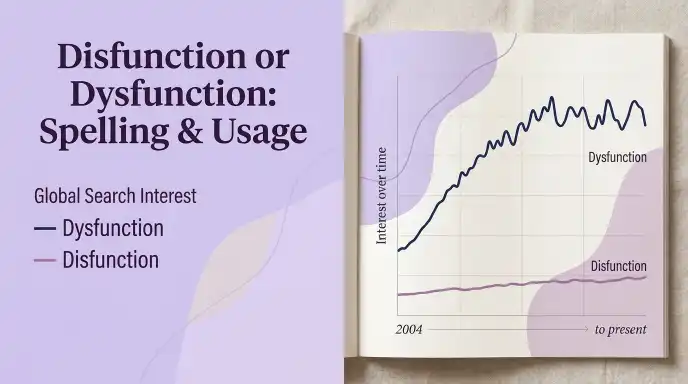
People may search for both disfunction and dysfunction because the spellings look similar. However, search queries alone do not establish which spelling is correct.
The standard spelling is dysfunction. It appears in medical terminology, academic discussions, workplace writing, and everyday English.
The word also forms part of common expressions, including family dysfunction, sexual dysfunction, dysfunctional behavior, and organizational dysfunction. The exact meaning depends on how the term is used.
A live Google Trends comparison has not been checked for this article, so no search-volume figures or popularity percentages are provided. Search interest can change over time and may vary by location.
For spelling decisions, use dysfunction rather than relying on how often a variation appears online. Established usage and the intended meaning matter more than an isolated search result.
Dysfunction vs. Disfunction: Key Differences
The main difference is spelling. Dysfunction is the standard form, while disfunction is generally treated as a nonstandard spelling.
| Feature | Dysfunction | Disfunction |
| Spelling status | Standard | Nonstandard |
| Meaning | Impaired or abnormal functioning | Intended to mean the same thing |
| Formal writing | Recommended | Avoid |
| Academic writing | Recommended | Avoid |
| Medical terminology | Standard form | Not the preferred form |
| British English | Correct | Nonstandard |
| American English | Correct | Nonstandard |
The adjective follows the same pattern: use dysfunctional, not disfunctional, in standard writing.
Remember that the difference is not a British-versus-American spelling rule. Dysfunction is the preferred spelling across major English varieties.
Frequently Asked Questions
Q1. Is disfunction or dysfunction correct?
Dysfunction is the correct standard spelling. Disfunction is a nonstandard variant, so use dysfunction in formal and everyday writing.
Q2. What does dysfunction mean?
Dysfunction means impaired, abnormal, or ineffective functioning. It can describe a body system, relationship, organization, or process that does not work properly.
Q3. Is disfunction a real word?
People sometimes write disfunction, and readers may understand the intended meaning. However, it is not the standard spelling recommended for modern English writing. Choose dysfunction instead.
Q4. Is dysfunction the same in British and American English?
Yes. Both British English and American English use dysfunction. The spelling does not change between these varieties.
Q5. What is the adjective form of dysfunction?
The adjective is dysfunctional. It describes something that does not function properly or involves unhealthy behavior or relationships.
Example: The organization changed its dysfunctional procedures.
Q6. How do you use dysfunction in a sentence?
You can use dysfunction to describe problems in relationships, workplaces, or body systems.
Example: Poor communication contributed to dysfunction within the department.
Q7. Why do people misspell dysfunction as disfunction?
People may confuse the prefix dys- with dis- because both appear in many English words. However, the standard spelling of this noun is dysfunction.
Conclusion:
The correct spelling is dysfunction, not disfunction. Although both forms may appear in online writing, dysfunction is the standard choice in modern English.
The word describes impaired or abnormal functioning. You can use it when discussing health conditions, family relationships, workplace problems, organizations, or systems that do not work properly. Its adjective form is dysfunctional.
There is also no difference between British and American English in this case. Writers in the United States, the United Kingdom, Canada, Australia, and other English-speaking regions should use dysfunction.
To remember the spelling, focus on the prefix dys-, which often relates to difficulty or abnormal functioning. When writing an essay, preparing a report, or sending a professional email, choose the standard form.
In short, use dysfunction for accurate and clear writing. Avoid disfunction when you want your spelling to follow standard modern English usage.

I’m Nora Ellis, an English language writer passionate about making grammar, spelling, and confusing words easy to understand. I share clear explanations and practical examples to help readers improve their English and use words with confidence.





2 thoughts on “Disfunction or Dysfunction: Which Spelling Is Correct?”