Usable or useable? Both spellings are correct, but usable is the more common choice in modern English. Both words have the same meaning and describe something that can be used or is suitable for a particular purpose. However, most writers prefer usable because it is shorter and widely accepted.
This spelling question often comes up when people write emails, school assignments, business reports, product descriptions, and website content. Both forms look correct, so writers may wonder if useable is a mistake or if usable is missing a letter. The confusion comes from the base word use, which ends in the letter e.
In this guide, you will learn the meaning of both words, their origin, their use in British and American English, and the common mistakes to avoid. You will also find practical examples, spelling advice, frequently asked questions, and useful resources.
Usable or Useable: Featured Snippet Answer
Usable and useable are both correct English spellings. They mean fit for use or able to be used. However, usable is more common in modern English and is the preferred choice for most writing. Both forms can appear in British and American English, so choose usable unless a style guide requires another form.
Usable or Useable: Quick Answer
Both usable and useable are correct. They have the same meaning, but one spelling is more common.
- Usable: The preferred spelling in most modern English writing.
- Useable: An accepted alternative spelling.
- Meaning: Fit for use or able to be used.
- Best choice: Use usable when you are unsure which spelling to choose.
Examples:
- The old laptop is still usable.
- We need a usable plan for the project.
- The website has a simple and useable design.
All three sentences are correct. However, many editors would choose usable in the last example because it is the more common spelling.
What Does Usable or Useable Mean?
The words usable and useable are adjectives. They describe something that can be used, works for its intended purpose, or is suitable for use.
Both spellings have the same meaning. The difference is spelling preference, not meaning.
What Does Usable Mean?
Usable means fit for use, available for use, or able to be used for a particular purpose.
For example, a phone with a cracked screen may still be usable if it works properly. A room may be usable if it is safe and suitable for the people who need it.
Examples:
- The chair is old but still usable.
- We need more usable space in the office.
- The instructions should be clear and usable.
- The app has a clean and usable design.
The word can describe objects, tools, space, information, software, plans, and many other things.
What Does Useable Mean?
Useable has the same meaning as usable. It describes something that can be used or is suitable for a purpose.
Examples:
- The damaged table is still useable.
- The team created a useable guide.
- We need a useable version of the report.
These examples are grammatically correct. However, useable is less common than usable, so the shorter spelling is often a better choice for general writing.
When Should You Use These Words?
You can use either spelling when describing something that works or serves a purpose.
Common contexts include:
- Technology: Usable software, usable devices, and usable features.
- Design: Usable websites, layouts, and menus.
- Work: Usable data, reports, and plans.
- Daily life: Usable furniture, tools, and space.
- Education: Usable notes, resources, and examples.
In each case, the spelling does not change the meaning.
Usable vs. Useful
Do not confuse usable with useful. They are related, but they do not mean exactly the same thing.
- Usable means something can be used or is fit for use.
- Useful means something helps you or provides a benefit.
For example, an old computer may be usable because it still works. It may also be useful if it helps you finish your work.
A tool can be usable without being very useful for a particular task. This difference can help you choose the right word.
The Origin of Usable or Useable
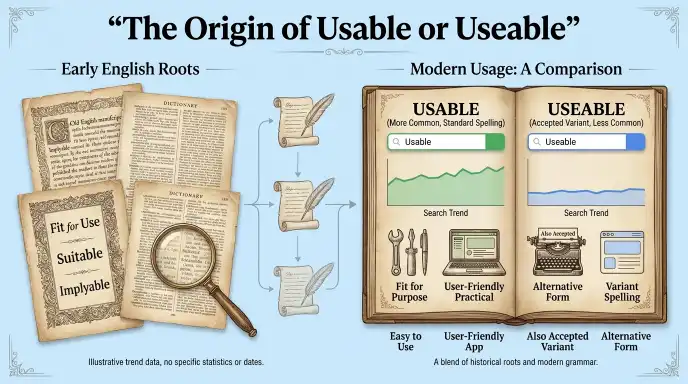
The words usable and useable come from the verb use. The verb has a long history in English and entered the language through French, from Latin usus, meaning use or employment, related to uti, meaning to use.
English forms adjectives by adding endings to base words. The suffix -able often means capable of being or suitable for something.
For example:
- Readable: Able to be read.
- Washable: Able to be washed.
- Understandable: Able to be understood.
- Usable: Able to be used.
The spelling useable keeps the final e from use before adding -able. The spelling usable drops that e. Both forms have been used in English, and both remain acceptable.
English does not follow one perfect rule for every word ending in e. Compare usable with lovable, changeable, and noticeable. Some words keep the final e, while others drop it.
The key point is that usable is not a mistake or an incomplete word. It is an established spelling and the more common choice in modern writing.
British English vs American English
Unlike words such as colour and color, usable and useable are not a clear British-versus-American spelling pair. Both forms can appear in British and American English.
The main difference is frequency and editorial preference. Usable is generally the more common form in both varieties, while useable remains an accepted alternative.
Spelling Comparison Table
| British English | American English | Example |
| Usable | Usable | The room is usable. |
| Useable | Useable | This is a useable tool. |
| Usable is generally preferred | Usable is generally preferred | The software is usable. |
| Useable is an accepted alternative | Useable is an accepted alternative | We need a useable version. |
Does British English Prefer Useable?
No simple rule says that British English must use useable. British writers commonly use usable, and the spelling is widely understood in the UK.
Some writers may prefer useable because it keeps the original word use visible. However, that preference does not make it the standard British form.
Does American English Prefer Usable?
Usable is also the usual choice in American English. It appears naturally in writing about technology, business, education, and daily life.
American editors may accept useable, but they will often choose usable for consistency and common usage.
What About Style Guides?
A dictionary can confirm if a spelling is accepted. A style guide helps writers decide which accepted form to use consistently.
If you are writing for a publisher, school, company, or website, follow its spelling rules. If no rule exists, usable is the clearest default.
Which Version Should You Use?
The best choice is usable. It is widely accepted, easy to read, and suitable for most audiences. Use useable when you have a clear reason to follow that spelling.
United States
For American readers, choose usable in school assignments, business reports, emails, product descriptions, and online content.
Example: The new software is usable on older computers.
United Kingdom
For British readers, usable is also the best general choice. You may see useable in some publications, but it is not required by British spelling rules.
Example: The guide offers clear and usable advice.
Canada
Canadian English includes features from both British and American spelling traditions. In this case, usable is a strong choice because it is common in both varieties.
Example: The team needs usable data before making a decision.
Australia
Australian writers can also use usable as the default. It is clear and familiar to readers, and there is no need to use it simply because you are writing for an Australian audience.
Example: The council plans to create more usable public space.
International Writing
If your readers live in different countries, use usable. It avoids an unnecessary spelling choice and works well in international English.
This is especially helpful for websites, online courses, help pages, and articles that target readers around the world.
Academic Writing
In academic writing, follow your university’s style guide or the spelling used by your journal. If the guide does not specify a preference, use usable.
Example: The researchers collected enough usable data for their analysis.
Business Writing
Use usable in reports, presentations, instructions, and customer communications. It is concise and familiar.
Example: The company needs a usable plan before launching the product.
Best advice: Choose usable for most writing. It is correct, common, and suitable for nearly every audience.
Common Mistakes with Usable or Useable
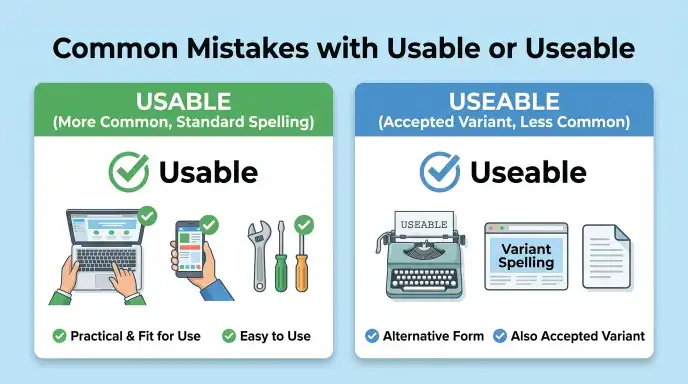
Although both spellings are correct, writers can still make mistakes by choosing the wrong meaning, using an awkward phrase, or changing spellings without a reason.
Thinking Useable Is Always Wrong
Incorrect claim: Useable is never a correct word.
Correct explanation: Both usable and useable are accepted spellings.
Example: The old printer is still useable.
Why it matters: You do not need to mark useable as a spelling error. However, usable is the more common choice.
Thinking Usable Is Missing an E
Incorrect claim: Usable is wrong because the base word is used.
Correct spelling: The file is usable.
Explanation: English spelling does not always keep the final e when adding -able. Usable is an established spelling.
Memory tip: Remember that usable is complete without the extra e.
Confusing Usable with Useful
Less suitable: The instructions are very usable because they help me understand the topic.
Better: The instructions are very useful because they help me understand the topic.
Explanation: Usable focuses on if something can be used. Useful focuses on how much it helps.
Memory tip: Something is usable if you can use it. Something is useful if it helps you.
Using Usable When You Mean Easy to Use
Less clear: The website is usable.
More specific: The website is easy to use.
Explanation: Usable can mean that a website works for its intended purpose. It does not always mean that the website is simple or pleasant to use.
When discussing website design, consider the exact point you want to make.
Mixing Both Spellings in One Document
Inconsistent: The report contains usable figures and useable charts.
Better: The report contains usable figures and usable charts.
Explanation: Both spellings are accepted, but switching between them without a reason can distract readers.
Memory tip: Pick one spelling at the start and use it throughout the document.
Assuming Usable Means Perfect
Incorrect assumption: If a device is usable, it must work perfectly.
Correct explanation: A usable device can still have limits or faults. It only needs to be fit for the purpose in question.
Example: The old phone is damaged, but it is still usable for calls.
Memory tip: Usable means fit for use, not perfect.
Usable or Useable in Everyday Examples
Both spellings can appear in everyday writing. The examples below use usable as the preferred form, while a few also show useable as an accepted alternative.
Emails
Subject: Updated Project File
Hi Sam,
I have checked the latest file. It is now usable, and the main figures are clear.
Please review it before the meeting.
Best,
Alex
Business Writing
The company needs usable data before it can make a final decision.
The new process should create a more usable report for the sales team.
These examples show how the word describes information or documents that can serve a practical purpose.
News Headlines
- New Plan Aims to Create More Usable Public Space
- Updated App Offers a More Usable Design
- Old Equipment Remains Usable After Repairs
These are example headlines, not reports of actual news events.
Blogs
A clear blog layout helps readers find the information they need. Short paragraphs, useful headings, and simple menus can make a website more usable.
The word works well when writing about web design, content, and user experience.
Social Media
- This old laptop is slow, but it is still usable!
- We need a more usable plan for our next project.
- The new app has a clean layout and a usable menu.
In casual writing, people may use either spelling. Still, usable is the simpler default.
Academic Writing
The study included only records that contained usable data.
The researchers created a usable model for testing the results.
In research, usable often means that information is complete or suitable enough for analysis.
Daily Conversation
Person A: Can we still use this table?
Person B: Yes, it is old, but it is still usable.
Another example:
Person A: Is the new app easy to use?
Person B: Yes. It has a simple and usable design.
In normal conversation, people may use the word to describe objects, plans, tools, or information.
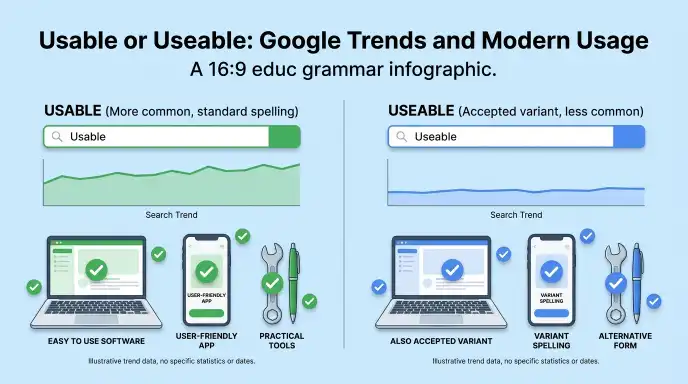
Usable or Useable: Google Trends and Modern Usage
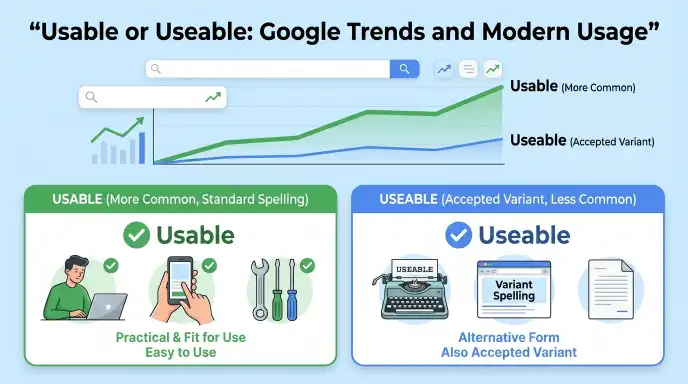
People search for usable or useable because both spellings look reasonable. The base word use ends in e, so some writers expect the adjective to keep that letter. Others have learned the shorter spelling and want to confirm that it is correct.
Regional Popularity
Both spellings appear in English-speaking countries, including the United States, the United Kingdom, Canada, and Australia. Usable is generally the more common spelling, but the exact difference in search interest can vary by country and time period.
There is no need to assume that useable belongs only to one country. It is an accepted alternative rather than a strict regional spelling.
Why Do People Search for This Keyword?
Common reasons include:
- Checking if usable is spelled correctly.
- Finding out if useable is a real word.
- Choosing a spelling for school or university work.
- Editing business documents and website content.
- Learning the difference between usable and useful.
- Following a preferred dictionary or style guide.
What Does Google Trends Tell Us?
Google Trends can compare interest in the search terms usable and useable. It displays relative search interest over a selected period and location, rather than exact total search counts.
Without a current, verified comparison, it would not be accurate to state that one spelling receives a specific number or percentage of searches. The general usage pattern supports usable as the preferred spelling, but that does not replace a live Trends check.
To compare the terms, select both spellings in Google Trends, choose the countries you want to study, and set the same date range for each.
Modern Usage in Technology and Design
The word usable is common in discussions about software, websites, apps, tools, and digital products.
For example:
- Usable design: A design that people can use for its intended purpose.
- Usable data: Data that is suitable for a task or analysis.
- Usable space: Space that can serve a practical purpose.
- Usable interface: An interface that people can operate to complete tasks.
In technology, usability may also appear in discussions of usability, which is the ease and effectiveness with which people use a product or system.
The two terms are related, but they are not identical. Usable describes something that can be used. Usability refers to the quality of the experience when using it.
Usable vs Useable: Quick Comparison Table
| Version | Meaning | Correct? | Region | Example |
| Usable | Fit for use | Yes | US, UK, and international English | The room is usable. |
| Useable | Fit for use | Yes | Used in different varieties of English | The room is useable. |
| Useful | Providing help or benefit | Yes | All major varieties | This guide is useful. |
| Usability | The quality of being easy or effective to use | Yes | All major varieties | The app needs better usability. |
| Unusable | Not fit for use | Yes | All major varieties | The damaged file is unusable. |
The main comparison is simple: usable and useable mean the same thing. Useful, usability, and unusable have related but different meanings.
Key Takeaways
- Usable and useable are both correct spellings.
- Both words mean fit for use or able to be used.
- Usable is the more common choice in modern English.
- Neither British nor American English requires the spelling useable.
- Use usable in most school, business, academic, and online writing.
- Useful means helpful, while usable means fit for use.
- Choose one spelling and use it consistently throughout your writing.
FAQs About Usable or Useable
Q1. Is Usable or Useable Correct?
Both usable and useable are correct. They have the same meaning: fit for use or able to be used. However, usable is more common in modern English and is the best default for most writing. You can use it if it matches an established style preference, but there is usually no need to choose it over the shorter form.
Q2. Is Useable a Real Word?
Yes, useable is a real and accepted English word. It is an alternative spelling of usable, not a spelling error. Both forms describe something that can be used or is suitable for a purpose.
Still, many writers and editors favor usability, so that spelling is often the safer choice in formal and general writing.
Q3. Is it British or American English?
Usable is common in both British and American English. The spelling useable also appears in both varieties.
Unlike pairs such as colour/color or organise/organize, this is not a clear regional spelling difference. If you are writing for either a British or American audience, usable is a reliable choice.
Q4. Why Does Usable Drop the E in Use?
English often drops the final e when adding a suffix, but the pattern is not the same for every word. In usable, the final e in use is dropped before adding -able. The spelling useable keeps that letter and is also accepted. You do not need to add the e to make it usable correct.
Q5. Does Usable Mean the Same as Useful?
No. Usable means that something can be used or is fit for a purpose. Useful means that something helps or provides a benefit. A device may be usable because it works, while a feature may be useful because it saves time. The words can describe the same thing, but they focus on different qualities.
Q6. Which Spelling Should I Use in Formal Writing?
Use usable in formal writing unless your organization or style guide specifies another form. It is common in academic papers, business reports, technical documents, and web content.
If you are editing a document that is already usable, you do not always need to change it. The most important point is to follow one consistent spelling choice.
Q7. Is Usable More Common Than Useable?
Yes, usable is generally the more common spelling in modern English. However, the exact level of preference can vary across publications, dictionaries, and search periods.
If you need exact regional search comparisons, use Google Trends or a current language corpus rather than relying on an unsupported percentage. For everyday writing, choose usable.
Q8. What Is the Opposite of Usable?
The most direct opposite is unusable, which means not fit for use or unable to be used for the intended purpose. For example, “The file was damaged and became unusable.” Depending on the context, words such as ineffective or impractical may also fit, but they do not always mean exactly the same thing.
Conclusion:
The choice between usable or useable is easier than it first appears. Both spellings are correct, and both have the same meaning. They describe something that can be used or is suitable for a particular purpose.
However, usable is the more common form in modern English. It works well in American and British English, as well as in writing for readers around the world. You can use it in emails, school assignments, business reports, academic papers, websites, and product descriptions without worrying that you have left out a letter.
The spelling useable is also accepted. You may encounter it in books, websites, or personal writing, but it is not required by British or American spelling rules. If your school, publisher, or company has a style guide, follow its preference and keep the spelling consistent.
Also, remember that usable and useful do not mean exactly the same thing. Something is usable when it is fit for use. Something is useful when it helps you.
Remember: When in doubt, choose usable. If this guide helped you understand the difference, apply the same simple rule when editing your next piece of writing.

I’m Nora Ellis, an English language writer passionate about making grammar, spelling, and confusing words easy to understand. I share clear explanations and practical examples to help readers improve their English and use words with confidence.