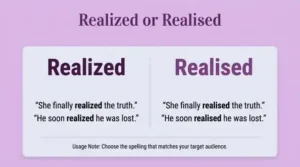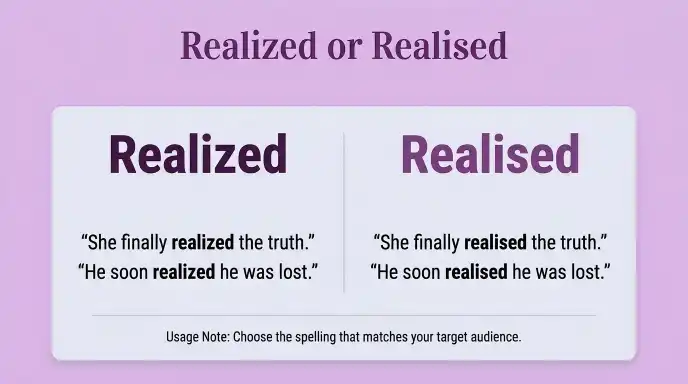
Realized and realised are both correct spellings. Realized is the standard spelling in American English, while realised is commonly used in British English and other varieties that follow British spelling rules.
Both words have the same meaning, so the right choice depends on your audience and writing style. Have you ever stopped while writing an email or an essay because you were unsure if to use realized or realised? You are not alone.
Many English learners, students, and writers face this spelling question because American and British English use different forms of some words ending in -ize or -ise.
Both spellings mean to understand something, become aware of a fact, or make something real. For example, an American writer might write, “I realized my mistake,” while a British writer might write, “I realised my mistake.” Both sentences are correct.
Realized or Realised: Featured Snippet Answer
Realized and realised are both correct. American English generally uses realized, while British English commonly uses realised, although realize is also accepted in many British dictionaries and style guides. Both spellings have the same meaning. Choose the form that matches your audience or required style guide, and use it consistently throughout your writing.
Realized or Realised: Quick Answer
The correct spelling depends on the variety of English you use.
- Realized: Preferred in American English.
- Realised: Common in British English, Australian English, and other varieties that follow British spelling conventions.
Both words are the past tense and past participle of realize or realise.
Examples:
- American English: I realized that I was wrong.
- British English: I realised that I was wrong.
- Both varieties: She has realized/realised her dream.
Easy rule: Use realized for American audiences and realised when following a British-style spelling preference. If a publisher, teacher, or employer provides a style guide, follow that guide.
What Does Realized or Realised Mean?
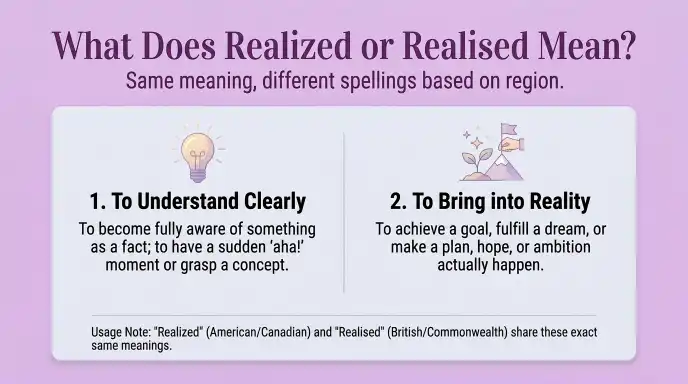
The words realized and realised have the same meanings. The only difference is their spelling.
To Understand or Become Aware
The most common meaning of realized/realised is to understand something or become aware of a fact.
Examples:
- I realized that I had forgotten my keys.
- She realised that the answer was wrong.
- They realized why the plan had failed.
In each sentence, someone becomes aware of something.
To Achieve Something
These words can also mean to make a goal, hope, or dream come true.
Examples:
- He realized his dream of becoming a teacher.
- She realised her ambition through hard work.
- They finally realized their goal.
This meaning often appears in personal stories, business writing, and news reports.
To Understand the Importance of Something
The words can describe a moment when someone understands the value, risk, or importance of a situation.
Examples:
- We realized the value of teamwork.
- She realised how much time the task would take.
- He soon realized the risks of his decision.
To Make Money or Value from Something
In financial and business contexts, realize/realise can mean to receive money from selling an asset or to convert something into a financial return.
Examples:
- The company realized a profit from the sale.
- The seller realised a good price for the property.
- The business realized the value of its investment.
The spelling depends on the chosen English variety, not the meaning.
Realized vs Realised: Meaning Table
| Word | Meaning | Example |
| Realized | Became aware or understood | She realized her mistake. |
| Realised | Became aware or understood | She realised her mistake. |
| Realized | Achieved a goal | He realized his dream. |
| Realised | Achieved a goal | He realised his dream. |
Remember: Both spellings are correct. The difference is regional spelling preference, not grammar or meaning.
The Origin of Realized or Realised
The spelling difference between realized and realised developed through the history of English spelling. Both forms come from the same verb, realize or realise.
Where Does the Word Come From?
The verb realize developed from real, a word linked to the idea of something actual or existing. The suffix -ize helps form verbs that can mean making something real or bringing something into a particular state.
Over time, the verb also developed the meaning of becoming aware of something or understanding a fact.
Why Are There Two Spellings?
The difference comes from spelling conventions used in different English-speaking regions.
American English generally favors -ize in words such as:
- Realize
- Organize
- Recognize
- Apologize
British English often uses -ise in these words:
- Realise
- Organise
- Recognise
- Apologise
However, there is an important detail: -ize is also accepted in many British English dictionaries and publishing styles. It is not always an American-only spelling.
The Oxford style, for example, commonly uses -ize forms, while many British newspapers and other publishers prefer -ise.
Why Does the Past Tense End in -ed?
Both spellings form the past tense by adding -d to the base form:
- Realize → Realized
- Realise → Realised
The spelling choice stays the same throughout the verb forms:
- Present: realize / realise
- Past: realized / realised
- Past participle: realized / realised
- Present participle: realizing / realising
Learning the full pattern helps you avoid mixing American and British forms in the same document.
Realized or Realised: British English vs American English

The main difference between realized and realised is the spelling convention used by the writer. American English strongly favors -ize, while many British English publications favor -ise.
| British English | American English | Example |
| Realised | Realized | She realised/realized her mistake. |
| Organised | Organized | They organised/organized the event. |
| Recognised | Recognized | He recognised/recognized the name. |
| Apologised | Apologized | She apologized/apologized for the delay. |
| Specialised | Specialized | The clinic specialised/specialized in care. |
| Finalised | Finalized | We finalised/finalized the plan. |
These examples show a common spelling pattern. They do not mean that every British publication must use -ise.
American English Spelling
In the United States, realized is the standard choice in general writing.
Examples:
- I realized I had made an error.
- The team realized its full potential.
- She realized that the meeting had changed.
American dictionaries and many American style guides use -ize forms.
British English Spelling
In the United Kingdom, realised is widely used, especially by publishers and newspapers that follow an -ise style.
Examples:
- I realised that I had made an error.
- The team realised its full potential.
- She realised that the meeting had changed.
Some British dictionaries and publishers also accept or prefer realized. Always check the required style guide if the distinction matters.
What About Canada and Australia?
Canadian English uses both patterns, depending on the publication and style guide. The -ize form is common in some Canadian editorial styles, while -ise forms also appear.
Australian English commonly uses realised, but the best choice depends on the organization or publication’s house style.
Key point: The spelling difference is a matter of regional and editorial preference. Neither form is universally more correct than the other.
Which Version Should You Use?
Choose the spelling that fits your readers, location, or required style guide.
United States
Use realized for most American writing.
Examples:
- I realized that the deadline was today.
- She realized her professional goals.
This form is suitable for American schoolwork, websites, emails, and business reports.
United Kingdom
Use realised if your school, employer, or publisher follows the common British -ise convention.
However, realized may also be correct under a British style guide that uses -ize spellings.
Canada
Canadian English does not follow one rule for every publication. Some Canadian style guides prefer -ize, while other publishers use -ise.
Advice: Check your organization’s spelling policy and follow it consistently.
Australia
Use realised when following the common Australian spelling convention. If a publisher or employer has a specific style guide, follow its instructions.
International Writing
For a global audience, either form is understandable. The best choice is the one that matches the main audience or the spelling convention used across your website or document.
Avoid switching between realized and realised without a reason.
Academic Writing
Universities, journals, and academic publishers may have their own spelling rules.
Before submitting an essay, thesis, or research paper:
- Check the assignment instructions.
- Review the required style guide.
- Use one spelling convention throughout the paper.
- Check related words, such as organized/organised and recognized/recognised.
Business Writing
For business emails, reports, and proposals, use the spelling convention followed by your company or clients.
Consistency makes your writing look professional. If your company uses American English, choose realized. If it follows a British -ise style, choose realised.
Common Mistakes with Realized or Realised
Writers often assume that one spelling is correct everywhere. In fact, both forms are standard, but mixing styles can create problems.
Calling Realised Incorrect in American English
Incorrect claim: Realised is always wrong.
Better explanation: Realized is the standard American spelling, but realised is a recognized British-style variant.
Why? English has regional spelling conventions. A form that is less common in one region may be correct in another.
Calling Realized Incorrect in British English
Incorrect claim: Realized is never used in British English.
Better explanation: Realised is common in British writing, but realized is also accepted by many British dictionaries and style guides.
Why? British English does not follow a single -ise rule across all publishers.
Mixing Spelling Styles
Inconsistent example: The team organized the event and then realised its goal.
Consistent American version: The team organized the event and then realized its goal.
Consistent British -ise version: The team organised the event and then realised its goal.
Why? Keeping a consistent style makes a document easier to edit and read.
Misspelling the Past Tense
Incorrect: I realizd my mistake.
Correct: I realized my mistake.
Also correct: I realised my mistake.
Why? Both standard forms end in -ed. The difference lies in the base spelling, not the past-tense rule.
Changing the Meaning
Incorrect assumption: Realized means something different from realised.
Correct explanation: Both spellings carry the same meaning.
Example: “She realized her dream” and “She realised her dream” both mean that she achieved her dream.
Memory Tip
Think of the final letters:
- American style: Realized
- Common British -ise style: Realised
Choose your style first, then use it throughout the document.
Realized or Realised in Everyday Examples
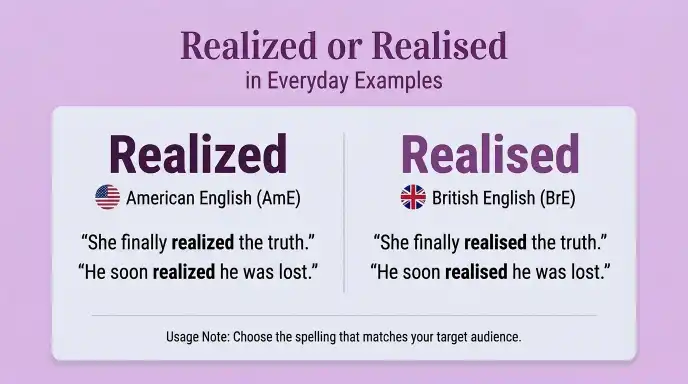
Both spellings work in everyday communication. The examples below show how to use them in different settings.
Emails
American English:
- I realized that I sent the wrong attachment.
- We realized the meeting time had changed.
British -ise style:
- I realised that I sent the wrong attachment.
- We realised the meeting time had changed.
Business Writing
- The company realized a profit from the sale.
- The team realised its goal ahead of schedule.
- The manager realized the need for a new plan.
Choose the spelling that matches your business’s style.
News Headlines
- The team realized its potential after a strong season.
- The local council realised the need for better services.
- The company realized a gain after selling the asset.
News organizations usually follow their own editorial style guides.
Blogs
- I realized that small habits can make a difference.
- She realised her dream after years of practice.
- We realized that the simple answer was correct.
Bloggers should choose one spelling style and use it consistently across their articles.
Social Media
- “I finally realized what I needed to change.”
- “I realised that progress takes time.”
- “Today, I realized how far I have come.”
Both versions are clear and natural.
Academic Writing
- The researcher realized that the sample was too small.
- The student realised the importance of checking sources.
- The study realized its main objective.
For academic work, follow the spelling rules required by your institution or journal.
Daily Conversation
- “I realized I left my phone at home.”
- “She realised that she was late.”
- “We realized the answer after talking.”
The spoken word sounds the same in both varieties, so the spelling choice usually matters only when writing.
Realized or Realised: Google Trends and Modern Usage
People search for realized or realised because they want to know which spelling is correct, especially when writing for a specific country or audience.
The two spellings have the same meaning. Search interest can vary by region, but a reliable comparison requires current data from Google Trends. Without checking those results, exact popularity figures or country rankings should not be claimed.
Regional Usage Patterns
General spelling conventions offer a useful guide:
- United States: Realized is the usual spelling.
- United Kingdom: Realised is common, but realized is also accepted in some styles.
- Canada: Both forms appear, depending on the style guide.
- Australia: Realization is common.
- International writing: Either form can work if used consistently.
These are broad usage patterns, not exact search rankings.
Why Do People Search for Both Spellings?
Common reasons include:
- They want to check the correct spelling.
- They are writing for an American or British audience.
- They are editing an essay, report, or website.
- They have noticed different spellings in books or online articles.
- They want to keep their writing consistent.
Which Form Is More Popular?
Popularity depends on the country, publication, and context. Realized is standard in American English, while realised is common in British-style writing.
However, search frequency does not determine correctness. Both forms are accepted, and the right choice depends on the writing convention you follow.
How to Check Google Trends
To compare interest, enter realized and realised in Google Trends. Select a country and time range, then compare the results.
Remember that Google Trends reports relative search interest, not exact search volume. Use it to explore regional patterns, not to decide if a spelling is correct.
Realized or Realised: Quick Comparison Table
| Version | Meaning | Correct? | Region | Example |
| Realized | Understood or became aware | Yes | Common in the US | I realized my mistake. |
| Realised | Understood or became aware | Yes | Common in British-style writing | I realised my mistake. |
| Realized | Achieved a goal | Yes | US and some other styles | She realized her dream. |
| Realised | Achieved a goal | Yes | UK, Australia, and other styles | She realised her dream. |
Key Takeaways
- Realized and realised are both correct spellings.
- Realized is the standard choice in American English.
- Realised is common in British English and Australian English.
- Many British dictionaries and style guides also accept realized.
- Both words have the same meaning and pronunciation.
- Use the spelling required by your school, employer, or publisher.
- Keep related spellings consistent throughout your writing.
FAQs About Realized or Realised
Q1. Is realized or realised correct?
Both realized and realised are correct. American English generally prefers realized, while realised is common in British-style writing. Some British publishers also use realized. Choose the spelling that matches your audience and style guide.
Q2. Is it American or British English?
Realized is the standard spelling in American English. It is also accepted by many British dictionaries and publishing styles. Therefore, it is not strictly an American-only spelling, even though it is the usual choice in the United States.
Q3. Is realised wrong in American English?
Realised is not the usual American spelling, but it is a recognized variant in English. If you are writing for an American audience, use realized unless your publisher or organization specifies a different spelling convention.
Q4. Which spelling does British English use, realized or realised?
Realised is widely used in British English, especially by publishers that follow the -ise convention. However, realized is also accepted by many British dictionaries and style guides. Check the publication’s rules when writing for a specific British audience.
Q5. Do realized and realised mean the same thing?
Yes. Both words can mean understood, became aware, achieved a goal, or received value from an asset. The meaning does not change with the spelling. Only the spelling convention differs.
Q6. Is it realized or realised in Australia?
Realised is common in Australian English. However, organizations and publishers may follow their own style guides. If you are writing for an Australian employer, school, or publication, check its spelling preferences before choosing a form.
Q7. How do you spell realize in the past tense?
The past tense is realized in American English and realised in the common British -ise style. Both forms are correct. The past participle uses the same spelling, as in “I have realized the truth” or “I have realised the truth.”
Q8. Why are there two spellings of realized?
The two spellings come from different English spelling conventions. American English generally uses -ize, while many British publishers prefer -ise. However, British English also accepts -ize in several style systems. Both forms have the same origin and meaning.
Conclusion: Realized or Realised
The choice between realized and realised depends on your spelling convention, not on the meaning of the word. Both forms are correct and can describe understanding something, becoming aware of a fact, achieving a goal, or receiving value from an asset.
For most American writing, realized is the best choice. In British and Australian writing, realised is common, although some dictionaries, publishers, and style guides accept or prefer realized. Canadian English also uses both forms, depending on the style guide.
If you are writing an essay, report, business email, or online article, check the rules for your audience. Then use the same spelling across the whole document. Apply the same approach to related words, such as organized/organised and recognized/recognised, to keep your writing consistent.
There is no need to worry that one form changes the meaning or makes your sentence grammatically incorrect. The key is to choose the form that suits your readers and follow it carefully.
Remember: Both spellings are correct, but consistency makes your writing stronger.

I’m Nora Ellis, an English language writer passionate about making grammar, spelling, and confusing words easy to understand. I share clear explanations and practical examples to help readers improve their English and use words with confidence.