Similes or Metaphors, Learn the difference between these figures of speech, including comparisons, definitions, examples, and literary devices.
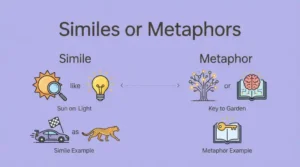
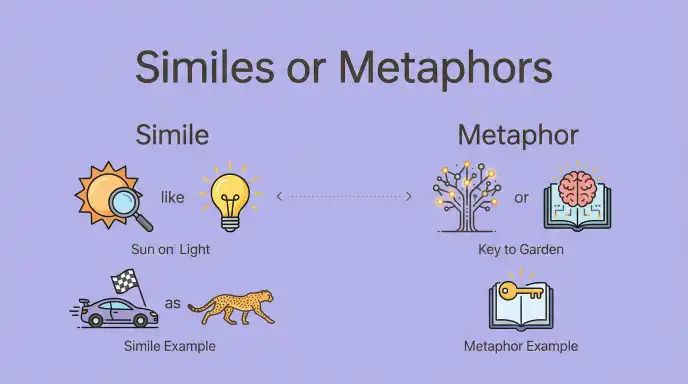
A simile compares two different things using “like” or “as,” while a metaphor describes one thing as another to show a shared quality. Both are figures of speech that help readers picture ideas, feelings, and experiences. However, they work in different ways.
People often search for similes or metaphors because the two terms sound similar and serve a similar purpose. Both make writing more vivid. Both help readers understand an idea through comparison. The main confusion is knowing when a comparison is a simile and when it is a metaphor.
For example, “Her smile is like sunshine” is a simile because it is used to compare her smile with sunshine. “Her smile is sunshine” is a metaphor because it describes her smile as sunshine directly.
These figures of speech appear in poems, novels, songs, speeches, emails, and everyday conversations. Learning the difference can make your writing clearer, more colorful, and more memorable. In this guide, you will find simple definitions, easy examples, common mistakes, and practical tips to help you use both devices with confidence.
Similes or Metaphors: Quick Answer
A simile compares two things using “like” or “as.” A metaphor describes one thing as another without using those comparison words.
Simile example: The baby slept like an angel.
Meaning: The baby slept peacefully, just as people imagine an angel might.
Metaphor example: The baby was an angel.
Meaning: The baby was very sweet or well-behaved. The sentence does not mean the baby was literally an angel.
Here is the easiest way to remember the difference:
- Simile: Makes a comparison using like or as.
- Metaphor: Makes a direct comparison by describing one thing as another.
- Both: Help readers understand an idea by connecting it to something familiar.
Quick tip: If the sentence uses like or as to compare two things, it is often a simile. If it says one thing is another in a figurative sense, it may be a metaphor.
Definition and Meaning of Similes or Metaphors
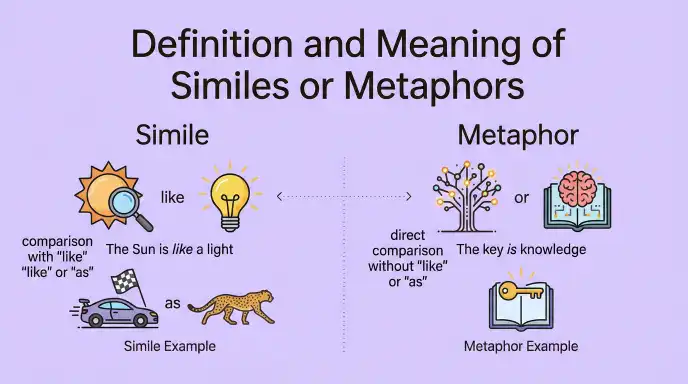
Similes and metaphors are both figures of speech. A figure of speech uses words in a creative way to express an idea beyond their most literal meaning.
Writers use them to explain difficult ideas, describe feelings, and create strong mental pictures. The difference lies in how each comparison works.
What Is a Simile?
A simile is a figure of speech that compares two different things using “like” or “as.” The comparison highlights a shared quality, such as speed, beauty, strength, or sound.
Example 1: He runs like the wind.
Meaning: He runs very fast.
The sentence compares his running speed with the speed of the wind. It does not suggest that he literally becomes wind.
Example 2: Her skin was as soft as silk.
Meaning: Her skin felt very smooth and soft.
The word as connects the skin with silk, which people often associate with softness.
Example 3: The classroom was as quiet as a library.
Meaning: The classroom was very quiet.
The writer uses a library as a familiar example of a quiet place.
Remember: A simile makes the comparison clear by using words such as like or as. However, not every sentence containing these words is a simile. The words must create a comparison.
What Is a Metaphor?
A metaphor is a figure of speech that describes one thing as another to suggest a shared quality. Unlike a typical simile, it does not use like or as to make the comparison.
Example 1: Time is money.
Meaning: Time is valuable, so people should use it wisely.
Time is not literally money. The metaphor connects time with money because both can be treated as valuable resources.
Example 2: The classroom was a zoo.
Meaning: The classroom was noisy, busy, or difficult to control.
The sentence does not mean that wild animals were inside the classroom. It uses zoo to create a picture of disorder.
Example 3: She has a heart of stone.
Meaning: She seems cold, unkind, or unwilling to show sympathy.
The metaphor compares her emotional behavior with the hardness of stone.
Remember: A metaphor makes a direct figurative comparison. It helps readers understand one thing by thinking about another.
Are Similes and Metaphors the Same?
No. Similes and metaphors are related, but they are not the same. Both compare things, yet they present the comparison differently.
| Feature | Simile | Metaphor |
| Main purpose | Compares two things | Describes one thing as another |
| Common signal | Like or as | Direct figurative statement |
| Example | Her voice is like music. | Her voice is music. |
| Meaning | Her voice sounds pleasant. | Her voice is described as beautiful or pleasing. |
| Effect | Makes the comparison explicit | Often creates a stronger or more direct image |
The meaning can be similar even when the structure changes.
Simile: His words were like a knife.
Metaphor: His words were a knife.
Both sentences suggest that his words caused emotional pain. The metaphor makes the comparison more direct.
The Origin of Similes or Metaphors
The words simile and metaphor have different historical roots. Their origins help explain why English uses separate names for these two ways of comparing things.
Where Does the Word Simile Come From?
Simile comes from a Latin word meaning “like” or “similar.” The term fits the purpose of a simile because it highlights a resemblance between two things.
For example:
The moon looked like a silver coin.
Meaning: The moon’s round shape and bright appearance reminded the writer of a silver coin.
The comparison helps readers picture the moon more easily.
Where Does the Word Metaphor Come From?
Metaphor comes through Latin from Greek metaphora, a word associated with carrying or transferring. In figurative language, a quality or idea is transferred from one thing to another.
Consider this sentence:
The news was a ray of hope.
Meaning: The news gave people a feeling of hope during a difficult time.
The sentence transfers the idea of light from a ray to the feeling of hope. It helps readers imagine hope as something that brightens a dark situation.
Why Do Writers Use Both?
Writers have long used comparisons to explain ideas and create vivid descriptions. Similes make the connection easy to see, while metaphors can make an image feel direct and powerful.
Simile: His anger spread like wildfire.
Metaphor: His anger was a wildfire.
Meaning of both: His anger grew quickly and became difficult to control.
The first sentence clearly signals a comparison. The second presents anger as a wildfire to create a stronger image.
British English vs American English Spelling
Simile and metaphor are spelled the same way in British English and American English. Unlike words such as colour and color, these terms do not have separate standard spellings for the two regions.
The difference is in their meaning and use, not their regional spelling.
| Term | British English | American English | Example |
| Simile | Simile | Simile | Her eyes shone like stars. |
| Metaphor | Metaphor | Metaphor | Her eyes were stars. |
| Similes | Similes | Similes | The poem contains several similes. |
| Metaphors | Metaphors | Metaphors | The story uses powerful metaphors. |
Do the Rules Change by Country?
No. Readers in the United States, United Kingdom, Canada, and Australia can use the same spellings for these terms.
Example: The teacher explained the difference between similes and metaphors.
This sentence is correct in both British and American English.
What About Schools and Style Guides?
Schools may have their own instructions about how students should identify and explain figures of speech. Publishers may also have preferences for punctuation, quotation marks, and formatting.
However, those style choices do not change the spelling or basic definition of simile and metaphor.
Similes or Metaphors: Which Spelling Should You Use?
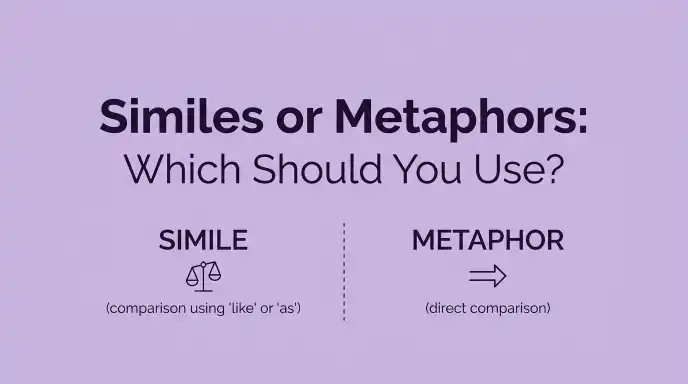
You do not need to choose between two regional spellings. Use “simile” and “metaphor” in both British and American English.
Here is practical advice for different writing situations:
- United States: Use simile and metaphor in essays, reports, stories, and lessons.
- United Kingdom: Use the same spellings in schoolwork, books, and professional writing.
- Canada: Use the standard spellings in academic and everyday writing.
- Australia: Use the same terms in educational, creative, and business contexts.
- International writing: Define each term in simple language if your readers are learning English.
- Academic writing: Explain the effect of the figure of speech and support your interpretation with an example.
- Business writing: Use figures of speech carefully. Clear, direct language is often better for instructions, policies, and technical information.
How Should Students Answer a Test Question?
If a question asks you to identify a simile, look for a comparison using like or as. Then check if those words actually compare two things.
Example: The water sparkled like diamonds.
Answer: Simile.
Why: The sentence compares the sparkling water with diamonds using like.
If a question asks you to identify a metaphor, look for a direct figurative comparison.
Example: The water was a sheet of glass.
Answer: Metaphor.
Why: The sentence describes the water as glass to suggest that it was smooth, still, or reflective.
Common Mistakes with Similes or Metaphors
Readers often confuse these figures of speech because both create comparisons. The following mistakes show how to identify them correctly.
| Common mistake | Correct understanding | Explanation |
| Calling every comparison a simile | Check how the comparison is expressed. | A metaphor may also compare two things. |
| Calling every sentence with like a simile | Check the meaning of like. | In “I like apples,” the word expresses preference, not comparison. |
| Thinking metaphors must use is | Look for a direct figurative comparison. | A metaphor can use other forms, such as “The city swallowed him.” |
| Assuming metaphors are always untrue mistakes | Recognize figurative meaning. | “Time is money” expresses an idea, not a literal fact. |
| Treating simile and metaphor as regional spellings | Learn them as separate literary terms. | They name two different techniques, not US and UK spelling options. |
Mistake 1: Confusing “Like” with a Simile
Sentence: I like the new teacher.
Correct answer: This is not a simile.
Meaning: The speaker enjoys or approves of the new teacher.
The word like expresses a feeling here. It does not compare the teacher with something else.
Now consider:
Sentence: The new teacher is like a guiding light.
Correct answer: Simile.
Meaning: The teacher helps or guides others, much as a light helps people see.
Mistake 2: Taking a Metaphor Literally
Sentence: My brother is a night owl.
Meaning: My brother tends to stay awake late at night.
Why it is a metaphor: The sentence describes a person as an owl to suggest a habit. It does not mean he is a bird.
Mistake 3: Using a Comparison That Does Not Help
A simile or metaphor should make the meaning clearer or more interesting. A confusing comparison can distract readers.
Weak example: The report was like a thing.
Better example: The report was as long as a winter night.
Meaning: The report seemed very long.
The second example gives readers a more vivid idea of the experience.
Memory tip: A simile compares using like or as. A metaphor makes a direct figurative comparison. Always focus on what the sentence means, not just one word.
Similes or Metaphors in Everyday Examples
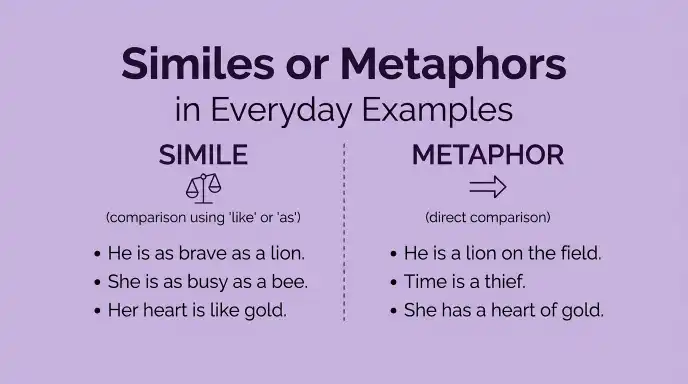
Similes and metaphors are not limited to poems or schoolbooks. People use them in conversations, emails, social media posts, news writing, and formal speeches.
1. Emails
Simile: Your explanation was as clear as glass.
Meaning: Your explanation was easy to understand.
Metaphor: Your explanation was a guiding light.
Meaning: Your explanation helped the reader understand what to do.
Writing tip: A simile can make friendly emails warmer. A metaphor can make praise more expressive, but keep the message clear in professional settings.
2. News Writing
Simile: The crowd moved like a river through the streets.
Meaning: The crowd moved in a large, continuous flow.
Metaphor: A wave of support swept through the city.
Meaning: Support grew quickly among many people.
Writing tip: News writers use figurative language to help readers imagine events. They should still make facts and claims clear.
3. Social Media
Simile: Today feels like a fresh start.
Meaning: The speaker feels ready to begin again.
Metaphor: Today is a blank page.
Meaning: The speaker sees the day as a new opportunity.
Writing tip: Short comparisons can make captions memorable. Choose words that match the feeling you want to express.
4. Formal Writing
Simile: The evidence spread through the report like a thread through fabric.
Meaning: The evidence connected different parts of the report.
Metaphor: Trust is the foundation of a strong team.
Meaning: Trust supports the team’s success, just as a foundation supports a building.
Writing tip: Figurative language can strengthen speeches and reflective essays. In scientific or legal writing, literal wording is often better when precision matters.
5. Academic Writing
Simile: The character’s fear rose like a tide.
Meaning: The character’s fear increased gradually and became stronger.
Metaphor: The character’s fear was a rising tide.
Meaning: Fear grew and began to overwhelm the character.
Writing tip: When analyzing literature, do more than name the device. Explain what the comparison suggests and how it affects the reader.
6. Daily Conversation
Simile: I’m as hungry as a bear.
Meaning: I am very hungry.
Metaphor: This bag is a ton of bricks.
Meaning: The bag feels extremely heavy.
Writing tip: Everyday speech often uses familiar comparisons. The literal meaning is usually not intended.
7. Describing a Person
Simile: She is as brave as a lion.
Meaning: She is very brave.
Metaphor: She is a lion in a crisis.
Meaning: She acts bravely when facing a difficult situation.
Both examples praise courage. The simile states the comparison openly, while the metaphor describes the person more directly.
Similes or Metaphors: Google Trends and Modern Usage
People search for similes or metaphors for several reasons. Students may need to complete homework. Teachers may want simple examples for lessons. Writers may want to make a story, speech, or caption more vivid.
Why Is the Difference Commonly Confusing?
Both devices connect one idea with another. For example, a person can describe someone as brave as a lion or a lion in a crisis. The meaning is similar, so the difference can be easy to miss.
The key is the structure:
- “Brave as a lion” is a simile.
- “A lion in a crisis” is a metaphor.
Which Term Is More Popular Online?
Search interest can vary by country, school season, and the reason people are looking for information. Students may search for definitions and worksheets, while writers may search for examples or creative techniques.
No exact Google Trends figures are included here, because live comparative data has not been verified. It would be misleading to claim that one term receives a specific percentage more searches than the other without checking the data.
What Should Readers Learn First?
Start with the core distinction, then practice identifying the meaning of each comparison.
Simile: The stars were like diamonds.
Meaning: The stars looked bright and sparkling.
Metaphor: The stars were diamonds scattered across the sky.
Meaning: The stars are described as diamonds to create a vivid image of their brightness.
Learning to explain the effect of a comparison is more useful than simply memorizing labels. A strong reader can identify the figure of speech and explain why the writer chose it.
Quick Comparison Table: Similes vs Metaphors
| Feature | Simile | Metaphor |
| Definition | Compares two things using like or as | Describes one thing as another figuratively |
| Example | The snow was like a blanket. | The snow was a blanket. |
| Meaning | Snow covered the ground like a blanket covers a bed. | Snow covered the ground in a smooth layer. |
| Comparison style | Explicit | Direct |
| Common use | Description, stories, poems, conversation | Description, stories, poems, speeches |
| Literal meaning? | Usually not intended | Usually not intended |
| Spelling in US English | Simile | Metaphor |
| Spelling in UK English | Simile | Metaphor |
| Main purpose | Help readers picture a similarity | Create a direct image or connection |
The main difference is how the comparison is presented. A simile signals the comparison with like or as. A metaphor expresses the comparison directly.
Key Takeaways
- A simile compares two things using “like” or “as.”
- A metaphor describes one thing as another in a figurative way.
- “Her voice is like music” is a simile.
- “Her voice is music” is a metaphor.
- Both figures of speech help readers picture ideas, emotions, and experiences.
- Simile and metaphor have the same spelling in British and American English.
- Do not label every use of like as a simile. Check the sentence’s meaning.
- In literary analysis, explain the effect of the comparison instead of only naming it.
FAQs About Similes or Metaphors
Q1. What is the main difference between a simile and a metaphor?
A simile compares two things using “like” or “as,” while a metaphor describes one thing as another. For example, “He is like a rock” is a simile. “He is a rock” is a metaphor. Both may suggest that he is strong or dependable, but the comparison is expressed differently.
Q2. What is an easy example of a simile?
“The child was as busy as a bee” is an easy simile. It compares the child’s activity with a bee’s busy behavior using as. The sentence means that the child was very active. It does not mean the child was an insect.
Q3. What is an easy example of a metaphor?
“The classroom was a zoo” is a metaphor. It describes the classroom as a zoo to suggest that it was noisy, crowded, or difficult to control. The sentence is not meant literally. It creates a quick mental picture of a chaotic classroom.
Q4. Can a sentence contain both a simile and a metaphor?
Yes, a passage can contain both devices. For example, “Her smile was sunshine, bright like a summer morning” uses a metaphor in “her smile was sunshine” and a simile in “bright like a summer morning.” Each comparison adds a different detail to the description.
Q5. Are similes and metaphors used only in poetry?
No. They appear in stories, speeches, emails, advertising, social media, and everyday conversation. People use them to describe feelings and experiences in memorable ways.
However, formal or technical writing may need more literal language when accuracy is more important than imagery.
Q6. Are simile and metaphor spelled differently in British and American English?
No. Both terms use the same standard spelling in British and American English. A simile remains simile, and a metaphor remains metaphor. These are different literary devices, not regional spelling variations.
Q7. How can I remember the difference between a simile and a metaphor?
Remember that a simile often signals comparison with “like” or “as,” while a metaphor makes a direct figurative comparison. “Her eyes shine like stars” is a simile. “Her eyes are stars” is a metaphor. Then ask what shared quality the sentence is describing.
Conclusion: Similes or Metaphors
Understanding similes or metaphors can make reading and writing much easier. Both figures of speech help readers connect unfamiliar ideas with familiar things. The main difference is how they make the comparison.
A simile uses “like” or “as” to compare two things. A metaphor describes one thing as another without using those comparison words. For example, “His voice was like thunder” is a simile, while “His voice was thunder” is a metaphor. Both suggest a loud, powerful voice, but they create the comparison in different ways.
These devices can improve stories, poems, speeches, and everyday conversations. They can also help students understand the language choices writers make. However, figurative language should always serve a purpose. A comparison works best when it makes the intended meaning clearer or creates a useful image.
You do not need to memorize dozens of examples to understand the difference. Start with simple sentences, identify the comparison, and explain what it means. The best way to master similes and metaphors is to recognize both the words and the idea behind them.
Keep practicing, and soon you will be able to identify and use both figures of speech with confidence.

I’m Nora Ellis, an English language writer passionate about making grammar, spelling, and confusing words easy to understand. I share clear explanations and practical examples to help readers improve their English and use words with confidence.