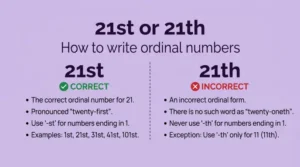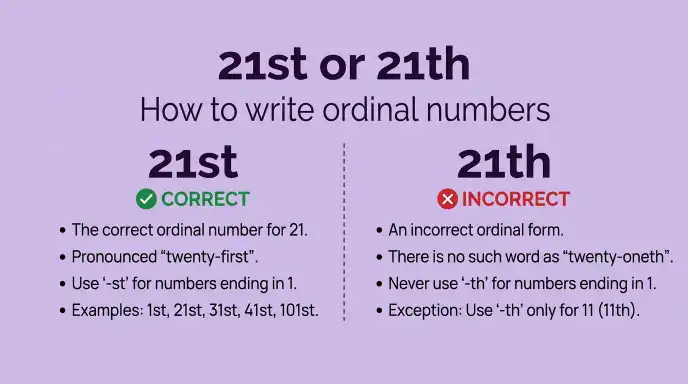
21st is correct, while 21th is incorrect. The correct ordinal form of twenty-one is twenty-first (21st). It describes the position, order, or rank of something in a sequence.
People often confuse 21st and 21th because English ordinal numbers use different endings, including -st, -nd, -rd, and -th. Although many numbers use -th, the number 21 follows a different pattern.
For example, we write 1st (first), 2nd (second), 3rd (third), and 21st (twenty-first). The correct ending comes from the ordinal word, not from adding -th to every number.
This small spelling difference matters in birthday invitations, dates, school assignments, business documents, and everyday communication. Using the right form makes your writing clearer and more professional.
In this guide, you will learn the meaning of 21st, why 21th is incorrect, how ordinal-number suffixes work, and how to use the correct form in real-life examples.
Featured Snippet: Is It 21st or 21th?
21st is the correct spelling, while 21th is incorrect. The number 21 is written as twenty-first in ordinal form, so it takes the suffix -st. Use 21st for birthdays, dates, rankings, positions, and centuries. For example, write 21st birthday, not 21th birthday.
21st or 21th : Quick Answer
The correct choice is 21st.
When expressing the position of number 21, English uses the word twenty-first. Its numerical abbreviation is 21st.
| Spelling | Correct or Incorrect | Explanation |
| 21st | Correct | Short form of twenty-first |
| 21th | Incorrect | Does not follow the standard ordinal form |
Examples of 21st in Sentences
- She celebrated her 21st birthday with her family.
- Our office is located on the 21st floor.
- This is the 21st chapter of the book.
- He finished in 21st place.
- We live in the 21st century.
Remember: If you mean twenty-first, always write 21st.
What Does 21st or 21th Mean?
To understand this comparison, you first need to know the difference between cardinal and ordinal numbers.
Meaning of 21st
21st is the ordinal form of twenty-one. It describes the position, order, or rank of something in a sequence.
In simple words, it means twenty-first.
Here are some common examples:
- 21st birthday: The birthday marking 21 years of age.
- 21st floor: The floor in position number twenty-one.
- 21st position: The place after twentieth.
- 21st century: The period from 2001 through 2100.
- 21st chapter: The chapter that comes after the twentieth chapter.
Meaning of 21th
21th is an incorrect spelling and has no accepted standard use as an English ordinal number.
People sometimes write it because they assume every ordinal number must end in -th. However, English uses different suffixes depending on the number.
Cardinal Numbers vs Ordinal Numbers
| Cardinal Number | Ordinal Number | Written Form |
| 1 | 1st | First |
| 2 | 2nd | Second |
| 3 | 3rd | Third |
| 4 | 4th | Fourth |
| 20 | 20th | Twentieth |
| 21 | 21st | Twenty-first |
Cardinal numbers tell us how many. Ordinal numbers tell us which position something occupies.
For example:
- I bought 21 books. (Cardinal number)
- I read the 21st book. (Ordinal number)
The Origin of 21st and Ordinal Number Suffixes
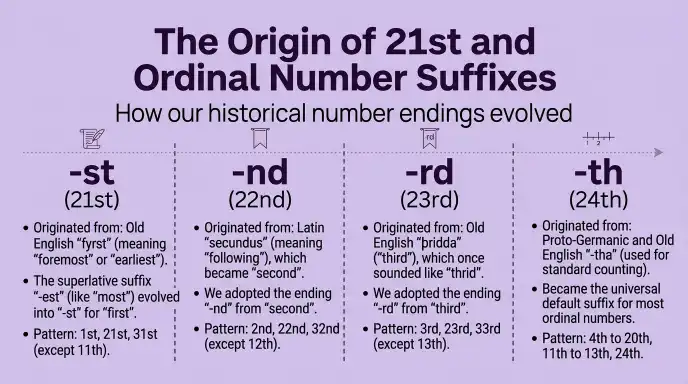
English ordinal numbers developed from older forms of the language. Their modern spellings reflect the words used to describe positions and sequences.
The abbreviation 21st comes from the ordinal word first in twenty-first.
Over time, English writers adopted shortened forms to make numbers easier to use in dates, lists, records, and other written material.
The Four Main Ordinal Endings
English uses four common ordinal suffixes:
- -st: First, 21st, 31st, 41st.
- -nd: Second, 22nd, 32nd, 42nd.
- -rd: Third, 23rd, 33rd, 43rd.
- -th: Fourth, 20th, 24th, 30th, 100th.
These endings help readers recognize the position of a number without spelling out the entire word.
Why Does 21st Use -st?
The number 21 is pronounced twenty-first.
The final word is first, so its abbreviation uses the ending -st.
Compare these examples:
- Twenty-first = 21st
- Twenty-second = 22nd
- Twenty-third = 23rd
- Twenty-fourth = 24th
The ending comes from the ordinal word, not simply from adding -th to the number.
British English vs American English
There is no difference between British and American English when writing 21st.
Both varieties use the same ordinal form. The difference mainly appears in how dates are arranged.
| Writing Style | Date Format | Example |
| British English | Day, Month, Year | 21st October 2026 |
| American English | Month, Day, Year | October 21st, 2026 |
| International numeric style | Year-Month-Day | 2026-10-21 |
British English
British writers commonly place the day before the month.
Example: The event will take place on 21st October.
American English
American writers usually place the month before the day.
Example: The event will take place on October 21st.
Is 21th Ever Correct in British or American English?
No. Neither British nor American English accepts 21th as the standard ordinal form.
The correct spelling remains 21st in both varieties.
Which Version Should You Use?
Always use 21st when writing the ordinal form of twenty-one. The spelling does not change according to country, audience, or writing style.
Here is how to use it in different situations.
United States
American English uses 21st for birthdays, rankings, and positions.
Example: She is celebrating her 21st birthday.
United Kingdom
British English follows the same spelling rule.
Example: The meeting is scheduled for 21st November.
Canada
Canadian English also uses 21st.
Example: He finished in 21st place.
Australia
Australian writers use 21st in dates and other ordinal expressions.
Example: The competition begins on 21st March.
International Writing
For international readers, 21st is the standard form.
Example: Technology has transformed life in the 21st century.
Academic Writing
Academic writers should use the correct ordinal form and follow their institution’s preferred style guide.
Example: The discussion appears in the 21st chapter.
Business Writing
Use 21st in schedules, reports, invitations, and professional correspondence.
Example: The final report is due on the 21st.
The safest choice in every region is 21st, never 21th.
Common Mistakes When Writing 21st or 21th
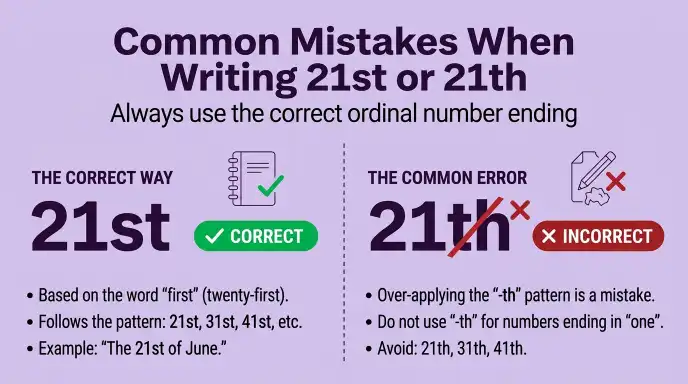
One common mistake is adding -th to every number. Although many ordinal numbers use this ending, numbers such as 21 follow a different pattern.
Incorrect vs Correct Forms
| Incorrect Form | Correct Form | Reason |
| 21th | 21st | Twenty-first |
| 22th | 22nd | Twenty-second |
| 23th | 23rd | Twenty-third |
| 31th | 31st | Thirty-first |
| 32th | 32nd | Thirty-second |
| 33th | 33rd | Thirty-third |
Why Do People Write 21th?
There are several reasons behind this mistake.
1. Overgeneralization
Many learners know that numbers such as 4th, 5th, and 20th use -th. They may apply the same ending to 21.
2. Confusion Between Ordinal Numbers
English uses several suffixes, which can make ordinal numbers difficult to remember.
3. Typing Mistakes
Some writers type quickly without checking the correct ordinal ending.
Important Exceptions: 11th, 12th, and 13th
Numbers ending in 11, 12, and 13 use -th, even though their final digits are 1, 2, and 3.
Examples:
- 11th = Eleventh
- 12th = Twelfth
- 13th = Thirteenth
- 111th = One hundred eleventh
- 112th = One hundred twelfth
- 113th = One hundred thirteenth
Important rule: Check the last two digits first. If they are 11, 12, or 13, use -th. Otherwise, follow the final digit.
An Easy Memory Trick
Think of the word first whenever you write 21.
- Twenty-first = 21st
- Thirty-first = 31st
- Forty-first = 41st
This simple connection makes the correct spelling easier to remember.
21st or 21th in Everyday Examples
Knowing a grammar rule is useful, but seeing it in real situations makes it easier to apply.
Here are examples from different types of writing.
1. Emails
Correct: Your appointment is confirmed for the 21st of November.
Incorrect: Your appointment is confirmed for the 21th of November.
2. Business Writing
Correct: The company will publish its annual report on the 21st.
Incorrect: The company will publish its annual report on the 21th.
3. News Headlines
Correct: New Technology Is Transforming the 21st Century.
Incorrect: New Technology Is Transforming the 21th Century.
4. Blogs
Correct: Communication has changed significantly in the 21st century.
Incorrect: Communication has changed significantly in the 21th century.
5. Social Media
Correct: Finally celebrating my 21st birthday!
Incorrect: Finally celebrating my 21th birthday!
6. Academic Writing
Correct: The research examines developments during the 21st century.
Incorrect: The research examines developments during the 21th century.
7. Daily Conversation
Correct: My office is on the 21st floor.
Incorrect: My office is on the 21th floor.
Across all these situations, 21st is the only standard correct form.
21st or 21th: Google Trends and Modern Usage
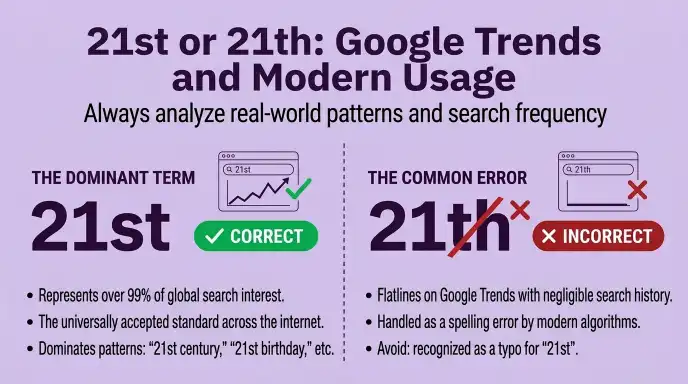
The comparison between 21st and 21th is mainly driven by confusion about English ordinal-number endings.
People commonly search for this spelling comparison when writing:
- Birthday invitations and messages.
- Dates and appointment reminders.
- School assignments.
- Academic documents.
- Social media captions.
- Rankings and numbered lists.
21st is the established form in modern English. The alternative 21th is generally a spelling error rather than a regional or stylistic variation.
Search interest may change around birthdays, anniversaries, and important dates. However, exact Google Trends figures should be checked directly rather than estimated or invented.
For everyday writing, the best approach is to remember the ordinal-number pattern and use the correct suffix.
Quick Comparison Table: 21st vs 21th
| Version | Meaning | Correct? | Usage | Example |
| 21st | Twenty-first | Yes | Standard English | 21st birthday |
| 21th | No standard ordinal meaning | No | Spelling error | Incorrect form |
Final verdict: Use 21st whenever you mean twenty-first.
Key Takeaways
- 21st is correct, while 21th is incorrect.
- 21st means twenty-first.
- Ordinal numbers describe position, order, or rank.
- Numbers ending in 1 generally use -st.
- Numbers ending in 2 generally use -nd.
- Numbers ending in 3 generally use -rd.
- Numbers ending in 11, 12, and 13 use -th.
- British and American English both use the 21st.
- Always check the last two digits before choosing an ordinal suffix.
Frequently Asked Questions
1. Is it 21st or 21th?
21st is correct. It is the standard ordinal form of twenty-one. The form 21th is incorrect.
2. Why is 21st correct instead of 21th?
21st comes from the word twenty-first. Since the ordinal word ends in first, its abbreviation uses -st.
3. How do you write 21 in ordinal form?
Write it as 21st or spell it out as twenty-first. Both forms express the same ordinal number.
4. Is 21st correct in British English?
Yes. British English uses 21st for dates, birthdays, positions, and centuries.
5. Is 21st correct in American English?
Yes. American English also uses the 21st. The spelling is the same in both varieties.
6. Why is 11th different from 21st?
11th is an exception. Numbers ending in 11, 12, and 13 use -th, while 21 uses -st.
7. What is the difference between 21 and 21st?
21 is a cardinal number, while 21st is an ordinal number. The first shows quantity, and the second shows position.
8. How do you write 21st in words?
The correct written form is twenty-first. Use a hyphen between twenty and first.
Conclusion:
Choosing between 21st and 21th is easy once you understand English ordinal numbers. 21st is the only correct standard form because twenty-one becomes twenty-first when expressing a position or sequence.
The incorrect form 21th often appears because people assume that all ordinal numbers use the -th ending. However, English has different suffixes for different numbers. Remember that first becomes 1st, second becomes 2nd, third becomes 3rd, and twenty-first becomes 21st.
If you are writing a birthday invitation, preparing an academic assignment, creating a social media caption, or mentioning a date, always choose 21st. The same spelling works in British, American, Canadian, and Australian English.
The easiest way to remember this rule is to say the number in words before writing its abbreviation.
Keep learning these small grammar rules to make your English writing clearer and more accurate.

I’m Nora Ellis, an English language writer passionate about making grammar, spelling, and confusing words easy to understand. I share clear explanations and practical examples to help readers improve their English and use words with confidence.