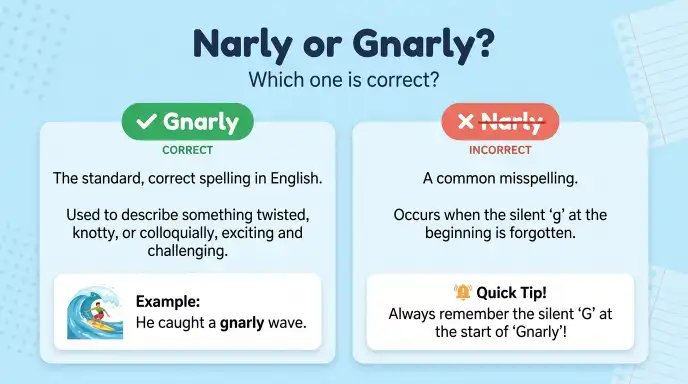
The correct spelling is gnarly, not narly, in standard English. The word describes something rough, twisted, difficult, or extreme. In casual speech, it can also mean impressive or exciting.
Many people search for narly or gnarly because the first letter in gnarly is silent. When people hear the word, it sounds like “nar-lee.” As a result, they may leave out the letter g when writing it. However, the standard spelling always includes that letter.
The meaning of gnarly also depends on the context. For example, a tree may have gnarly branches, while a surfer may ride a gnarly wave. In the first sentence, the word describes a twisted shape. In the second, it may describe an extreme or exciting experience.
Narly or Gnarly: Quick Answer
Gnarly is the correct standard spelling. It can describe something rough, twisted, difficult, dangerous, or impressive. The word begins with a silent g, which explains why some people mistakenly write narly.
Examples:
- The old tree has gnarly branches.
- That was a gnarly surfing trick.
- We faced a gnarly problem at work.
Remember: The word sounds like “narly,” but its correct spelling is gnarly.
What Does Narly or Gnarly Mean?
The word gnarly has several meanings. Its exact meaning depends on the situation and the speaker’s intention.
Gnarly Means Rough or Twisted
The traditional meaning describes something rough, knotty, or twisted. It often refers to tree roots, branches, and other uneven shapes.
Examples:
- The tree has gnarly roots.
- His hands looked rough and gnarly.
- We walked past an old tree with gnarly branches.
In these examples, the word describes a physical feature. It helps readers picture something uneven or twisted.
Gnarly Means Difficult or Dangerous
In informal English, gnarly can describe something hard to manage or risky.
For example, a climber may face a gnarly path, or a driver may encounter a gnarly road. In both cases, the word suggests a difficult situation.
Consider these examples:
- The hikers faced a gnarly climb.
- We had to solve a gnarly technical problem.
- The road became gnarly after the storm.
Here, the word expresses difficulty rather than a twisted physical shape.
Gnarly Means Extreme or Impressive
The word is also common in informal speech about surfing, skateboarding, and other action sports. In these settings, gnarly can express excitement, admiration, or respect for a difficult feat.
Examples:
- That was a gnarly skateboard trick!
- She caught a gnarly wave.
- The snowboarder made a gnarly jump.
In this context, the word often has a positive meaning. However, the same word can describe a dangerous or unpleasant experience in another sentence.
Is Narly a Real Word?
Narly is generally a misspelling when someone intends to write the common English word gnarly. You may still see it in usernames, creative writing, brand names, or informal online posts.
However, those uses do not make it the standard spelling. For school assignments, articles, and professional writing, choose gnarly.
Gnarly and Narly Compared
| Word | Meaning | Standard spelling? | Example |
| Gnarly | Rough or twisted | Yes | The tree has gnarly roots. |
| Gnarly | Difficult or dangerous | Yes | We faced a gnarly climb. |
| Gnarly | Extreme or impressive | Yes | That trick was gnarly. |
| Narly | Usually a misspelling of gnarly | No, for the intended word | Write gnarly instead. |
The key point is simple: gnarly is the standard form, although its meaning can change with context.
The Origin of Narly or Gnarly
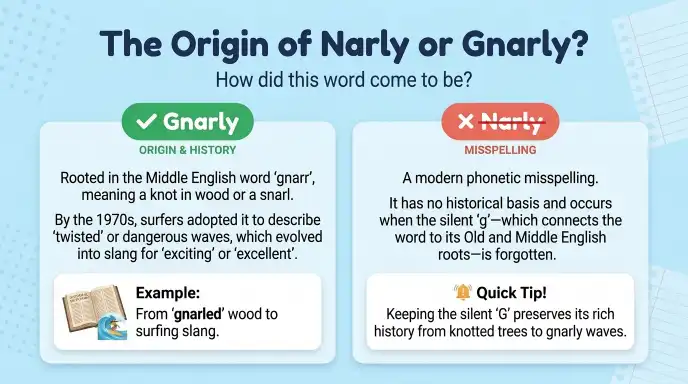
The word gnarly is linked to gnarl, a word used for a knot or twisted part of wood. This connection explains why the adjective first described rough and uneven shapes.
Where Does Gnarly Come From?
The word gnarl refers to a knot or irregular twist, especially in wood. The adjective gnarly describes something that has these features.
For example, a tree may have a thick, twisted trunk or roots that spread in uneven shapes. Calling them gnarly gives readers a clear picture of their appearance.
The word later developed broader informal meanings. Today, it can describe both physical features and challenging experiences.
How Did Gnarly Become Slang?
Over time, gnarly became associated with surfing and other action sports. People used it to describe difficult waves, challenging tricks, and extreme experiences.
As a result, the word gained meanings linked to excitement, danger, and admiration. A gnarly wave might be difficult to ride, but a surfer might also use the word to praise it.
For example, “That was a gnarly ride” could describe a thrilling experience or a dangerous one. The surrounding context helps explain the speaker’s meaning.
Why Is the G Silent?
The initial g in gnarly is silent in modern English. The word is commonly pronounced NAR-lee, so its sound does not reveal every letter in its spelling.
English has other words with a silent initial g, including:
- Gnat
- Gnaw
- Gnome
- Gnarled
These words show a similar spelling pattern. Therefore, hearing the word alone may not help someone spell it correctly.
Why Do People Write Narly?
People may write narly because they have heard the word but have not seen it in print. Others may type it quickly in a message or use it as a deliberate creative spelling.
Even so, the accepted spelling of the common English word remains gnarly. When accuracy matters, keep the silent g.
British English vs American English
British English and American English use the same spelling: gnarly. Neither variety normally removes the initial g.
The informal meaning is strongly associated with American surfing and action-sport slang. Nevertheless, the word is also understood in other English-speaking regions.
British English Examples
- The old tree has gnarly branches.
- The hikers faced a gnarly climb.
- That was a gnarly surfing trick.
American English Examples
- The tree has gnarly roots.
- We ran into a gnarly problem.
- That was a gnarly skateboard move.
The spelling remains the same in every example. The main difference is not regional spelling but the level of formality and the meaning intended.
British vs American English Comparison Table
| British English | American English | Example |
| Gnarly | Gnarly | The tree has gnarly roots. |
| Gnarly | Gnarly | That was a gnarly wave. |
| Gnarly | Gnarly | We faced a gnarly problem. |
| Narly is usually incorrect | Narly is usually incorrect | Use gnarly instead. |
Do Style Guides Prefer One Version?
The standard spelling does not change between British and American English. However, the slang meaning may not suit every reader.
In formal documents, academic papers, and business reports, a more precise word may be better. For example, a complex problem is often clearer than a gnarly problem in a professional report.
By contrast, a casual blog or sports article may use gnarly naturally when the audience understands the expression.
Which Version Should You Use?
For standard English, use gnarly in every region. The choice is not between British and American spelling. Instead, it is between the standard spelling and a nonstandard form.
United States
In the United States, gnarly works in everyday conversation, blogs, and informal sports writing.
Example: That was a gnarly skateboard trick.
United Kingdom
British writers can use gnarly for the same meanings. If the audience may not know the slang, a simpler word can make the sentence clearer.
Example: The old tree had gnarly branches.
Canada
Canadian writers also use the standard spelling gnarly. The word can suit informal writing when the intended meaning is clear.
Example: The team solved a gnarly technical issue.
Australia
In Australia, gnarly can describe something rough, extreme, or impressive. It may fit casual conversation and sports-related content.
Example: The surfer caught a gnarly wave.
International Writing
For a global audience, choose words that readers can understand easily. Although gnarly may be familiar to many English speakers, its slang meanings can vary by context.
Instead of “The team faced a gnarly challenge,” you could write, “The team faced a difficult challenge.”
Academic Writing
In academic writing, use gnarly when discussing slang, quoting a speaker, or analyzing informal language. Otherwise, words such as complex, difficult, or twisted are often more precise.
Business Writing
In professional emails and reports, gnarly may sound too casual. For example, “We found a gnarly issue in the system” could become “We found a complex issue in the system.”
Best advice: Use gnarly when its meaning and tone suit your audience, but always keep the standard spelling.
Common Mistakes with Narly or Gnarly
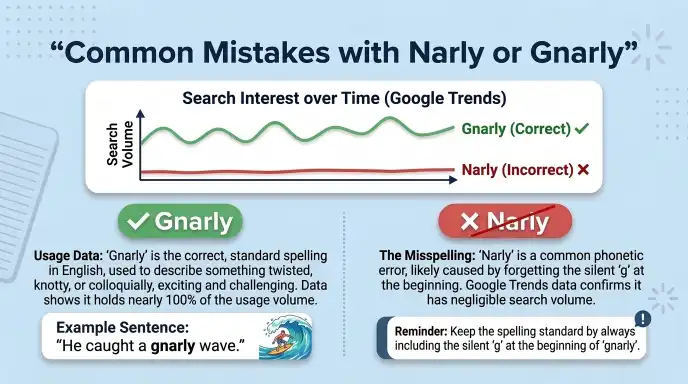
The most common mistake is leaving out the silent g. Other errors happen when writers misunderstand the word’s tone or meaning.
Writing Narly Instead of Gnarly
Incorrect: That was a narly wave.
Correct: That was a gnarly wave.
Why? The standard spelling includes the silent g. Although the incorrect form may look natural based on pronunciation, it is not the accepted spelling of the word.
Assuming Gnarly Always Means Good
Incorrect assumption: Gnarly always means amazing.
Correct understanding: Gnarly can mean rough, difficult, dangerous, extreme, or impressive.
Why? Context determines if the word expresses praise, concern, or a physical description.
Using Gnarly in Formal Writing Without a Clear Reason
Less suitable: The company faced a gnarly financial problem.
Clearer: The company faced a complex financial problem.
Why? Slang can sound informal in business or academic writing. A precise alternative often makes the meaning easier to understand.
Confusing Gnarly and Gnarled
These words are related, but their uses are not exactly the same.
- Gnarly: Can describe something rough, twisted, difficult, or extreme.
- Gnarled: Usually describes something twisted, knotty, or misshapen.
Examples:
- The tree has gnarly branches.
- The tree has gnarled branches.
Both sentences can be correct. However, gnarled focuses more directly on physical shape.
Common Errors and Corrections
| Incorrect or Less Suitable | Better Choice | Reason |
| Narly wave | Gnarly wave | Correct standard spelling |
| A narly problem | A gnarly problem | Includes the silent g |
| A gnarly report in formal writing | A complex report | More professional wording |
| Gnarly always means good | Meaning depends on context | The word has several senses |
Memory Tip
Remember this phrase: “Gnarly has a silent g.” The word sounds like “nar-lee,” but its standard spelling begins with gn.
When in doubt, check the spelling before publishing your work.
Everyday Examples of Gnarly
The word gnarly can appear in casual messages, blogs, news stories, sports coverage, and everyday conversations. The best choice depends on the subject and the audience.
In Emails
In casual emails, gnarly can describe a difficult task or problem.
Examples:
- We found a gnarly issue in the software.
- The team handled a gnarly challenge this week.
For a formal business email, complex or difficult may be better. These words communicate the problem without relying on slang.
In Business Writing
In professional writing, use gnarly only when the informal tone is suitable.
Casual: The developers fixed a gnarly bug.
Formal: The developers fixed a complex software bug.
The second example is more suitable for a formal report because it uses a clear, neutral description.
In News Headlines
The word may appear in informal news coverage, especially in sports or adventure stories.
Examples:
- Surfer Rides a Gnarly Wave
- Skater Lands a Gnarly Trick
- Climbers Face a Gnarly Route
These are illustrative headlines, not claims about specific published news reports.
In Blogs
Blogs often use gnarly to make descriptions lively and conversational.
Examples:
- The trail had a gnarly climb near the top.
- We explored a forest filled with gnarly trees.
- The repair turned into a gnarly project.
The word adds an informal tone. However, make sure the reader can understand the intended meaning.
On Social Media
On social platforms, gnarly often expresses excitement or admiration.
Examples:
- “That was a gnarly trick!”
- “What a gnarly ride!”
- “These tree roots look so gnarly.”
Depending on the post, the word may express praise, surprise, or concern.
In Academic Writing
In academic work, gnarly usually belongs in a discussion of slang, language, or informal speech.
Example: “The speaker used gnarly as an informal adjective to describe an extreme experience.”
For other academic subjects, more precise words such as complex, irregular, or twisted may be more suitable.
In Daily Conversation
Here are some natural examples:
- “That was a gnarly wave.”
- “The tree has gnarly roots.”
- “We had a gnarly day on the mountain.”
- “This is a gnarly problem to solve.”
These examples show how the same word can describe physical features, challenging situations, or exciting experiences.
Narly or Gnarly: Google Trends and Modern Usage
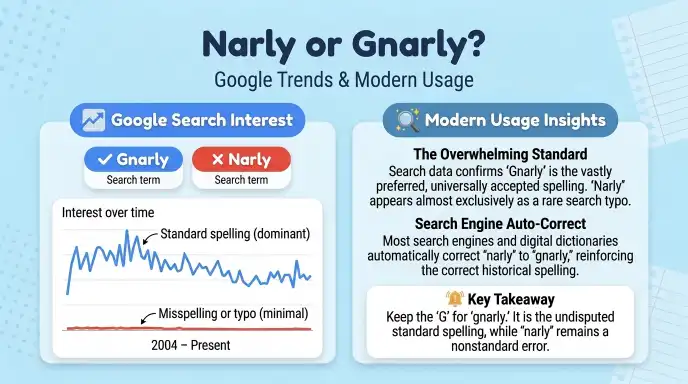
People search for narly or gnarly because the spoken word does not reveal its full spelling. Since the initial g is silent, the incorrect form may seem reasonable to someone who has only heard it.
The word also attracts interest because it has both traditional and slang meanings. For example, a reader may know it from a surfing video but still want to understand how it works in other settings.
Why Do People Search for Narly or Gnarly?
Common reasons include:
- Spelling questions: People want to know if the first letter is a g.
- Definition searches: Readers want to understand the word’s meaning.
- Slang questions: People encounter it in videos, messages, or social media posts.
- Writing help: Students and writers want to use the word correctly.
- Regional usage: Readers want to know if it is common in British or American English.
Regional Popularity
The informal use of gnarly is strongly associated with American surfing and action-sport slang. However, the word is also understood in other English-speaking regions.
Exact popularity rankings can change over time. Without current Google Trends results, it would not be accurate to claim that a particular country has the highest search interest or to provide specific percentages.
Modern Usage
Today, gnarly can be used in several ways:
- Traditional: A tree with twisted branches.
- Negative: A dangerous road or difficult situation.
- Positive: An impressive stunt or exciting ride.
- Informal: A challenging task or unusual experience.
The surrounding words usually help explain the intended meaning. Therefore, writers should consider their audience before using the slang sense.
How to Compare Search Interest
To study search interest, compare “narly or gnarly,” “gnarly meaning,” and “narly spelling” over the same time period and region.
Google Trends shows relative search interest rather than exact search volume. It can help reveal patterns, but it does not establish if a spelling is correct.
For standard writing, gnarly remains the correct choice regardless of search popularity.
Quick Comparison Table: Narly vs Gnarly
| Version | Meaning | Correct? | Region | Example |
| Gnarly | Rough or twisted | Yes | International English | The tree has gnarly roots. |
| Gnarly | Difficult or dangerous | Yes | Informal English | We faced a gnarly climb. |
| Gnarly | Extreme or impressive | Yes | Informal English | That trick was gnarly. |
| Narly | Usually a misspelling of gnarly | No, for standard usage | Any region | Write gnarly instead. |
The correct standard spelling is gnarly. Although its meaning changes with context, the spelling stays the same.
Key Takeaways
- Gnarly is the correct standard spelling.
- Narly is usually a misspelling of gnarly.
- The initial g in gnarly is silent.
- Gnarly can mean rough, twisted, difficult, dangerous, extreme, or impressive.
- The word is common in informal speech and action-sport slang.
- British and American English use the same spelling.
- In formal writing, consider words such as complex, difficult, or twisted when they communicate your meaning more clearly.
FAQs About Narly or Gnarly
Q1. Is it narly or gnarly?
Gnarly is the correct standard spelling. The initial g is silent, so the word sounds like “nar-lee.” Narly is generally considered a misspelling when you mean the common English adjective. Use gnarly in schoolwork, professional writing, articles, and other edited content.
Q2. What does gnarly mean?
Gnarly can mean rough, twisted, or full of knots. In informal English, it can also describe something difficult, dangerous, extreme, or impressive.
For example, gnarly branches are twisted, while a gnarly surfing trick may be exciting or challenging. The sentence and context help readers understand the intended meaning.
Q3. Why is the g silent in gnarly?
The word gnarly begins with the letters gn, but the initial g is not pronounced in modern English. This spelling pattern also appears in words such as gnat, gnaw, and gnome. Because the sound does not match every letter, some people mistakenly write narly.
Q4. Is gnarly a slang word?
Gnarly can be slang, especially when it means extreme, exciting, or impressive. This use is associated with surfing, skateboarding, and other action sports.
However, the word also has a traditional meaning related to rough or twisted shapes. It is not limited to slang, although some uses are more informal than others.
Q5. Does gnarly mean good or bad?
Gnarly can have either a positive or negative meaning. A gnarly accident may be serious or unpleasant, while a gnarly skateboard trick may be impressive.
In other cases, it may simply describe something rough or twisted. Always consider the sentence and situation before deciding if the word expresses praise or concern.
Q6. Is gnarly correct in British English?
Yes. Gnarly is the standard spelling in British English, just as it is in American English. There is no regional spelling change that removes the initial g.
However, the informal slang meaning may suit some audiences better than others. In formal British writing, a more precise word may be preferable.
Q7. Can I use gnarly in formal writing?
You can use gnarly in formal writing when you are discussing the word itself, quoting someone, or analyzing slang. In most professional reports and academic essays, a clearer alternative is often better.
For example, use complex problems instead of gnarly problems when you want a neutral and professional tone.
Q8. What is the difference between gnarly and gnarled?
Gnarly can describe something rough or twisted, but it also has informal meanings such as difficult or impressive. Gnarled usually describes something twisted, knotty, or misshapen, especially a tree or a person’s hands.
For example, “gnarly branches” and “gnarled branches” can both be correct, but gnarled focuses more directly on physical shape.
Conclusion: Narly or Gnarly
The correct spelling is gnarly, not narly, when you mean the common English word. The silent g may make the spelling confusing, but the standard form remains the same in British English, American English, and international writing.
The word has several meanings. It can describe rough, twisted tree branches or other uneven shapes. In informal English, it can also describe a difficult situation, a dangerous experience, or an impressive stunt. The meaning depends on context, so readers should consider the full sentence before interpreting it.
For casual conversations, blogs, and sports-related content, gnarly can add energy and personality. However, for academic papers, formal reports, and professional emails, words such as complex, difficult, twisted, or impressive may communicate the meaning more clearly.
If you are unsure which spelling to use, remember that gnarly includes a silent g. Do not remove the letter simply because you cannot hear it. Use the standard spelling, choose a meaning that fits your sentence, and keep your writing clear for your audience.
Remember: It sounds like “narly,” but the correct spelling is “gnarly.”

I’m Nora Ellis, an English language writer passionate about making grammar, spelling, and confusing words easy to understand. I share clear explanations and practical examples to help readers improve their English and use words with confidence.


2 thoughts on “Narly or Gnarly: Meaning, Usage, and Examples in English”