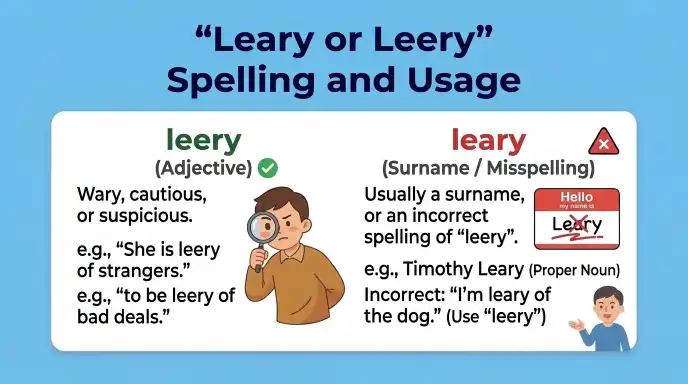
Have you ever wondered if to write leary or leery? The correct spelling for the common meaning “cautious, suspicious, or unwilling to trust” is leery.
For example, “She was leery of strangers” means she was cautious around people she did not know. Many people search for “leary or leery” because both spellings look similar and sound alike in everyday speech.
Although leery is the standard spelling of the adjective, Leary is also used as a surname and may appear in personal or family names. This difference can make the two words confusing. Choosing the right spelling depends on what you want to say.
In this guide, you will learn the meaning of leery, why people confuse it with leary, how to use it in sentences, and which spelling fits formal and informal writing. You will also find common mistakes, everyday examples, and answers to frequently asked questions.
Leary or Leery: Quick Answer
Leery is the correct spelling when you mean cautious, suspicious, or wary of something or someone.
Example: “I am leery of offers that sound too good to be true.”
Leary is commonly a surname, not the standard spelling of the adjective. Use it when referring to someone whose name is Leary.
Definition and Meaning of Leary or Leery
What Does Leery Mean?
Leery is an adjective that describes someone who feels cautious, doubtful, or suspicious about a person, situation, or offer. A leery person may hesitate because they are unsure if something is safe, honest, or reliable.
Examples:
- I am leery of clicking unknown links.
- She felt leery about accepting the offer.
- The customers were leery of the new policy.
In each sentence, leery shows a lack of trust or a careful attitude.
What Does Leary Mean?
Leary is most often used as a surname. It may refer to a person or family with that name. It is not the standard spelling of the adjective meaning cautious or suspicious.
Example: “Mr. Leary will lead the meeting.”
Here, Leary is a person’s name, so the capital letter is appropriate.
Leary vs. Leery: The Main Difference
The main difference is their use. Leery describes a feeling of caution or suspicion, while Leary is generally a proper name.
Remember this simple rule: if you mean “wary” or “suspicious,” write leery.
Origin of Leary and Leery

Origin of Leery
The word leery developed in English as a term for being wary or suspicious. It is associated with the idea of looking at someone or something cautiously. Over time, its meaning became linked to doubt, distrust, and careful judgment.
Today, writers use leery when describing a person who is not fully convinced or comfortable with a situation.
Origin of Leary
Leary is commonly found as a surname. Surnames can have different historical and linguistic origins, and their spelling does not follow the same rules as ordinary English adjectives.
Because leary and leery look and sound similar, writers may confuse them. However, similarity in spelling does not make them interchangeable.
Leary or Leery: British vs. American English
| Feature | Leery | Leary |
| Standard adjective meaning cautious | Yes | No |
| Common in American English | Yes | Used as a surname |
| Common in British English | Yes | Used as a surname |
| Meaning “suspicious or wary” | Correct | Nonstandard spelling |
| Used as a person’s name | Possible only if that is the name | Yes |
Leery is the standard spelling in both British and American English when describing caution or suspicion. There is no usual regional spelling difference for this adjective.
Which Spelling Should You Use?
In American English
Use leery when writing for an American audience. It is the standard spelling in everyday, professional, and academic writing.
Example: “Investors are leery of risky business deals.”
In British English
British English also uses leery to mean cautious or suspicious. You do not need to change it to leary for a British audience.
Example: “She was leery of the unfamiliar neighbourhood.”
In Canadian and Australian English
Use leery in Canadian and Australian writing as well. The adjective keeps the same spelling across these varieties of English.
In Academic and Business Writing
Choose leery when you want to describe doubt or caution. In formal writing, you may also use alternatives such as wary, cautious, or suspicious, depending on the sentence.
Example: “The committee remained wary of the proposed changes.”
In Names and Personal References
Use Leary when it is someone’s actual surname. Proper names should follow the person’s established spelling.
Example: “Dr. Leary presented the research findings.”
Common Mistakes with Leary or Leery
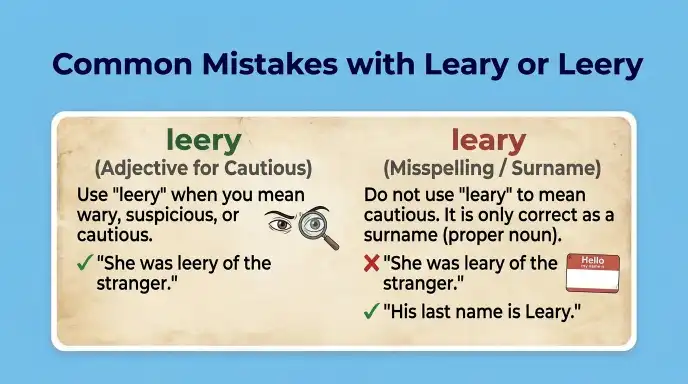
Writers often choose leary because it looks like a possible spelling of the adjective. However, leery is the standard choice for the meaning “cautious or suspicious.”
| Incorrect or Confusing Usage | Correct Usage | Explanation |
| I am leary of strangers. | I am leery of strangers. | Leery means cautious or suspicious. |
| She was leary about the offer. | She was leery about the offer. | Use leery for doubt or distrust. |
| They are leary of online scams. | They are leery of online scams. | Leery is the standard adjective. |
| Mr. Leery attended the meeting. | Mr. Leary attended the meeting, if that is his name. | Personal names must use the correct spelling. |
How to Avoid These Mistakes
Follow these simple tips:
- Use leery when you mean cautious, wary, or suspicious.
- Use Leary when referring to a person with that surname.
- Check the sentence’s meaning before choosing a spelling.
- In formal writing, replace leery with wary or cautious if that makes your meaning clearer.
Leary or Leery in Everyday Examples
Everyday Conversations
- “I’m leery of trying food from a place I don’t know.”
- “He seemed leery when I mentioned the plan.”
- “Are you leery of buying things online?”
Emails and Workplace Writing
- “Our team is leery of making changes without more information.”
- “The client was leery of the revised agreement.”
- “I am leery of approving the proposal until we review the costs.”
Academic Writing
- “Participants were leery of claims that lacked supporting evidence.”
- “The researchers remained leery of drawing conclusions from a small sample.”
News and Reports
- “Consumers remain leery of products with unclear safety information.”
- “Some residents are leery of the proposed development.”
Social Media and Text Messages
- “I’m leery of that website. It looks suspicious.”
- “She was leery about meeting someone she had only spoken to online.”
- “Be leery of messages asking for your password.”
These examples show how leery works in both casual and formal contexts.
Leary or Leery: Google Trends and Modern Usage
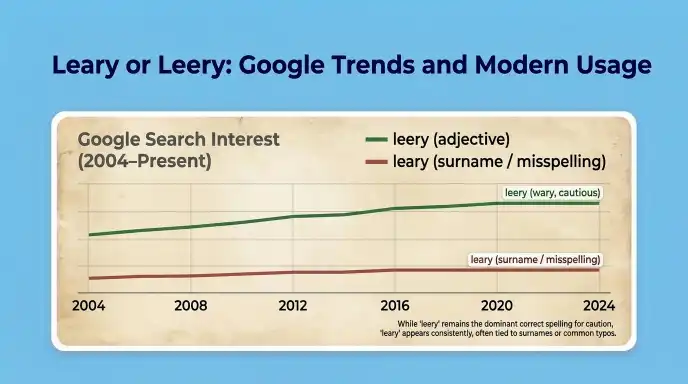
People may search for leary or leery because the words look similar and can be pronounced alike. The search usually reflects a spelling question: which form should be used to express caution or suspicion?
In modern English, leery is the standard adjective. It appears in conversations, news writing, business communication, and online discussions.
Leary continues to appear as a surname and in references to people who have that name. Search results for the two spellings may therefore include different types of content.
Without checking current Google Trends data, it would not be accurate to claim an exact search volume or say how much more popular one spelling is. The practical writing rule remains clear: use leery for the adjective and Leary for the surname when that is the correct name.
Leary vs. Leery: Comparison Table
| Word | Part of Speech or Use | Meaning | Example |
| Leery | Adjective | Cautious, wary, or suspicious | I am leery of the offer. |
| Leary | Proper noun, usually a surname | A person’s family name | Ms. Leary joined the discussion. |
The words are not interchangeable in standard writing. Choose the spelling that matches the meaning you intend to express.
Key Takeaways
- Leery is the standard spelling of the adjective meaning cautious or suspicious.
- Leary is generally used as a surname.
- Both British and American English use leery for the adjective.
- Use context to decide which spelling belongs in your sentence.
- In formal writing, wary and cautious can serve as alternatives to leery.
Frequently Asked Questions
Q1. Is it leary or leery?
Leery is correct when you mean cautious, suspicious, or wary. Leary is generally a surname. For example, write “I am leery of the offer,” but use “Leary” if it is someone’s actual name.
Q2. What does leery mean?
Leery means cautious, suspicious, or unwilling to trust something fully. A person may feel leery when a situation seems risky or uncertain. For example, “She was leery of the deal” means she did not fully trust the offer.
Q3. Is leary a real word?
Leary is a real spelling, most commonly used as a surname. However, it is not the standard spelling of the adjective meaning cautious or suspicious. For that meaning, use leery.
Q4. Is leery correct in American English?
Yes. Leery is the standard spelling in American English when describing caution or suspicion. For example, “The buyers were leery of the unusually low price.” The spelling does not change to leary in American usage.
Q5. Is leery correct in British English?
Yes. British English also uses leery to mean wary or suspicious. The spelling is the same in British and American English, so you can use it for either audience.
Q6. What is a synonym for leery?
Common synonyms for leery include wary, cautious, suspicious, distrustful, and guarded. The best choice depends on the context. Wary and cautious are often suitable when you want a neutral tone.
Q7. How do you use leery in a sentence?
You can use leery to describe doubt or caution about a person, plan, or situation. For example, “I am leery of offers that promise guaranteed profits.” This sentence shows that the speaker does not fully trust the offer.
Q8. Are leary and leery pronounced the same?
They are often pronounced alike or very similarly in English. This is one reason people confuse their spelling. However, pronunciation does not make them interchangeable: leery is the standard adjective, while Leary is commonly a surname.
Conclusion:
When deciding between leary or leery, the correct choice depends on what you want to communicate. Leery is the standard English adjective for someone who feels cautious, doubtful, or suspicious. You can use it when describing concerns about a person, an offer, a website, a decision, or an unfamiliar situation.
Leary, on the other hand, is commonly used as a surname. It should not replace leery when you want to express distrust or caution. This distinction applies in both British and American English, so there is no need to choose a different spelling based on the country.
To avoid mistakes, remember this simple rule: use leery to describe a feeling and Leary for a name when that is the person’s correct spelling. Once you understand this difference, choosing the right word becomes much easier in everyday conversations, emails, schoolwork, and professional writing.

I’m Nora Ellis, an English language writer passionate about making grammar, spelling, and confusing words easy to understand. I share clear explanations and practical examples to help readers improve their English and use words with confidence.