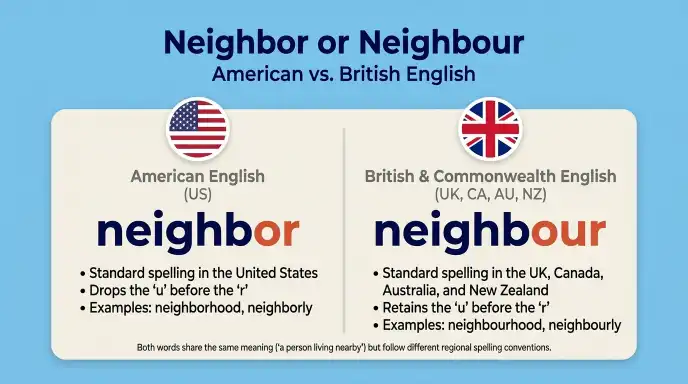
Neighbor and neighbour are both correct spellings, but neighbor is used in American English, while neighbour is used in British English. Both words mean a person who lives near you, such as someone next door or on your street. The difference is only in spelling, not meaning.
Many people search for “neighbor or neighbour” because they want to know which spelling to use in schoolwork, emails, articles, or other writing. The extra u can make the British spelling look different, but it does not change how the word is used. Both forms refer to people who live nearby.
Choosing the right spelling depends on your audience. If you are writing for readers in the United States, use neighbor. If you are writing for readers in the United Kingdom, use neighbour. Other countries may follow British or American spelling conventions, so it helps to know who will read your work.
In this guide, you will learn the meanings, origins, spelling rules, common mistakes, and everyday uses of both words. You will also find simple examples to help you choose the right spelling every time.
Neighbor or Neighbour: Quick Answer
Both neighbor and neighbour are correct.
- Neighbor is the standard American English spelling.
- Neighbour is the standard British English spelling.
Examples:
- American English: My neighbor has a friendly dog.
- British English: My neighbour has a friendly dog.
Both sentences have the same meaning. The only difference is the spelling.
Definition and Meaning of Neighbor or Neighbour
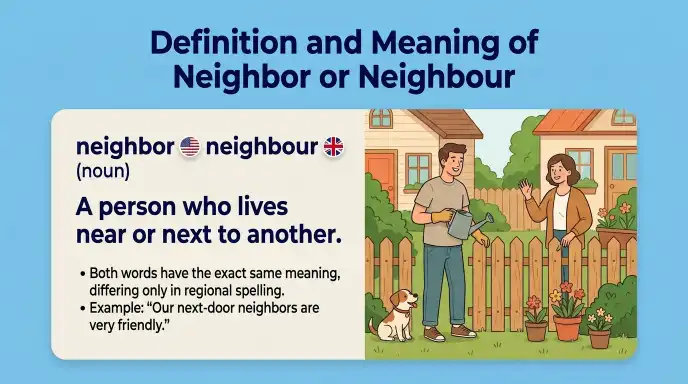
What Does Neighbor or Neighbour Mean?
A neighbor or neighbour is a person who lives near another person. This may be someone who lives next door, in the same building, or nearby in the same area.
Examples:
- My neighbor helped me carry my bags.
- Our neighbour invited us to dinner.
- I often see my neighbor at the local shop.
Both spellings have the same meaning. The correct form depends on the type of English you are using.
Neighbor or Neighbour as a Noun
The word is most often used as a noun. It describes a person who lives close to you.
Examples:
- Our neighbor is very kind.
- My neighbour has moved to another house.
- We invited our neighbors to the party.
The plural form is neighbors in American English and neighbours in British English.
Neighbor or Neighbour as a Verb
The word can also be used as a verb, although this use is less common in everyday conversation. As a verb, it means to be next to or close to something.
Examples:
- The park neighbors the school.
- The two properties neighbour each other.
The verb follows the same regional spelling pattern. American English uses neighbor, while British English uses neighbour.
Neighborly or Neighbourly
The same spelling difference appears in related words.
- American English: neighborly
- British English: neighbourly
Both mean friendly, helpful, or kind toward people who live nearby.
Example: “They showed a neighborly attitude by helping the new family.”
The Origin of Neighbor or Neighbour
The word neighbor comes from Old English nēahgebūr. It combines elements linked to being near and being a person who lives in a particular place. Over time, the word developed into the modern English term for someone who lives nearby.
The spelling changed as English developed. British English kept the u in words such as neighbour, while American English often removed the u from similar words.
This pattern can also be seen in other word pairs:
- Colour in British English and color in American English
- Favour in British English and favor in American English
- Labour in British English and labor in American English
These differences became more established as American spelling conventions developed. American lexicographer Noah Webster helped promote simpler and more consistent spelling forms in the United States.
Today, neighbor and neighbour remain accepted regional spellings. Neither is wrong when used in the correct variety of English.
British English vs American English Spelling
The main difference between neighbor and neighbour is the letter u. American English leaves it out, while British English keeps it.
| Feature | American English | British English |
| Singular | Neighbor | Neighbour |
| Plural | Neighbors | Neighbours |
| Related adjective | Neighborly | Neighbourly |
| Verb | Neighbor | Neighbour |
| Common usage | United States | United Kingdom |
| Meaning | Person living nearby | Person living nearby |
Examples in American English
American writers use neighbor in everyday and formal writing.
- My neighbor works at the hospital.
- We invited our neighbors to dinner.
- She is a friendly and neighborly person.
Examples in British English
British writers usually use neighbour.
- My neighbour works at the hospital.
- We invited our neighbours to dinner.
- She is a friendly and neighbourly person.
Remember: The meaning stays the same. Only the spelling changes.
Which Spelling Should You Use?
The best spelling depends on your audience, location, and writing style.
For American Readers
Use neighbor when writing for people in the United States. This spelling is expected in American schools, newspapers, websites, business emails, and official documents.
Example: “My neighbor helped me repair the fence.”
For British Readers
Use neighbour when writing for people in the United Kingdom. It is the standard spelling in British English.
Example: “My neighbour helped me repair the fence.”
For Canadian Readers
Canadian English often uses British-style spellings, including neighbour. However, Canadian spelling has its own conventions, and usage can vary by word and context. For most Canadian writing, neighbour is the usual choice.
For Australian Readers
Australian English generally follows British spelling conventions. Use neighbour in schoolwork, articles, business communication, and other writing for an Australian audience.
For International Readers
If your readers come from many countries, choose one spelling style and use it consistently. You can use neighbor for an American English style or neighbour for a British English style.
For Academic and Business Writing
Follow the style guide required by your school, university, employer, or publication. Do not switch between neighbor and neighbour in the same piece of writing unless you are quoting a source or discussing spelling differences.
Consistency makes your writing look clear and professional.
Common Mistakes with Neighbor or Neighbour
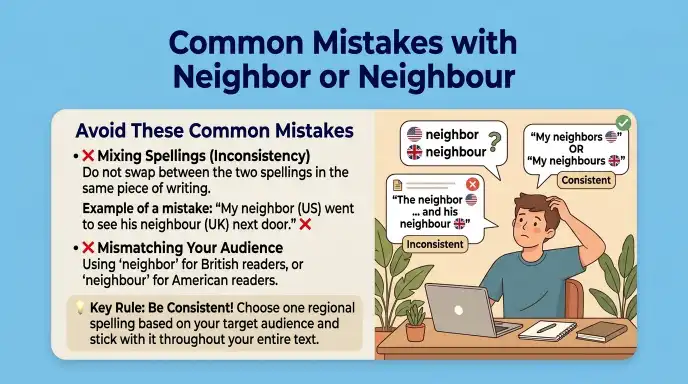
Writers sometimes mix American and British spellings. Others may use the correct spelling in the singular but forget to keep the same style in related words.
| Common Mistake | Correct American English | Correct British English |
| Mixing both forms | My neighbor is kind. | My neighbour is kind. |
| Incorrect plural style | Neighbors | Neighbours |
| Incorrect related adjective for the chosen style | Neighborly | Neighbourly |
| Changing spelling within one article | Neighbor throughout | Neighbour throughout |
Mixing Regional Spellings
Avoid using neighbor in one paragraph and neighbour in another when you are writing in one consistent style.
Incorrect: My neighbor is friendly. My neighbour often helps me.
Correct American style: My neighbor is friendly. My neighbor often helps me.
Correct British style: My neighbour is friendly. My neighbour often helps me.
Assuming One Spelling Is Wrong
Both spellings are correct. The difference comes from regional spelling conventions, not from a difference in meaning.
Forgetting the Plural
The plural follows the same pattern:
- American English: neighbors
- British English: neighbours
Using the Wrong Style for Your Audience
If you are writing for a British newspaper, neighbour is usually the better choice. If you are writing for an American publication, use neighbor.
Neighbor or Neighbour in Everyday Examples
Both forms work in many situations. Choose the spelling that matches your preferred English style.
In Emails
American English:
“Hello, I wanted to let you know that my neighbor will collect the package this afternoon.”
British English:
“Hello, I wanted to let you know that my neighbour will collect the package this afternoon.”
In News Writing
American English:
“A neighbor reported seeing smoke near the building.”
British English:
“A neighbour reported seeing smoke near the building.”
On Social Media
American English:
“My neighbor brought me fresh cookies today. So kind!”
British English:
“My neighbour brought me fresh biscuits today. So kind!”
In Formal Writing
American English:
“The neighbor provided a statement about the incident.”
British English:
“The neighbour provided a statement about the incident.”
In Schoolwork
American English:
“Write three sentences about your neighbor.”
British English:
“Write three sentences about your neighbour.”
In each example, the word has the same meaning. The spelling changes to match the regional style.
Neighbor or Neighbour: Google Trends and Usage Data
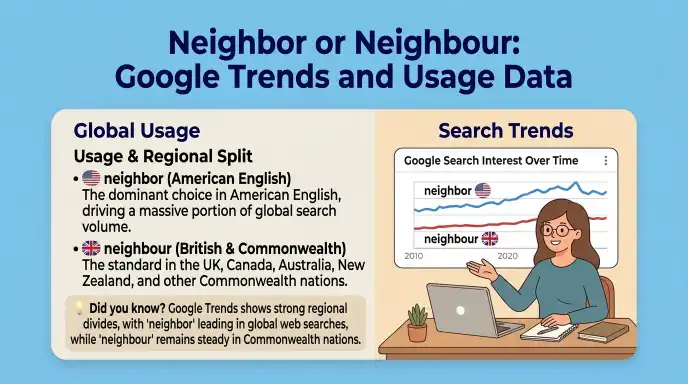
The search phrase “neighbor or neighbour” usually reflects a spelling question. People want to know if the word needs a u and which form is right for their audience.
The two spellings are linked to different regional conventions:
- Neighbor is associated mainly with the United States.
- Neighbour is associated mainly with the United Kingdom, Australia, and commonly British-style Canadian spelling.
These patterns explain why both forms appear in English-language content around the world. Search interest may also change depending on school assignments, writing tasks, and the location of the people searching.
Google Trends can help compare interest in the two spellings over a selected time and region. However, its results show relative search interest rather than exact search counts. Without checking live data for a specific period and country, it would be misleading to provide exact popularity figures.
For practical writing, you do not need search statistics to decide. Use neighbor for American English and neighbour for British English and other audiences that follow that spelling convention.
Neighbor vs Neighbour: Comparison Table
| Word or Variation | American English | British English |
| Singular noun | Neighbor | Neighbour |
| Plural noun | Neighbors | Neighbours |
| Related adjective | Neighborly | Neighbourly |
| Verb | Neighbor | Neighbour |
| Meaning | Someone who lives nearby | Someone who lives nearby |
| Correctness | Correct in American English | Correct in British English |
This comparison shows that the spelling pattern applies to more than one form of the word. Remember to keep the same style throughout your writing.
Frequently Asked Questions
Q1. Is it neighbor or neighbour?
Both neighbor and neighbour are correct. Neighbor is the American English spelling, while neighbour is the British English spelling. Both words mean a person who lives nearby. Choose the form that matches your audience and keep it consistent throughout your writing.
Q2. Which spelling is American: neighbor or neighbour?
Neighbor is the standard American English spelling. Writers in the United States use it in everyday communication, schoolwork, newspapers, and professional documents. The plural is neighbors, and the related adjective is neighborly.
Q3. Which spelling is British: neighbor or neighbour?
Neighbour is the standard British English spelling. It keeps the letter u, as do words such as colour and favour. Its plural is neighbours, and the related adjective is neighbourly.
Q4. Does neighbor or neighbour have a different meaning?
No. Neighbor and neighbour have the same meaning. Both describe a person who lives near another person. The difference is regional spelling, not meaning or pronunciation in ordinary use.
Q5. Is neighbour correct in Canada?
Yes. Neighbour is commonly used in Canadian English and is the usual spelling in many Canadian writing contexts. Canadian spelling follows British conventions for some words, although it has its own rules and exceptions. Follow the style guide required for your work.
Q6. Is neighbor or neighbour correct in Australia?
Neighbour is the standard spelling in Australian English. Australia generally follows British spelling conventions for this word. Use neighbour, neighbours, and neighbourly when writing for an Australian audience.
Q7. What is the plural of neighbor or neighbour?
The plural depends on the spelling style. In American English, write neighbors. In British English, write neighbours. Both forms refer to two or more people who live nearby.
Q8. How do you spell neighborly in British English?
In British English, the word is spelled neighbourly. In American English, it is neighborly. Both words describe someone who is friendly, helpful, or kind toward people living nearby.
Conclusion:
The choice between neighbor or neighbour depends on the type of English you are using. Both spellings are correct, and both describe a person who lives near you. The only difference is regional spelling.
Use neighbor when writing in American English. Use neighbour when writing in British English. The same pattern applies to related forms, including neighbors/neighbours and neighborly/neighbourly. Canadian and Australian English commonly use neighbour, although you should always follow the style guide required for your work.
If you write for an international audience, select one spelling style and use it consistently. This makes your writing easier to read and helps it look professional. Do not worry about one spelling being universally right and the other wrong. Each is correct in its own regional context.
The easiest rule to remember is simple: American English usually drops the u, while British English keeps it. Once you know your audience, choosing the correct spelling becomes easy.

I’m Nora Ellis, an English language writer passionate about making grammar, spelling, and confusing words easy to understand. I share clear explanations and practical examples to help readers improve their English and use words with confidence.