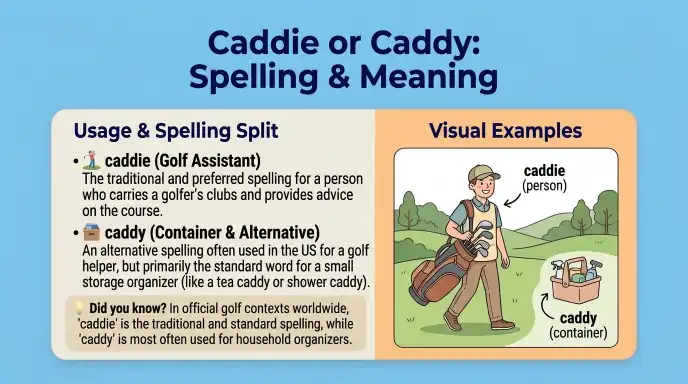
Caddie and caddy are both correct spellings, but their meanings and uses can differ. A caddie usually helps a golfer by carrying clubs and offering advice, while a caddy can refer to a golf assistant or a small container used to store or carry items.
People often search for “caddie or caddy” because the words sound alike and sometimes share the same meaning. Choosing the right spelling depends on the context and the type of writing.
In golf, caddie is a traditional and widely used spelling, especially in professional golf. However, caddy is also an accepted spelling for a golf assistant. Outside golf, caddy commonly refers to a container, such as a tea caddy or a shower caddy.
These differences can make the choice confusing for students, writers, and English learners. This guide explains the meaning, origin, and usage of both words.
You will learn how British and American English use them, which spelling to choose for different audiences, and how to avoid common mistakes. Clear examples and practical tips will help you use caddie and caddy with confidence.
Caddie or Caddy: Quick Answer
Both caddie and caddy are correct spellings.
- Caddie: Commonly refers to a person who carries golf clubs and assists a golfer.
- Caddy: Can also refer to a golf assistant. It is also commonly used for a container that holds or carries items.
Examples:
- The golfer thanked his caddie after the match.
- She placed the tea bags in a caddy.
Quick tip: For a person who assists a golfer, either spelling may be correct. For a storage container, caddy is the usual choice.
Definition and Meaning of Caddie or Caddy
What Does Caddie Mean?
Caddie is a noun that usually describes a person who carries golf clubs for a golfer. A caddie may also help the golfer by giving advice about clubs, distances, or the course.
Examples:
- The golfer spoke with his caddie before taking the shot.
- Her caddie carried the golf bag across the course.
- The professional golfer trusted his experienced caddie.
In golf, the caddie plays a useful role by helping the player prepare for each shot and manage equipment.
What Does Caddy Mean?
Caddy is a noun with several common uses. It can refer to a container designed to hold or carry items. Examples include a tea caddy, a shower caddy, and a desk caddy.
The word caddy can also mean a person who assists a golfer. In this sense, it is an accepted alternative spelling of caddie.
Examples:
- She keeps her tea leaves in a metal caddy.
- I bought a shower caddy to organize my toiletries.
- The golfer thanked his caddy after the final hole.
Context and Usage
The meaning depends on the sentence.
Use caddie when you want to refer specifically to a golf assistant and prefer the traditional spelling. Use a caddy for a storage container. When describing a golf assistant, either spelling can be correct.
The Origin of Caddie and Caddy
Origin of Caddie
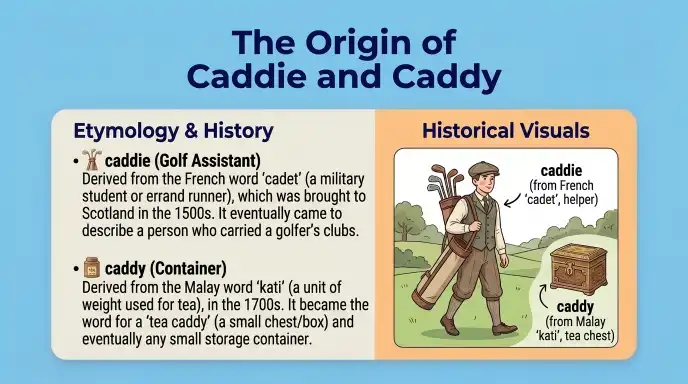
The word caddie is linked to the French word cadet, which refers to a younger person or junior member. The word entered Scots usage, where it was associated with a young person who performed errands or carried items.
Over time, the term became closely connected with golf. A caddie came to mean someone who carries golf clubs and assists a player around the course.
Origin of Caddy
Caddy developed as a spelling variant of caddie and became established in English. It is used for golf assistants as well as containers that hold or carry things.
The container meaning is often associated with tea storage, including tea caddies used to keep tea leaves. Today, caddy is also common in phrases such as shower caddy, desk caddy, and tool caddy.
Why Do the Spellings Differ?
English has many words with more than one accepted spelling. Some differences develop through historical usage, while others become established in particular contexts.
Caddie is strongly associated with golf, while caddy is especially common for containers. However, these are usage preferences, not strict rules that make the two spellings completely separate in every context.
British English vs American English Spelling
Both caddie and caddy are used in British and American English. The main difference is often the context rather than the country.
| Feature | Caddie | Caddy |
| British English | Used for a golf assistant | Used for a golf assistant and containers |
| American English | Used for a golf assistant | Used for a golf assistant and containers |
| Golf-related meaning | Correct | Also correct |
| Storage container | Less common | Common |
| Tea storage | Less common | Common |
| Shower or desk organizer | Uncommon | Common |
Examples in British English
- The golfer thanked his caddie after the round.
- She stored the tea in a decorative caddy.
- He bought a shower caddy for the bathroom.
Examples in American English
- The player discussed the course with his caddie.
- I keep my tools in a small caddy.
- She placed the tea bags in a kitchen caddy.
Important: Neither spelling belongs exclusively to British or American English. Choose the word that best fits the meaning and follow the spelling used by your organization or publication.
Which Spelling Should You Use?
For American Readers
Use caddie when referring to a golf assistant if you prefer the traditional golf spelling. Caddy is also acceptable in this meaning. For a container, use a caddy.
Example: “The golfer thanked his caddie for the helpful advice.”
For British Readers
British English also uses caddie and caddy for golf assistants. For a container, caddy is the usual choice.
Example: “She placed the tea leaves in a tea caddy.”
For Canadian and Australian Readers
Both spellings can be understood in Canadian and Australian English. Use caddie or caddy for a golf assistant according to your preferred style, and use caddy for a storage container.
For Academic and Professional Writing
In formal writing, choose the spelling that fits the meaning. If you are writing about golf, caddie is a clear and traditional choice. If you mean a container, caddy is generally more appropriate.
Be consistent throughout the document. If you are following a style guide, dictionary, or publication’s house style, use its preferred form.
For Global Audiences
For international readers, make the meaning clear through context. If the word could be confusing, write golf caddie or storage caddy on the first mention.
This small change helps readers understand exactly what you mean.
Common Mistakes with Caddie or Caddy
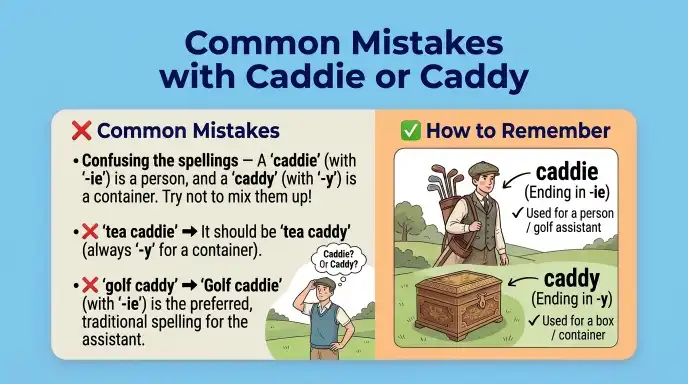
Writers sometimes assume that one spelling is always correct and the other is always wrong. In reality, both spellings are accepted, but they are not equally common in every context.
| Common Mistake | Better Choice | Explanation |
| Calling caddy an incorrect word | Recognize both spellings | Both can refer to a golf assistant. |
| Writing “tea caddie” for a storage container | Tea caddy | Caddy is the usual spelling for a container. |
| Using “caddie” for a shower organizer | Shower caddy | Caddy is the standard everyday term. |
| Assuming caddie is used only in Britain | Check the context | Caddie is also used in American English. |
| Switching spellings without a reason | Stay consistent | Consistency improves readability. |
How to Avoid These Mistakes
Follow these simple tips:
- Use caddie for a golf assistant when you prefer the traditional spelling.
- Use caddy for a container that stores or carries items.
- Remember that caddy can also mean a golf assistant.
- Check a reliable dictionary if a particular context requires a specific spelling.
- Keep the spelling consistent within the same article or document.
Caddie or Caddy in Everyday Examples
In Emails
When writing about golf, you could say, “Please confirm if a caddie will be available for our golf session.”
For a shopping request, try this: “I would like to order a tea caddy for the kitchen.”
In News and Sports Reports
During a golf match, a reporter might say, “The golfer consulted his caddie before choosing a club.”
After the game, another report could state, “The player praised his caddy for helping him read the course.”
In Social Media
Golf fans might post, “A good caddie can help a golfer make better decisions on the course.”
For a home organization post, you could write, “My new shower caddy keeps everything organized.”
Sharing a kitchen purchase? Try this caption: “Finally found a tea caddy that looks great in my kitchen!”
In Formal Writing
In a golf report, write, “The golfer’s caddie offered advice about the course conditions.”
For a product description, use this example: “The tea caddy provides a convenient way to store loose tea leaves.”
When discussing organization tools, you could say, “A portable tool caddy can help keep equipment organized.”
In Everyday Conversation
You might ask, “Where did you put the bathroom caddy?”
After a golf game, someone could say, “The golfer thanked his caddie.”
For art supplies, try asking, “Can you help me find a small caddy to carry my materials?”
These examples show that the correct choice depends on the meaning and context.
Caddie or Caddy: Google Trends and Usage Data
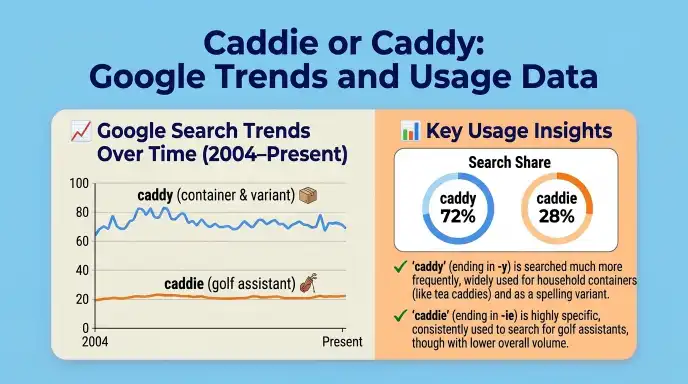
People search for caddie or caddy because the spellings are similar and both can describe a person who assists a golfer. The word caddy also has other common meanings, especially for containers used to store or carry items.
Search interest may vary by country and topic. Golf-related searches may use either spelling, while searches for products such as tea caddies, shower caddies, and desk caddies are likely to use caddy.
However, exact popularity depends on the search term, country, and date range. Without checking live Google Trends data, it would not be accurate to provide exact search volumes or claim that one spelling is always more popular worldwide.
For content, match the spelling to the reader’s intent. An article about golf can include both forms and explain their shared meaning. A page about storage products should generally use caddy in the title and main headings.
Caddie vs Caddy: Comparison Table
| Word | Main Meaning | Common Context | Example |
| Caddie | A person who assists a golfer | Golf | The caddie carried the golf bag. |
| Caddy | A container for storing or carrying items | Home and organization | She bought a shower caddy. |
| Caddy | A person who assists a golfer | Golf | The golfer spoke to his caddy. |
| Tea caddy | A container for storing tea | Kitchen and tea storage | The tea caddy is on the shelf. |
| Golf caddie | A golf assistant | Sports | The golf caddie studied the course. |
The easiest way to remember the difference is that caddie is strongly associated with golf, while caddy is the usual spelling for a storage container. Both can be used for a golf assistant.
Frequently Asked Questions
Q1. Is it caddie or caddy?
Both caddie and caddy are correct. Caddie is a traditional spelling for a person who assists a golfer. Caddy can also refer to a golf assistant and is commonly used for a container. Choose the spelling that fits your meaning.
Q2. What is the difference between a caddie and a caddy?
A caddie usually refers to someone who carries golf clubs and helps a golfer. A caddy can mean the same thing, but it is also commonly a container for holding items, such as tea, toiletries, or tools. Context helps you understand the intended meaning.
Q3. Is caddie the correct spelling in golf?
Yes. Caddie is a traditional and widely accepted spelling in golf. However, caddy is also an accepted spelling for a golf assistant. If you are writing a golf article, choose one form and use it consistently.
Q4. Is caddy only used for a container?
No. Caddy can refer to a container, but it can also mean a person who assists a golfer. For example, “She bought a shower caddy” refers to a container, while “The golfer thanked his caddy” refers to a golf assistant.
Q5. Is caddie British or American English?
Caddie is used in both British and American English. It is not exclusive to one country. Likewise, caddy is used in both varieties, especially for containers. The choice depends more on meaning and style than on regional spelling rules.
Q6. What is a tea caddy?
A tea caddy is a container used to store tea leaves or tea bags. It may be made of metal, wood, ceramic, or another material. The spelling caddy is the usual choice for this type of container.
Q7. Which spelling should I use in an article?
Choose the spelling that matches the subject. Use caddies when focusing on a golf assistant, while acknowledging that caddy is also accepted. Use caddy for storage containers and related products. Include both terms naturally when they help answer the reader’s question.
Conclusion:
When choosing between caddie or caddy, remember that both spellings are correct, but they often appear in different contexts. Caddie is a traditional and widely used spelling for a person who carries golf clubs and assists a golfer.
Caddy can also describe a golf assistant, so it is not incorrect in golf-related writing. However, caddy is the usual spelling for containers used to store or carry items, such as tea, toiletries, and tools.
There is no strict British-versus-American spelling rule that separates these words. Both forms appear in British and American English. The best choice depends on what you mean, the audience you are writing for, and any style guide you need to follow.
For clear writing, use caddie when discussing golf if you prefer the traditional form, and use caddy when describing a container. If your article covers both meanings, explain the difference early and use each word consistently.
These simple steps will help readers understand your message and help your content match the search intent behind the keyword.

I’m Nora Ellis, an English language writer passionate about making grammar, spelling, and confusing words easy to understand. I share clear explanations and practical examples to help readers improve their English and use words with confidence.