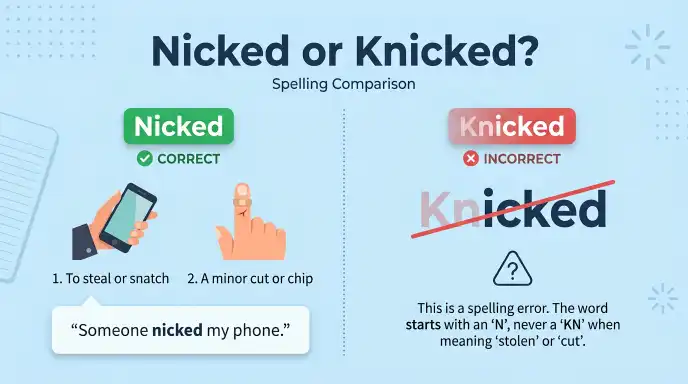
The correct spelling is nicked, not knicked, in standard English. The word nicked can mean stolen, cut slightly, or marked with a small notch. In informal British English, it can also mean arrested.
People often search for nicked or knicked because both words sound the same. English has words such as knife, knock, and knee that begin with a silent k. This pattern can make people think that knicked is also correct. However, the standard spelling of this word begins with n, not kn.
For example, you can write, “Someone nicked my pen,” to say that someone took it without permission. You can also say, “I nicked my finger while cooking,” to describe a small cut. In British slang, “The police nicked the thief” means the police arrested the thief.
Knowing the correct spelling helps you write clearly in school assignments, emails, blog posts, and everyday messages. This guide explains the meaning, origin, grammar, regional usage, and common mistakes linked to nicked and knicked. You will also learn how to use the word in different situations.
Nicked or Knicked: Featured Snippet Answer
Nicked is the correct spelling in standard English. Knicked is not a standard spelling of the word. Nicked is the past tense of nick and can mean stole something, made a small cut, or created a small notch. In informal British English, it can also mean arrested. For example, “Someone nicked my phone.”
Nicked or Knicked: Quick Answer
Use nicked, not knicked, in standard English writing.
- Nicked: The correct past-tense form of nick.
- Knicked: A nonstandard spelling that should generally be avoided.
- Nicked: Can mean stolen, slightly cut, or notched.
- Nicked: Can also mean arrested in informal British English.
Examples:
- Someone nicked my wallet.
- I nicked my finger with a knife.
- The edge of the glass was nicked.
- The police nicked the suspect.
Easy rule: Remember nick + ed = nicked. There is no k before the n.
What Does Nicked or Knicked Mean?
The words nicked and knicked may look similar, but only nicked is the standard spelling for the meanings explained in this article.
Nicked Means Stolen
In informal English, especially British English, nicked can mean stolen or taken without permission.
Examples:
- Someone nicked my phone on the bus.
- My brother nicked a biscuit from the kitchen.
- Someone has nicked my favourite pen.
In these examples, nicked means stole or took something without permission.
Nicked Means Cut Slightly
The word nicked can also describe a small cut or minor injury.
Examples:
- I nicked my finger while shaving.
- She nicked her hand with a sharp blade.
- He nicked his skin while trimming his beard.
Here, nicked means made a small cut. It does not usually suggest a deep wound.
Nicked Means Chipped or Notched
A small cut or notch on an object can also be called a nick.
Examples:
- I found a nicked edge on the plate.
- The knife has a nicked blade.
- The wooden surface was nicked during the move.
This meaning is common when describing damage to tools, furniture, glass, and other objects.
Nicked Means Arrested
In informal British English, nicked can mean arrested by the police.
Examples:
- The police nicked the suspect.
- He got nicked for stealing a bike.
- The man was nicked after the incident.
This use is slang. In formal reports, use arrested instead.
Is Knicked Ever Correct?
Knicked is generally a misspelling when you mean stolen, slightly cut, chipped, or arrested.
The standard forms are:
- Nick
- Nicks
- Nicked
- Nicking
Example:
Correct: She nicked my pencil.
Incorrect: She knicked my pencil.
The Origin of Nicked or Knicked
The word nicked comes from the verb nick. English uses this verb for several related ideas, including making a small cut or notch. It also has informal meanings, such as stealing something or arresting someone.
The exact history of every meaning is complex. It is best not to assume that all these meanings developed at the same time.
Where Does Nick Come From?
The verb nick has a long history in English. Its meaning of making a small cut or notch is linked to the idea of a small mark or break in a surface.
Over time, the word gained other uses. In informal British English, nick came to mean steal, while to nick someone can mean arrest them.
The past tense of the verb is nicked. English adds -ed to many regular verbs to form the past tense.
Examples:
- Present: I nick the surface by accident.
- Past: I nicked the surface by accident.
- Present: Someone nicks my things.
- Past: Someone nicked my things.
Why Is Knicked Incorrect?
English has many words that begin with a silent k, including knife, knock, and knee. This pattern may lead some people to think that knicked is the correct spelling.
However, nick does not begin with a silent k. It begins with the letter n, so its past tense is nicked.
| Base Word | Correct Past Tense | Incorrect Form |
| Nick | Nicked | Knicked |
| Kick | Kicked | Knicked |
| Pick | Picked | Knicked |
| Pack | Packed | Knacked |
Remember: The spelling of a word does not change simply because another word has a silent letter. Learn the correct base word first, then form its past tense.
Nicked or Knicked: British English vs American English
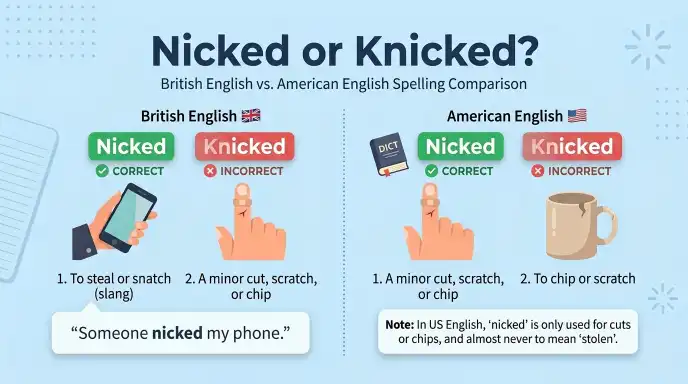
Both British English and American English use the spelling nicked. There is no standard regional spelling difference between nicked and knicked.
The main difference is how commonly certain meanings appear in everyday speech. The slang meaning of nicked, especially stolen or arrested, is strongly associated with informal British English.
| British English | American English | Example |
| Nicked is correct | Nicked is correct | The edge was nicked. |
| Informally, stolen | Less common as everyday slang for stolen | Someone nicked my bag. |
| Informally, arrested | Not the usual everyday choice | The police nicked him. |
| A small cut or notch | A small cut or notch | I nicked my finger. |
| Knicked is nonstandard | Knicked is nonstandard | Write nicked instead. |
British English Usage
In Britain, people may use nicked in casual conversation to mean stolen or arrested.
Examples:
- “Someone nicked my lunch.”
- “He got nicked by the police.”
These expressions are informal. They may suit a conversation, a character’s dialogue, or a casual blog. However, they are not usually the best choice for a formal report.
American English Usage
American English speakers also understand nick as a word for a small cut or notch. For theft, stole is often a clearer everyday choice. For police action, arrested is more suitable in most contexts.
Examples:
- I nicked my finger while cooking.
- Someone stole my backpack.
- The police arrested the suspect.
What About Style Guides?
Formal writing should use words that fit the audience and purpose.
- Academic writing: Use precise terms such as stole, cut, or arrested.
- News writing: Use stole or arrested when those words clearly describe the event.
- Creative writing: Use nicked when it fits a character’s voice or the setting.
- Casual writing: Use nicked naturally when your audience understands the slang.
The spelling remains nicked in all these contexts.
Which Version Should You Use?
Choose nicked whenever you need the past tense of nick. Do not use knicked as a standard spelling.
The best word for your sentence may still depend on your audience and the meaning you want to express.
United States
For American readers, use nicked for a small cut or notch. When you mean theft or police action, words such as stole and arrested may be clearer.
Examples:
- I nicked my finger while cooking.
- Someone stole my headphones.
- The police arrested the suspect.
United Kingdom
British readers may use nicked for a small cut, theft, or arrest in informal speech.
Examples:
- Someone nicked my umbrella.
- I nicked my hand on the sharp edge.
- He was nicked by the police.
Use more formal alternatives when writing for a professional audience.
Canada
Canadian readers will understand the standard spelling nicked. For clear, formal writing, choose the word that expresses the meaning directly.
Example: The sharp edge nicked the surface.
Australia
Australian English also uses nicked as the standard spelling. Informal expressions may vary by speaker and context, but knicked is not the standard alternative.
Example: I nicked my finger while working.
International Writing
For an international audience, prefer clear words that readers can understand without knowing local slang.
Instead of “Someone nicked my bag,” you can write “Someone stole my bag.”
Instead of “The police nicked him,” you can write “The police arrested him.”
Academic Writing
In academic work, avoid slang unless you are studying language, dialogue, or regional speech.
Use nicked for a small cut or notch when it is the right term. Use stole for theft and arrested for police action.
Business Writing
In emails and reports, clarity matters more than slang.
- Informal: Someone nicked my pen.
- Professional: Someone took my pen without permission.
- Technical: The metal edge was nicked during handling.
Best advice: Use nicked for the correct spelling, then choose the clearest meaning for your audience.
Common Mistakes with Nicked or Knicked
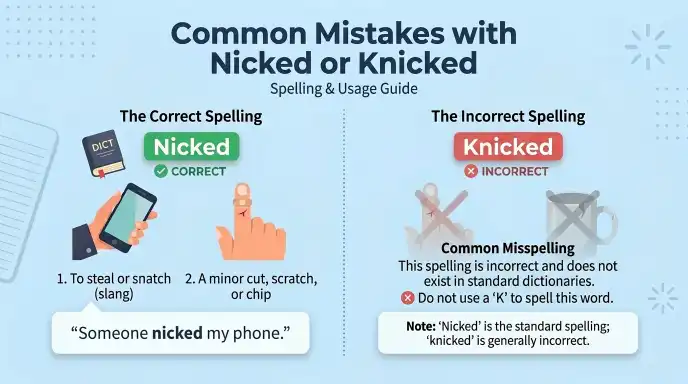
The most common mistake is adding a k to the beginning of nicked. Other mistakes happen when writers confuse the word’s different meanings.
Writing Knicked Instead of Nicked
Incorrect: Someone knicked my phone.
Correct: Someone nicked my phone.
Why? The base verb is nick, so the correct past tense is nicked.
Using Nicked When You Mean Kicked
Incorrect: He nicked the ball across the field. (If you mean he struck the ball with his foot.)
Correct: He kicked the ball across the field.
Why? Kicked comes from kick. Nicked comes from nick. These verbs have different meanings.
Confusing Nicked With a Nicked Edge
Incorrect: The glass was knicked on the edge.
Correct: The glass was nicked on the edge.
Why? A small chip or notch is a nick. The past-tense form is nicked.
Using Slang in Formal Writing
Informal: The police nicked the man.
Formal: The police arrested the man.
Why? Nicked is informal in this sense. Arrested is more suitable for professional and academic writing.
Common Errors and Corrections
| Incorrect | Correct | Explanation |
| Knicked my bag | Nicked my bag | Standard spelling |
| Knicked my finger | Nicked my finger | A small cut |
| The blade was knicked | The blade was nicked | A small notch |
| He nicked the ball with his foot | He kicked the ball with his foot | Different verb and meaning |
| The police knicked him | The police nicked him | Correct informal spelling |
Memory tip: Think of nick + ed = nicked. The word starts with N, not KN.
Nicked or Knicked in Everyday Examples
The correct spelling nicked can appear in many types of writing. The examples below show how to use it naturally.
Emails
In casual emails, nicked can describe a small cut or an item that someone took.
Examples:
- “I nicked my finger while preparing dinner.”
- “Someone seems to have nicked my pen from the meeting room.”
For a formal email, consider using cut, took, or stole, depending on what happened.
Business Writing
Business documents often describe damage to products or equipment.
Examples:
- “The metal edge was nicked during transport.”
- “The inspection found a nicked blade.”
- “The surface had a small nick near the corner.”
These examples use the word to describe physical damage.
News Headlines
News headlines should use clear and accurate words.
- Informal: Local Thief Nicked After Shop Incident
- Clearer formal style: Suspect Arrested After Shop Theft
- Product report: Damaged Equipment Found With a Nicked Edge
The slang version may suit a publication with a casual style. A formal news report will often prefer arrested or stolen.
Blogs
A blog can use nicked when explaining a personal experience or a small repair.
Examples:
- “I nicked my finger while cutting vegetables.”
- “The old table had a nicked corner.”
- “Someone nicked my favourite mug from the office.”
Use the spelling that matches the meaning, and make sure your readers understand the context.
Social Media
In social posts, the word can sound casual and natural.
Examples:
- “Just nicked my finger while cooking!”
- “Who nicked my charger?”
- “Found a tiny nick on my new phone case.”
If you want to avoid slang, write stole instead of nicked when talking about theft.
Academic Writing
Academic writing usually needs precise wording.
Examples:
- “The blade was nicked during the experiment.”
- “The metal surface showed a small notch.”
- “The report recorded a minor cut in the material.”
Avoid slang meanings unless your subject is English usage, dialect, or informal speech.
Daily Conversation
These examples show how people might use the word in everyday speech.
- “I nicked my hand on that sharp edge.”
- “Someone nicked my lunch from the fridge.”
- “The knife is nicked, so it needs attention.”
- “He got nicked for stealing.”
The meaning changes with the context, but the spelling stays the same.
Nicked or Knicked: Google Trends and Modern Usage
People search for nicked or knicked because the words sound alike, and English has several words that begin with a silent k. This makes the incorrect spelling seem possible to some writers.
However, nicked is the standard spelling. Knicked should not be treated as an accepted regional spelling.
Why Do People Search for This Keyword?
Common reasons include:
- Spelling checks: Writers want to know if nicked or knicked is correct.
- British slang: Readers encounter nicked in conversations, films, and online posts.
- Grammar learning: Students want to understand the past tense of nick.
- Writing and editing: Editors need to correct spelling mistakes.
- Meaning checks: Readers want to know if nicked means stolen, cut, or arrested.
Regional Usage
The spelling is consistent across major English-speaking regions, but the meanings may be more familiar in some places than others.
| Region | Common Context | Preferred Spelling |
| United States | Small cut or notch | Nicked |
| United Kingdom | Small cut, theft, or arrest in informal speech | Nicked |
| Canada | Small cut or notch | Nicked |
| Australia | Small cut or notch; informal uses may vary | Nicked |
| International English | Clear, context-based usage | Nicked |
These descriptions reflect general usage, not measured search rankings or exact regional frequencies.
Which Spelling Is More Popular?
The correct standard spelling is nicked. Without current search data, it would be misleading to provide exact Google Trends scores, search volumes, or country rankings.
Google Trends can help compare search interest over time, but it measures relative interest, not the correctness of a spelling. Search results may also include searches for slang meanings, definitions, or spelling corrections.
Practical takeaway: Use nicked in published content, and explain its meaning if your audience may not know the slang.
Nicked or Knicked: Quick Comparison Table
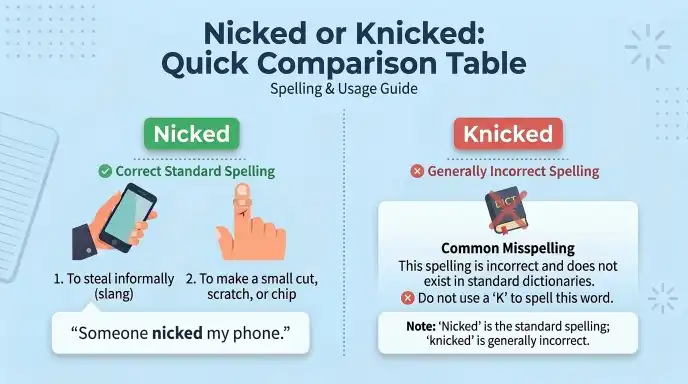
| Version | Meaning | Correct? | Region | Example |
| Nicked | Stole something | Yes | Especially informal British English | Someone nicked my bag. |
| Nicked | Made a small cut | Yes | Standard English | I nicked my finger. |
| Nicked | Made a small notch | Yes | Standard English | The blade was nicked. |
| Nicked | Arrested someone | Yes, as slang | British informal English | The police nicked him. |
| Knicked | Intended as a form of nick | No, not standard | No standard regional use | Write nicked instead. |
Key Takeaways
- Nicked is the correct spelling in standard English.
- Knicked is generally a misspelling.
- Nicked is the past tense of nick.
- It can mean stole, made a small cut, or made a small notch.
- In informal British English, nicked can also mean arrested.
- British and American English use the same standard spelling.
- Use stole or arrested in formal writing when those words are clearer.
- Remember the simple rule: nick + ed = nicked.
FAQs About Nicked or Knicked
Q1. Is it nicked or knicked?
Nicked is the correct spelling in standard English. Knicked is generally a spelling mistake. The word comes from the verb nick, which can mean to make a small cut, take something without permission, or arrest someone in informal British English.
Q2. What does nicked mean?
Nicked has several meanings. It can mean stolen, slightly cut, or marked with a small notch. In informal British English, it can also mean arrested. The sentence helps you understand the intended meaning. For example, “Someone nicked my phone” usually means someone stole it.
Q3. Is knicked ever a correct word?
Knicked is not the standard spelling of the past tense of nick. In ordinary writing, use nicked instead. If you see knicked in a message or document, it is usually a spelling error rather than an accepted British or American spelling variant.
Q4. Does nicked mean stolen?
Yes. In informal English, especially British English, nicked can mean stolen or taken without permission. For example, “Someone nicked my bag” means someone stole my bag. In formal writing, stole or stolen is often clearer.
Q5. Does nicked mean arrested?
Yes. In informal British slang, nicked can mean arrested by the police. For example, “He got nicked” means he was arrested. In formal reports, news writing, and academic work, arrested is usually the better choice because it is clear and direct.
Q6. Is nicked British or American English?
Nicked is a standard English spelling used in both British and American English. However, the slang meanings involving theft and arrest are especially associated with informal British English. Both varieties use the word for a small cut or notch.
Q7. What is the difference between nicked and kicked?
Nicked comes from nick and can mean stole something or made a small cut. Kicked comes from kick and means struck something with the foot. The words have different meanings, even though their spellings may be confused by learners.
Q8. What is the base word of nicked?
The base word is nick. It is a verb that can mean to make a small cut or notch, or to steal something in informal speech. Add -ed to form the regular past tense: nick + ed = nicked.
Conclusion: Nicked or Knicked
The correct spelling is nicked, not knicked. Although both forms may sound alike, only nicked is the standard spelling for the past tense of nick. It can mean that someone stole something, made a small cut, or left a small notch on a surface. In informal British English, it can also mean arrested.
The key is to understand the context. If you are describing a small cut on your finger or a chip on a blade, nicked is the right word. If you mean that someone took your belongings, it can work in informal speech, especially in British English. For formal writing, stole is often clearer. Similarly, use arrested rather than slang when writing a professional report.
British and American English do not have different standard spellings for this word. You should use nicked in schoolwork, emails, articles, and other published content. Avoid knicked, unless you are quoting a source that uses the incorrect spelling.
Remember: Nick + ed = nicked. Keep the spelling simple, choose the meaning that fits your sentence, and use clear language for your readers. If this guide helped you, try applying the same method to other commonly confused English words.

I’m Nora Ellis, an English language writer passionate about making grammar, spelling, and confusing words easy to understand. I share clear explanations and practical examples to help readers improve their English and use words with confidence.