The correct word depends on the meaning of your sentence: fare often means the cost of travel, while fair means just, equal, or reasonable. Both words are correct, but they have different meanings. Learning the difference helps you avoid spelling mistakes in everyday writing.
People often search for fare or fair because these words sound alike. However, their meanings are not the same. For example, you pay a bus fare when you travel, but you expect a fair price for your ticket. The word fare can also describe how well someone performs in a test, while fair can describe an event, such as a school fair.
Choosing the right word matters in schoolwork, emails, business reports, and daily conversations. Although the words sound the same, using the wrong one can make a sentence confusing or incorrect. Fortunately, a few simple rules can help you remember which spelling to use.
In this guide, you will learn the meanings, origins, and uses of fare and fair. You will also find common mistakes, practical examples, regional usage advice, and easy tips for choosing the correct word.
Fare or Fair: Quick Answer
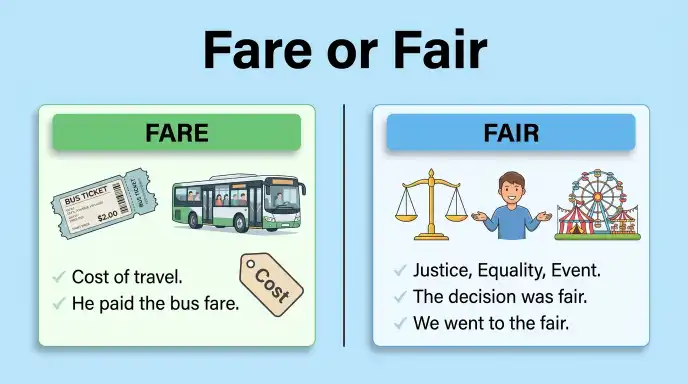
Fare and fair sound alike, but they have different meanings. Use fare for travel costs, food, or how someone performs. In contrast, fair means just, equal, reasonable, or a public event.
- Fare: The bus fare is five dollars.
- Fair: The teacher gave every student a fair chance.
- Fare: How did you fare in the exam?
- Fair: The shop offers a fair price.
Easy rule: You pay a fare, expect a fair deal, and ask how someone fared.
What Does Fare or Fair Mean?
The words fare and fair are homophones. In other words, they sound alike but have different spellings and meanings. Their correct use depends on the message you want to share.
What Does Fare Mean?
Fare can be a noun or a verb. Its meaning changes according to the sentence.
Fare as a noun: The cost of travel
A fare is the money you pay to travel by bus, train, taxi, or plane.
Examples:
- The train fare is affordable.
- I paid my bus fare this morning.
- The airline increased its ticket fares.
For example, when you buy a train ticket, the fare is the amount you pay for the journey.
Fare as a verb: To perform or manage
The verb fare means to do or perform in a particular situation. It often appears in questions about success, results, or progress.
Examples:
- How did you fare in your exam?
- The team fared well in the final match.
- Small shops may fare poorly during a slow season.
In these sentences, fare describes how someone or something performs. Therefore, it is useful when talking about results and experiences.
Fare as food or offerings
The noun fare can also mean the food served or available in a place. This meaning often appears in descriptions of restaurants, festivals, and traditional meals.
Examples:
- The restaurant serves local fare.
- Guests enjoyed traditional holiday fare.
- The festival offered simple food and regional fare.
Here, fare refers to food rather than travel costs.
What Does Fair Mean?
Fair is most often an adjective. However, it can also be a noun or an adverb in certain expressions.
Fair as just or equal
This meaning describes treatment, rules, or decisions that are reasonable and just.
Examples:
- Every child deserves a fair chance.
- The judge made a fair decision.
- We need a fair way to share the work.
In each example, fair describes equal or reasonable treatment.
Fair as reasonable
The word can also describe a price, offer, or amount that seems reasonable.
Examples:
- The shop gave me a fair price.
- That is a fair offer.
- The landlord asked for a fair rent.
As a result, the word often appears in discussions about money, deals, and business.
Fair as an event
A fair can be a public event where people sell goods, display products, or enjoy activities.
Examples:
- We visited the book fair.
- The school held a science fair.
- Local farmers displayed their products at the country fair.
These examples use fair as a noun.
Fair as light in color
The word fair can describe light skin or hair. This use often appears in descriptions of physical features.
Examples:
- She has fair hair.
- The story describes a fair-haired character.
The exact meaning depends on the context.
Fair in the phrase “play fair”
In expressions such as play fair, the word means to act honestly and follow the rules.
Example:
- Everyone should play fair during the game.
Fare vs Fair: Main Differences
| Word | Part of Speech | Meaning | Example |
| Fare | Noun | Travel cost | The bus fare went up. |
| Fare | Verb | To perform or manage | She fared well in the test. |
| Fare | Noun | Food served | The café serves local fare. |
| Fair | Adjective | Just or equal | That is a fair decision. |
| Fair | Noun | A public event | We went to the school fair. |
| Fair | Adverb | Honestly or according to rules | Please play fair. |
Remember: A bus has a fare, while a fair judge treats people fairly.
The Origin of Fare or Fair
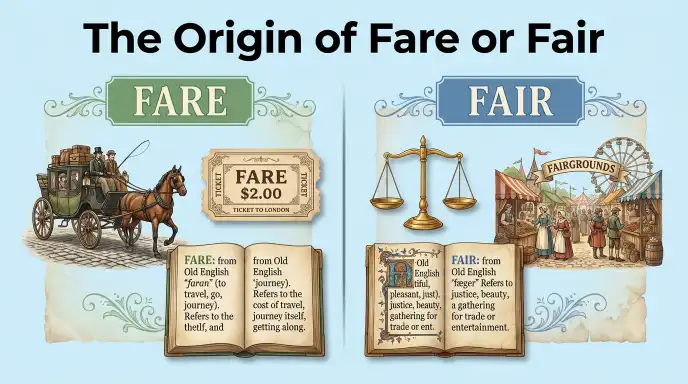
The words fare and fair have different histories. Although they sound alike today, their origins and meanings developed in different ways.
The Origin of Fare
Fare comes from Old English faran, a verb meaning to travel, go, or journey. Over time, the word developed several related meanings.
Its travel sense remains common in phrases such as bus fare, train fare, and airfare. The verb also developed the meaning of doing or managing in a situation, as in “How did you fare?”
In addition, the noun fare came to describe food served or available in a place.
Examples:
- The family paid the train fare.
- The team fared well during the season.
- The event served local fare.
These uses show how one word can develop several related meanings over time.
The Origin of Fair
Fair comes from Old English fæger, which meant beautiful, pleasant, or attractive. Over time, its meanings expanded to include ideas of justice, equality, and reasonable treatment.
Today, fair often describes honest rules, equal treatment, or a reasonable price. It also appears in the names of public events, such as a book fair or job fair.
Examples:
- The rules must be fair to everyone.
- We attended a job fair.
- The seller offered a fair price.
Why Do Fare and Fair Sound the Same?
English spelling and pronunciation have changed over many centuries. Consequently, words from different historical roots can develop the same pronunciation while keeping separate spellings and meanings.
Fare and fair are examples of homophones. Their pronunciation is similar in many English accents, but their meanings are different.
To remember them, connect each spelling with its common uses:
- Fare: Travel, performance, or food.
- Fair: Justice, equality, reasonable treatment, or an event.
British English vs American English
Fare and fair have the same standard spellings and basic meanings in British and American English. Neither word is a regional spelling alternative to the other.
| Feature | British English | American English | Example |
| Travel cost | Fare | Fare | The bus fare is high. |
| Just or equal | Fair | Fair | The rules are fair. |
| Performance | Fare | Fare | How did she fare in the exam? |
| Public event | Fair | Fair | We visited the school fair. |
Are There Any Regional Differences?
The basic meanings remain the same in the United States, United Kingdom, Canada, and Australia. However, related vocabulary and expressions may vary by region.
For example, people in different countries may use different terms for transport services or public events. These differences do not change the spelling of fare or fair.
What About Style Guides?
Standard dictionaries and editorial style guides treat fare and fair as different words, not spelling alternatives. Therefore, writers should select the word that matches the intended meaning.
Key point: If you write for a British or American audience, use fare for travel costs and related meanings. In contrast, use fair for justice, reasonable treatment, and public events.
Which Version Should You Use?
The correct spelling depends on your meaning, not your location. The same basic rules apply when writing for different countries and audiences.
United States
Use fare for travel costs and performance. Choose fair when discussing equal treatment, reasonable prices, or public events.
- The taxi fare was expensive.
- The company made a fair offer.
United Kingdom
British English follows the same distinction.
- The train fare increased.
- The judge made a fair decision.
Canada
Canadian English also uses both words with the same meanings.
- The bus fare is affordable.
- Everyone deserves a fair chance.
Australia
Australian English follows the same spelling rules.
- The flight fare changed.
- The school held a fair.
International Writing
When writing for a global audience, choose clear words and provide enough context to show the meaning.
For example, “The ticket fare includes the cost of the journey” is easy to understand in different English-speaking countries.
Academic Writing
In essays and assignments, use fare when discussing travel costs, performance, or food. On the other hand, use fair when discussing justice, equality, or reasonable treatment.
Examples:
- The study examined changes in railway fares.
- The researchers aimed to ensure a fair comparison.
Business Writing
In business emails and reports, the distinction matters when discussing prices, offers, and results.
- The delivery fare will be added to the total.
- We believe this is a fair price.
- The business fared well last year.
Professional advice: Read the sentence and ask what you mean. If you are describing a travel cost or an outcome, consider fare. If you mean justice or reasonableness, choose fair.
Common Mistakes with Fare or Fair
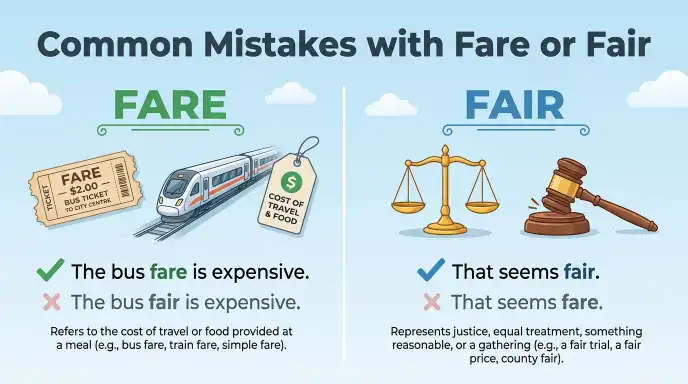
Because these words sound alike, writers often mix them up. However, checking the meaning of each sentence can help you avoid these errors.
Using Fair for a Travel Cost
Incorrect: The bus fair is five dollars.
Correct: The bus fare is five dollars.
Why? A fare is the money paid for a journey. By contrast, a fair is an event or something that is just or reasonable.
Using Fare for a Reasonable Price
Incorrect: The shop offered a fare price.
Correct: The shop offered a fair price.
Why? The sentence describes a reasonable price, not a travel cost.
Confusing Fair and Fare in Questions
Incorrect: How did the team fair in the match?
Correct: How did the team fare in the match?
Why? The verb fare means to perform or manage in a situation.
Confusing a Fair with a Fare
Incorrect: We went to the school fare.
Correct: We went to the school fair.
Why? A school fair is an event, not a travel cost.
Using Fair Instead of Fare for Food
Incorrect: The restaurant serves local fair.
Correct: The restaurant serves local fare.
Why? In this context, fare means the food offered or served.
Common Errors and Corrections
| Incorrect | Correct | Reason |
| Bus fair | Bus fare | Travel cost |
| Fare price | Fair price | Reasonable price |
| How fair were you? | How did you fare? | Performance or outcome |
| School fare | School fair | Public event |
| Local fair | Local fare | Food served |
Memory tip: Think of fare as the cost of getting somewhere. Meanwhile, think of fair as treating people right.
Fare or Fair in Everyday Examples
Both words appear in daily life, work, news, and education. The following examples show how to use them naturally in different settings.
Emails
In a travel email, you might write:
- Your train fare has been added to the travel bill.
- We hope the new policy offers a fair solution.
- Please confirm the total airfare before booking.
These examples cover travel costs, reasonable treatment, and booking details.
Business Writing
Business reports often discuss prices and performance. For example:
- The company reviewed its delivery fares.
- We want to offer customers a fair price.
- The business fared well during the first quarter.
Here, fare refers to costs or performance, while fair describes a reasonable price.
News Headlines
News headlines use both words in different contexts.
- Train Fares Rise Across the Region
- Local School Hosts Annual Science Fair
- Small Businesses Fare Better This Year
Each headline uses the word that matches its meaning.
Blogs
Writers can use these words when discussing travel, shopping, or local events.
- Learn how airline fares change during busy seasons.
- Discover how to find a fair deal when shopping.
- Read about how local restaurants fare during holidays.
As a result, choosing the correct spelling helps readers understand the topic quickly.
Social Media
These short examples work well in everyday posts.
- “Finally found a fair price for my new phone!”
- “The bus fare is higher than I expected.”
- “Our school science fair was so much fun!”
Academic Writing
Students and researchers may use both words in formal work.
- The report compared public transport fares in several cities.
- The researcher used a fair method to compare the results.
- The study examined how students fared in different learning settings.
These sentences show how the meaning changes with the context.
Daily Conversation
Here are some natural examples you can use when speaking:
- “How did you fare in your exam?”
- “That seems like a fair deal.”
- “How much is the bus fare?”
- “Are you going to the book fair?”
Quick tip: When speaking, the words may sound the same. However, when writing, the meaning tells you which spelling to choose.
Fare or Fair: Google Trends and Modern Usage
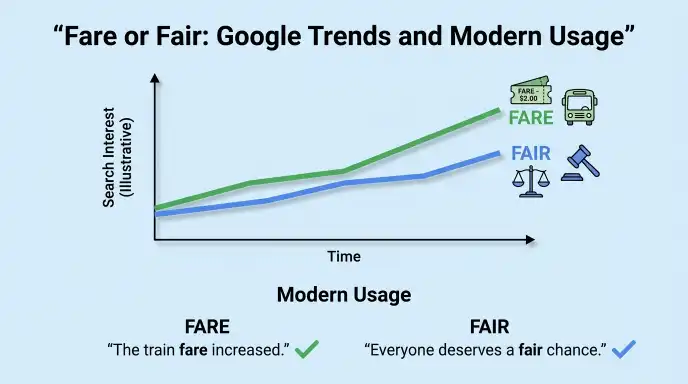
People search for fare or fair because they want to understand the difference between two words that sound alike. This question is common in spelling, grammar, and vocabulary learning.
Exact search popularity can change by country, date, and search intent. Without verified, current Google Trends data, it would be misleading to give exact figures or claim that one country searches for these words more often than another.
Why Do People Search for Fare or Fair?
Several common reasons explain this search:
- Spelling help: People want to know which word fits a sentence.
- Schoolwork: Students need to learn homophones.
- Travel planning: Travellers search for bus, train, and airline fares.
- Business writing: Workers need to describe prices and fair offers correctly.
- English learning: ESL learners want simple explanations and examples.
Modern Usage by Country
The meanings of fare and fair remain consistent across major English-speaking countries.
| Region | Common Context for Fare | Common Context for Fair |
| United States | Travel costs and performance | Justice, prices, and events |
| United Kingdom | Transport costs and outcomes | Equal treatment and events |
| Canada | Travel costs and performance | Reasonable prices and events |
| Australia | Transport costs and outcomes | Justice and public events |
| International English | Travel, food, and performance | Fairness, events, and reasonable treatment |
This table describes common uses, not measured search rankings.
How to Check Google Trends
To compare search interest, enter fare or fair, fare vs fair, and related phrases into Google Trends. Then select the same country and time range for each comparison.
Keep in mind that Google Trends shows relative search interest rather than exact search volumes. Therefore, a higher trend score does not prove that a word is more common in everyday writing or more grammatically correct.
Quick Comparison Table
| Version | Meaning | Correct? | Region | Example |
| Fare | Cost of travel | Yes | All English varieties | The bus fare is low. |
| Fair | Just or reasonable | Yes | All English varieties | That is a fair offer. |
| Fare | To perform or manage | Yes | All English varieties | She fared well. |
| Fair | Public event | Yes | All English varieties | We visited a book fair. |
| Fare | Food served | Yes | All English varieties | The café serves local fare. |
| Fair | Light in color | Yes | All English varieties | He has fair hair. |
Key Takeaways
- Fare and fair are homophones. They sound alike but have different meanings.
- Fare can mean a travel cost, food served, or how someone performs.
- Fair can mean just, equal, reasonable, or a public event.
- Use fare in phrases such as bus fare, airfare, and how did you fare?
- Use fair in phrases such as fair price, fair decision, and school fair.
- British and American English use the same spellings and basic meanings.
- Always check the meaning of your sentence before choosing a word.
FAQs About Fare or Fair
Q1. What is the difference between fare and fair?
Fare usually means the price of travel, food served, or how someone performs in a situation. Fair means just, equal, or reasonable. It can also refer to a public event. For example, you pay a bus fare, but you expect a fair price for your ticket.
Q2. Is fare or fair correct?
Both fare and fair are correct English words. The right choice depends on your meaning. Use fare when discussing travel costs or performance. In contrast, use fair when discussing justice, reasonable prices, or events. Neither spelling is a general replacement for the other.
Q3. Is it bus fare or bus fair?
The correct phrase is bus fare. It means the money you pay to travel by bus. For example, “The bus fare increased this month.” The word fair would be incorrect in this sentence because it does not mean the cost of a journey.
Q4. Is it fair or fare price?
The correct phrase is fair price. It means a price that seems reasonable or appropriate. For example, “The shop offered a fair price for the jacket.” Use fare when talking about transport costs, such as a train fare or taxi fare.
Q5. How do you use fare in a sentence?
You can use fare as a noun or a verb. As a noun, it describes a travel cost: “The train fare is affordable.” As a verb, it describes how someone performs: “She fared well in the interview.” It can also mean food, as in “traditional fare.”
Q6. How do you use fair in a sentence?
Use fair to describe something just, equal, or reasonable. For example, “The teacher gave everyone a fair chance.” You can also use it as a noun for an event: “We visited the school fair.” In the phrase “play fair,” it means to act honestly.
Q7. Do fare and fair sound the same?
Yes. In many English accents, fare and fair have the same pronunciation. They are called homophones because they sound alike but have different meanings and spellings. Therefore, you must use the sentence’s meaning to choose the right word when writing.
Q8. Is it how you fare or how fair you are?
The correct phrase is “How did you fare?” It asks how someone did or what happened to them in a situation. For example, “How did you fare in your exam?” The word fair does not have this meaning.
Conclusion: Fare or Fair
The difference between fare and fair becomes simple once you learn their meanings. Fare commonly refers to the money paid for travel, the food served in a place, or how someone performs in a situation. In contrast, fair describes something just, equal, or reasonable. It can also refer to an event, such as a school fair or a job fair.
Although these words sound alike, they cannot be used interchangeably. Writing “bus fair” instead of “bus fare” creates a spelling error. Likewise, “a fare price” is incorrect when you mean a reasonable price. The correct phrases are bus fare and fair price.
The same rules apply in British, American, Canadian, and Australian English. As a result, you do not need to learn separate regional spellings for these words. Instead, focus on the meaning you want to express and choose the matching word.
When in doubt, remember this simple tip: You pay a fare, expect a fair deal, and ask how someone fared. Practice these examples in your daily writing to build confidence and avoid common spelling mistakes. Keep learning one word pair at a time, and your English will become clearer.

I’m Nora Ellis, an English language writer passionate about making grammar, spelling, and confusing words easy to understand. I share clear explanations and practical examples to help readers improve their English and use words with confidence.