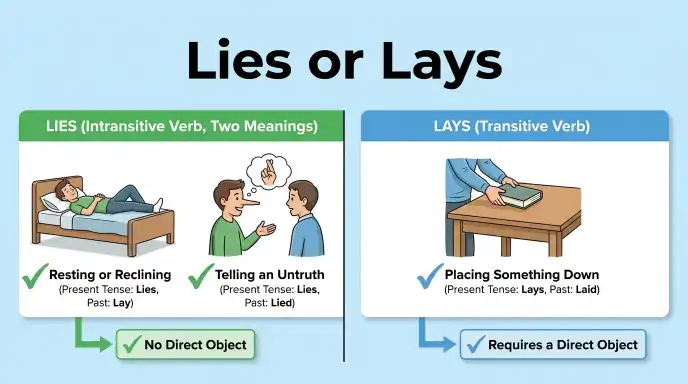
The correct word is lies when someone or something rests in a place, but lays when someone puts something down. Both words are correct, but they have different meanings and uses.
People often search for lies or lays because these words sound similar and can be confusing. The main difference is the action. Lies means to rest, stay, or be in a certain position. Lays means to put or place something somewhere. For example, you can say, “The cat lies on the sofa” or “She lays the book on the table.”
These words come from two different verbs: lie and lay. The verb lie does not need a direct object when it means to rest. The verb lay usually needs a direct object, such as a book, a bag, or a blanket. This simple rule helps you choose the correct word in most sentences.
In this guide, you will learn the meanings of lies and lays, their origins, common mistakes, and everyday examples. You will also learn if British and American English use these words differently and how to choose the correct form in school, work, and daily writing.
Lies or Lays : Quick Answer
Lies and lays are both correct words, but they have different meanings.
- Lies: Means to rest or be in a place.
- Lays: Means to put or place something somewhere.
- Lies: Can also mean to tell something that is not true.
Examples:
- Correct: The cat lies on the sofa.
- Correct: She lays the book on the desk.
- Correct: The village lies near the river.
- Correct: He lays his keys on the table.
- Correct: He lies to his friends.
Easy rule: You lie down, but you lay something down.
Definition and Meaning of Lies or Lays
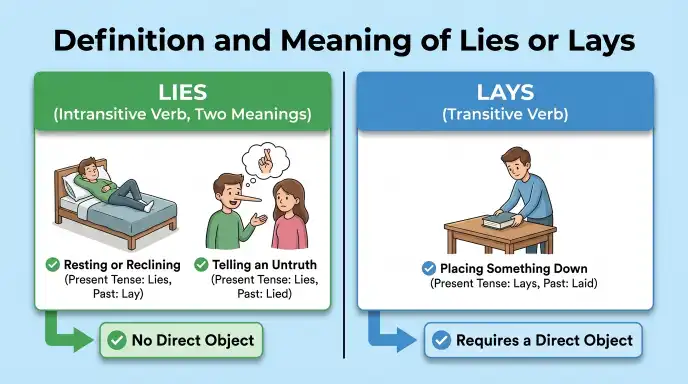
The words lies and lays are present-tense forms of two different verbs. Both are common in English, but they describe different actions.
What Does Lies Mean?
Lies is the present-tense form of lie used with he, she, it, or a singular noun. It has two main meanings.
To rest or be in a place
This meaning describes where a person or thing rests or is located.
Examples:
- The dog lies beside the door.
- Her phone lies on the desk.
- The village lies near the sea.
To tell something that is not true
The verb lie can also mean to say something false.
Examples:
- He lies about his age.
- She lies to avoid trouble.
- The man lies about what happened.
What Does Lays Mean?
Lays is the present-tense form of lay used with he, she, it, or a singular noun. It means to put or place something somewhere.
Examples:
- She lays her coat on the chair.
- He lays the papers on the desk.
- The hen lays an egg every morning.
In these examples, the action involves an object. The coat, papers, and egg are linked to the action of laying.
The Main Grammar Difference
The most useful difference is if the verb needs an object.
| Word | Base Verb | Main Meaning | Example |
| Lies | Lie | To rest or be located | The book lies on the table. |
| Lays | Lay | To put or place something | She lays the book on the table. |
| Lies | Lie | To tell something false | He lies about his work. |
| Lays | Lay | To produce an egg | The hen lays eggs. |
Remember: You lie down, but you lay something down.
The Origin of Lies or Lays
The words lies and lays come from different Old English verbs. Their history helps explain why they have different meanings.
Origin of Lie and Lies
The verb lie, meaning to rest or be in a position, comes from the Old English word licgan. It has long described a person or thing resting in a place.
Over time, the verb developed the present-tense form lies for singular subjects such as he, she, and it.
Examples:
- The child lies in bed.
- The answer lies in the final paragraph.
The word lie also has a separate meaning: to tell something false. This sense comes from a different Old English verb, lēogan.
Although both verbs use the spelling lie, their meanings differ.
Origin of Lay and Lays
The verb lay comes from the Old English word lecgan. It means to put or place something in a particular position.
Its present-tense form is lays when used with a singular subject.
Examples:
- She lays the blanket on the bed.
- The farmer lays his tools on the ground.
The verb usually takes an object because someone places something somewhere.
Why Do People Confuse Lies and Lays?
People often confuse these words for three main reasons:
- Both words can describe actions involving a bed, table, or other surface.
- Their meanings relate to position and placement.
- Their past-tense forms are irregular.
Compare these verb forms:
| Present | Past | Past Participle | Meaning |
| Lie | Lay | Lain | To rest or recline |
| Lay | Laid | Laid | To put or place |
| Lie | Lied | Lied | To tell something false |
For example, “Yesterday, I lay on the bed” means I rested there. However, “Yesterday, I laid the book on the bed” means I placed the book there.
British English vs American English Spelling
British English and American English use lies and lays in the same way. There is no spelling difference between these forms in standard British and American English.
Both varieties follow the same grammar rules. The correct choice depends on the meaning of the verb, not the country where the writer lives.
British English Examples
- The cat lies near the window.
- She lays the files on the desk.
- The answer lies in the report.
- The hen lays an egg each day.
American English Examples
- The dog lies on the couch.
- He lays his jacket on the chair.
- The problem lies in the details.
- The bird lays eggs in spring.
The examples use the same verb forms. Some vocabulary may vary by region, but the grammar stays the same.
British vs American English Comparison Table
| Feature | British English | American English |
| Correct form for resting | Lies | Lies |
| Correct form for placing | Lays | Lays |
| Past tense of lie (rest) | Lay | Lay |
| Past tense of lay (place) | Laid | Laid |
| Spelling difference | None | None |
| Grammar rule | Same | Same |
Which form should you choose? Use lies for resting or location, and use lays for placing something. This rule works in both countries.
Lies or Lays: Which Spelling Should You Use?
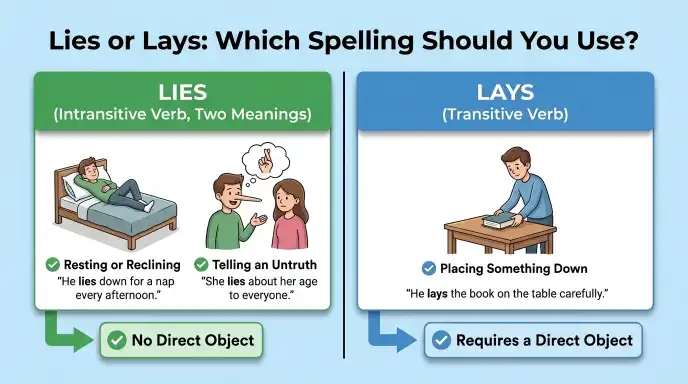
The correct choice between lies and lays depends on what you want to say. Your audience does not change the basic grammar rule.
For American English
If you write for readers in the United States, follow standard English grammar.
Examples:
- The wallet lies under the seat.
- She lays her phone beside the computer.
Both sentences are correct in American English.
For British English and Commonwealth Countries
Readers in the United Kingdom, Canada, Australia, and other Commonwealth countries use the same distinction.
Examples:
- The keys lie on the table.
- He lays the keys on the table.
Notice that lie is used with the plural subject keys, while lays is used with the singular subject he.
For International Readers
If you write for a global audience, use simple sentences that show the action clearly.
Examples:
- The baby lies in the cot.
- The mother lays the baby in the cot.
These sentences make the difference easy to understand.
For Academic and Professional Writing
In essays, reports, emails, and formal documents, choose the verb based on its meaning.
Incorrect: The manager lays in bed after work.
Correct: The manager lies in bed after work.
Incorrect: She lies the papers on the desk.
Correct: She lays the papers on the desk.
Professional tip: Check if the sentence describes resting or placing. This quick test can prevent many common grammar errors.
Common Mistakes with Lies or Lays
Many English learners confuse lies and lays because both verbs relate to position. The following examples show how to correct these errors.
Using Lays for Resting
Incorrect: He lays on the sofa every evening.
Correct: He lies on the sofa every evening.
Why? The person is resting. He is not placing an object somewhere.
Using Lies for Placing Something
Incorrect: She lies the book on the desk.
Correct: She lays the book on the desk.
Why? She is putting the book in a specific place, so the verb lay is needed.
Confusing Lie and Lay in the Past Tense
Incorrect: Yesterday, I laid on the bed.
Correct: Yesterday, I lay on the bed.
Why? The past tense of lie, meaning to rest, is lay. The past tense of lay, meaning to place, is laid.
Mixing Up Lies and Lays in Everyday Sentences
Incorrect: The farmer lays in the field to rest.
Correct: The farmer lies in the field to rest.
Why? The sentence describes resting, not placing something.
Mixing Up Lies and Lied
Incorrect: He lied to his parents every day.
Correct: He lies to his parents every day.
Why? Use lies for a present or repeated action. Use lies for a past action.
Common Errors and Corrections Table
| Incorrect Sentence | Correct Sentence | Reason |
| She lays on the bed. | She lies on the bed. | She is resting. |
| He lies the bag down. | He lays the bag down. | He places the bag. |
| I laid down yesterday. | I lay down yesterday. | Past tense of lie (rest). |
| The hen lies eggs. | The hen lays eggs. | A hen produces eggs. |
| He lied about it every day. | He lies about it every day. | Present-tense action. |
Easy memory trick: If someone puts an object somewhere, use lay. If someone rests or stays in a place, use lies.
Lies or Lays in Everyday Examples
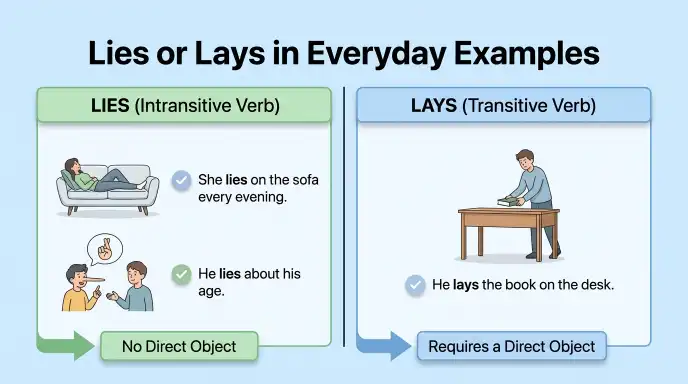
The words lies and lays appear in daily conversation, emails, news reports, social media posts, and formal writing. Using the correct word makes your meaning clear.
In Emails
In work emails, these verbs can describe where something is or what someone does with an item.
Examples:
- The signed contract lies in the top drawer.
- She lays the documents on your desk each morning.
- The main issue lies in the payment process.
The first and third examples describe a location or the source of a problem. The second describes placing documents.
In News Writing
News reports often use lies to describe a location or explain where a problem begins.
Examples:
- The village lies near the border.
- The cause of the delay lies in a technical fault.
- The bird lays its eggs in a protected area.
These examples show how both words can appear in factual reporting.
On Social Media
People use these words in captions, posts, and everyday messages.
Examples:
- “My cat lies in the sun all day.”
- “She lays her books out before studying.”
- “The real answer lies in the details.”
For casual posts, simple wording helps readers understand the intended meaning.
In Formal Writing
Formal writing requires accurate verb forms, especially in essays, reports, and research papers.
Examples:
- The responsibility lies with the project manager.
- The researcher lays out the results in the report.
- The evidence lies in the final section.
The phrase lays out means presents or arranges information. The phrase lies in points to the location or source of something.
In Everyday Conversation
Here are some natural examples:
- My brother lies on the couch after work.
- She lays the baby in the crib.
- The dog lies beside its owner.
- He lays his wallet on the counter.
Each sentence uses the verb that matches the action.
Everyday Usage Comparison
| Context | Example with Lies | Example with Lays |
| Home | The cat lies on the rug. | She lays the blanket on the bed. |
| Office | The answer lies in the report. | He lays the papers on the desk. |
| Nature | The village lies near a lake. | The bird lays eggs in a nest. |
| Conversation | He lies about his age. | She lays the cards on the table. |
| Formal writing | The issue lies in the method. | The author lays out the main points. |
Lies or Lays : Google Trends and Usage Data
People search for lies or lays when they want to know which word fits a sentence. The search usually reflects a grammar question rather than a difference in regional spelling.
Exact search popularity can change by country, time, and user intent. Without checking current Google Trends results, it would be misleading to claim that one country searches for this phrase more than another or to give exact search figures.
Why Do People Search for Lies or Lays?
There are several common reasons:
- Grammar learning: Students need to understand the difference between lie and lay.
- Word choice: Writers want to choose the correct form.
- English exams: Learners study irregular verbs and verb forms.
- Professional writing: Workers want to avoid grammar errors in reports and emails.
- Everyday communication: People want their sentences to sound natural and correct.
Usage in Different Countries
The grammar rule remains the same across major English-speaking countries.
| Country or Region | Correct Usage | Regional Spelling Difference |
| United States | Lies and lays | None |
| United Kingdom | Lies and lays | None |
| Canada | Lies and lays | None |
| Australia | Lies and lays | None |
| International English | Lies and lays | None |
Which Word Is More Common?
The frequency of lies and lays depends on the sentence and meaning. Lies appear in sentences about location, rest, and false statements. Lays appear in sentences about placing objects and producing eggs.
A fair comparison should consider the context in which each word appears. Search counts alone do not prove which verb is more common in everyday writing.
How to Check Current Google Trends Data
To compare interest in these terms, use the same time period and region for both searches. Check phrases such as “lies or lays” and “lie vs lay” separately.
Google Trends reports relative search interest, not exact search volume. This approach helps you study changing interest without inventing statistics or treating search popularity as proof of correct grammar.
Lies or Lays: Comparison Table
Use this table to review the main differences between lies and lays.
| Feature | Lies | Lays |
| Base verb | Lie | Lay |
| Main meaning | To rest or be located | To put or place something |
| Subject example | He lies down. | He lays the book down. |
| Direct object | Not needed for the resting meaning | Usually required |
| Past tense | Lay | Laid |
| Past participle | Lain | Laid |
| False statement meaning | He lies to me. | Not used for this meaning |
| Egg production | Not used | The hen lays eggs. |
Quick reminder: A person lies down, but a person lays a book down. The past tense of lie is lay, while the past tense of lay is laid.
FAQs About Lies or Lays
Q1. Is it correct to say lies or lays?
Yes, both lies and lays are correct words. Use lies when someone or something rests or stays in a place. Use lays when someone puts something somewhere.
Example: “The dog lies on the floor” and “She lays the book on the floor.”
Q2. What is the main difference between lies and lays?
The main difference is the action. Lies means to rest or be located, while lays means to put or place something. The verb lays usually needs a direct object, but lies, in its resting sense, does not.
Q3. Should I write she lies down or she lays down?
Write “She lies down” when you mean that she rests or reclines. In standard usage, lie down does not need an object.
Use “She lays the baby down” when she places the baby in a resting position.
Q4. Is it the cat lies on the bed or the cat lays on the bed?
The correct sentence is “The cat lies on the bed.” The cat is resting, so you should use lies.
Use lays when the subject puts something somewhere.
Q5. What is the past tense of lies?
The past tense of lie, meaning to rest, is lay. For example, “Yesterday, he lay on the sofa.”
However, the past tense of lie, meaning to tell something false, is lied. For example, “He lied about his age.”
Q6. Is lays the same as laid?
No. Lays is the present-tense form of lay used with a singular subject such as he, she, or it. Laid is the past tense and past participle of lay.
Examples:
- Present: She lays the keys on the table.
- Past: She laid the keys on the table.
Q7. Do British and American English use lies and lays differently?
No. British and American English follow the same grammar rules for lies and lays. Both forms have the same spelling and meaning in standard usage. The correct choice depends on if the sentence describes resting or placing something.
Q8. How can I remember when to use lies or lays?
Remember this simple rule: You lie down, but you lay something down.
- Lies: The child lies in bed.
- Lays: The child lays a toy on the bed.
This rule works for most everyday sentences involving rest and placement.
Conclusion: Lies or Lays
Choosing between lies and lays becomes easy when you understand what each verb means. Both words are correct, but they describe different actions. Lies is the present-tense form of lie when someone or something rests, stays in a place, or tells something false. Lays is the present-tense form of lay when someone puts or places something somewhere.
The simplest rule is to remember that you lie down, but you lay something down. For example, “The child lies on the bed” describes the child’s position. “The child lays a toy on the bed” describes an action involving an object.
The past-tense forms are also important. The past tense of lie, meaning to rest, is lay. The past tense of lay, meaning to place, is laid. Learning these forms will help you avoid common grammar mistakes.
British and American English use lies and lays in the same way, so you do not need to worry about regional spelling differences. If you are writing an email, completing a school assignment, preparing a report, or posting on social media, focus on the meaning of your sentence. With regular practice, you can choose the right word confidently and write clearer English.

I’m Nora Ellis, an English language writer passionate about making grammar, spelling, and confusing words easy to understand. I share clear explanations and practical examples to help readers improve their English and use words with confidence.