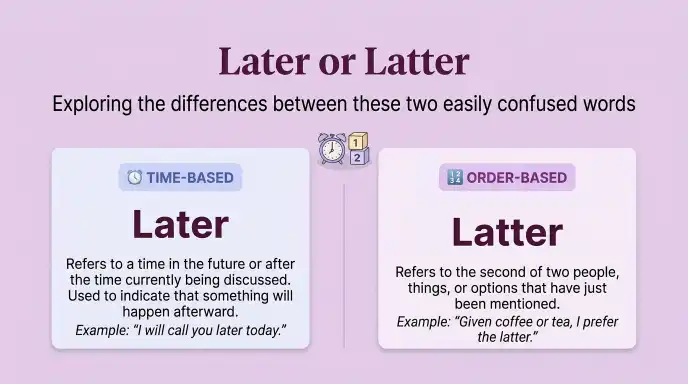
Later and latter have different meanings, even though they look similar. One refers to time, while the other identifies the second of two things.
Understanding this difference helps you choose the correct word in everyday conversations, emails, school assignments, and formal writing.
People often confuse these terms because their spelling is almost the same. However, you cannot use them interchangeably. When you want to describe something that will happen after now, later is the correct choice. When you refer to the second of two options mentioned earlier, use the latter.
For example, you might tell a friend that you will call them later. If you compare tea and coffee and prefer coffee, you can refer to it as the latter. The context makes the meaning clear.
Learning this simple rule can improve your writing and help you avoid common grammar mistakes. You do not need to memorize complicated grammar rules. Just remember that later relates to time, while latter relates to order. With a little practice, you can use both words naturally and confidently.
Quick Answer
Later means after now or after another event. Latter means the second of two people, things, or choices mentioned earlier.
- Later: I will finish my homework later.
- Latter: We can have tea or coffee. I prefer the latter.
Easy tip: Think of time when choosing the first word and the second choice when choosing the other.
Meaning and Definition
The Meaning of Later
Later is commonly used as an adverb to describe a time after the present moment or after another event. It can refer to something happening in the near future or at a point after an earlier activity.
In simple English, it means afterward, at another time, or after something else.
Example: I will call you later.
This means the call will happen after the present moment.
Example: Sarah arrived later than her brother.
Here, the word shows that Sarah arrived after her brother.
You can use this term in casual conversations, work emails, messages, and formal writing whenever you need to describe timing.
The Meaning of Latter
Latter refers to the second of two people or things mentioned earlier. It can function as an adjective or a noun, depending on the sentence.
In simple words, it means the second one.
Example: We could travel by train or bus. I prefer the latter.
The two choices are train and bus. The second choice, bus, is the one the speaker prefers.
Example: Jack and Daniel joined the team. The latter became its captain.
Here, the word refers to Daniel because he is the second person mentioned.
This term is useful in formal writing, but you should make sure the reader can easily identify the second item. If the reference is unclear, repeat the person’s name or the item’s name instead.
The Origin of These Words
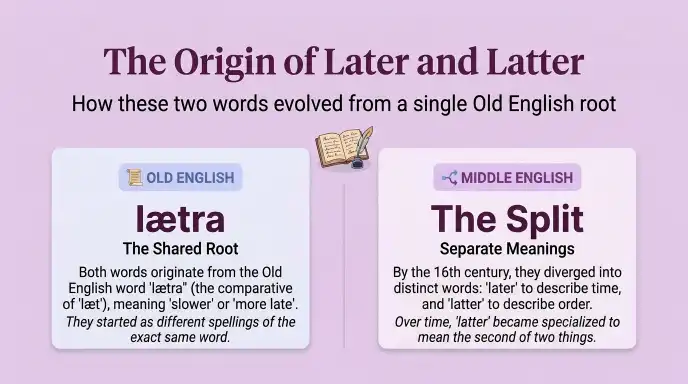
Although the two terms look alike, their histories help explain their different uses.
Where Later Comes From
Later developed from the word late, which relates to something happening after the expected or usual time. The ending -er forms a comparative word, as in sooner and faster.
Over time, it became a common way to describe something that happens after a particular moment.
Example: We ate dinner and watched a film later.
The word indicates that watching the film happened after dinner.
Where Latter Comes From
Latter comes from an older English form related to late. Its meaning developed to identify the second of two things mentioned.
Today, it is commonly used when comparing two people, choices, ideas, or objects.
Example: He considered tea and coffee, choosing the latter.
The word points to coffee because it appears second in the sentence.
Remember: A shared historical connection does not mean that two words have the same meaning today.
British and American English
There is no spelling difference between British and American English for these terms. Both varieties follow the same rules.
| Feature | American English | British English |
| Referring to a future time | See you later. | See you later. |
| Referring to the second choice | I prefer the latter. | I prefer the latter. |
| Spelling | Later / Latter | Later / Latter |
| Main distinction | Time versus order | Time versus order |
Key point: The meaning depends on the sentence, not the country where the writer lives.
Which Word Should You Choose?
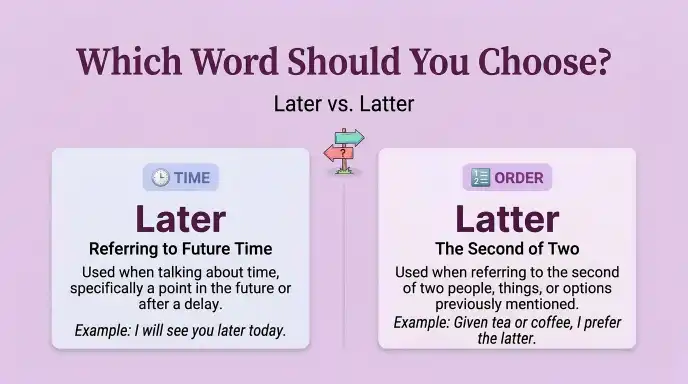
The correct choice depends on what you want to express. Think about if your sentence describes a time or identifies the second item in a pair.
American English Usage
American writers use later for future events and latter for the second of two options.
Example: I will complete the report later.
Example: We can order pizza or pasta. I would choose the latter.
The first sentence refers to time. The second identifies pasta as the preferred choice.
British English Usage
British writers follow the same rule. Neither word needs a different spelling in the United Kingdom.
Example: I will speak to you later.
Example: She could study history or geography. She chose the latter.
Both sentences use standard British English.
Canadian and Australian Usage
Canadian and Australian English also follow the same distinction. Writers in these countries do not need to change the spelling.
Example: We can meet later this afternoon.
Example: He offered a blue shirt and a black shirt. I preferred the latter.
The meaning stays the same across these English varieties.
International and Academic Writing
For international readers, later is usually easy to understand when discussing time. The other term works well when the sentence clearly presents two choices.
In academic writing, avoid using the latter if readers may struggle to identify the item it describes. Repeating the noun can make your point clearer.
Example: The researchers compared online learning with classroom learning. The classroom method produced better results.
This sentence is clear because it names the method directly.
Writing tip: Choose clarity over variety. Repeating a noun is often better than confusing the reader.
Common Mistakes to Avoid
Many writing mistakes happen when people focus on spelling instead of meaning. The following examples show how to choose the right word.
| Incorrect sentence | Correct sentence | Reason |
| I will call you latter. | I will call you later. | The sentence refers to time. |
| I prefer the later of the two options. | I prefer the latter of the two options. | It identifies the second option. |
| We can talk latter. | We can talk later. | The conversation will happen in the future. |
| I chose the later, which was tea. | I chose the latter, which was tea. | Tea is the second item mentioned. |
Using the Wrong Word for Time
Do not use the latter when you mean at a future time.
Example: Incorrect: I will send the file latter.
Correct: I will send the file later.
The sentence explains when the file will be sent, so the time-related word is needed.
Confusing the Second Choice
Use latter when referring to the second of two items already mentioned.
Example: Incorrect: I like apples and oranges. I prefer the later.
Correct: I like apples and oranges. I prefer the latter.
The second sentence refers to oranges.
Making the Reference Unclear
The reader should know exactly which two items you mean. If you mention several things, using the latter can create confusion.
Example: We discussed books, films, games, and music. I preferred the latter.
This sentence is unclear because it does not establish a simple pair.
Better: We discussed books and films. I preferred films.
Clear writing helps readers understand your meaning without having to guess.
Everyday Examples
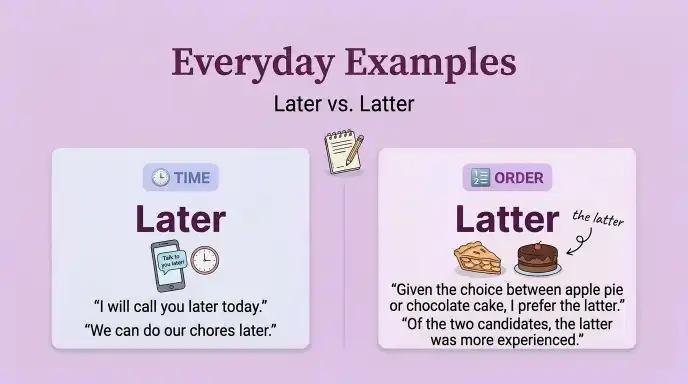
These words appear in emails, articles, text messages, and formal documents. The context tells you which one to choose.
In Emails
Use later when discussing a future response, meeting, or task.
Example: I will send you the updated document later today.
Example: We can discuss the remaining details later this week.
When you introduce two clear options, latter can refer to the second one.
Example: We can meet on Tuesday or Thursday. I prefer the latter.
In News and Articles
Writers often use later to describe events that happen after an earlier event.
Example: The team scored once in the first half and added two more goals later in the match.
Example: Officials released further details later that evening.
The word latter can help writers compare two ideas.
Example: The report examined cost and quality. The latter received more attention.
Here, it refers to quality.
In Social Media and Text Messages
In casual messages, later is common because people often discuss future plans.
Example: Talk to you later!
Example: I will post the pictures later.
The other term is less common in casual messages. People often repeat the name of the second choice instead.
Example: Should we watch a comedy or a thriller? I want the thriller.
This sounds natural and avoids unnecessary formality.
In Formal Writing
Both terms can appear in professional and academic documents.
Example: The committee will review the proposal later this month.
Example: The study compared two methods. The latter required fewer resources.
Always make sure your reader understands the reference. If there is any doubt, use the full name of the item.
Google Trends and Modern Usage
Search interest can change over time, but a trend chart does not prove that one word is more correct than another. Both are established English words with different meanings.
People may search for these terms because they are checking grammar, completing schoolwork, editing a document, or trying to understand the difference. Search interest can reflect these needs, but it does not determine correct usage.
The words should not be treated as alternative spellings of the same term. Each has its own role in a sentence.
To compare search interest accurately, enter both terms in Google Trends and select the same country and time range. Remember that Trends shows relative search interest, not a complete count of every time a word appears online.
Practical takeaway: Focus on meaning and context rather than popularity.
Key Differences at a Glance
Use this table as a quick reference when editing your writing.
| Feature | Later | Latter |
| Main meaning | At a time after now or another event | The second of two items |
| Common grammatical role | Adverb | Adjective or noun |
| Refers to | Time | Order or choice |
| Common phrase | See you later | The latter option |
| Sample sentence | We will leave later. | I chose tea over coffee, preferring the latter. |
| Can they replace each other? | No | No |
Easy memory trick: Later = time. Latter = second.
If your sentence answers “When?”, you probably need the time-related word. If it identifies the second of two choices, the other term may be correct.
Frequently Asked Questions
Q1. What is the main difference between these words?
Later refers to a future time or something that happens afterward. Latter identifies the second of two people, things, or choices mentioned earlier.
Example: I will visit you later. I prefer tea to coffee, so I choose the latter.
Q2. Are these words interchangeable?
No. They have different meanings, so one cannot replace the other in every sentence.
Example: “See you later” refers to a future meeting. “I chose the latter” identifies the second option.
Q3. How can I remember which one to use?
Connect later with time and latter with the second choice. This simple rule works in most everyday situations.
Example: I will finish my work later. Between tea and coffee, I prefer the latter.
Q4. Can the second term refer to three things?
It is best to use the latter when referring to the second of two items. When discussing three or more items, naming the specific item is usually clearer.
Example: I bought apples, pears, and peaches. I liked the peaches best.
This avoids an unclear reference.
Q5. Is the word latter formal or informal?
Latter is more common in formal or carefully edited writing. In everyday conversation, people often repeat the name of the second item.
Example: We compared two plans. The latter was cheaper.
Q6. Do British and American writers use different spellings?
No. Both varieties use the same spelling and follow the same meaning-based rule.
Example: Writers in both countries can say, “I will call you later.”
Q7. Can the latter refer to a person?
Yes. It can refer to the second of two people mentioned, as long as the reference is clear.
Example: Emma and Olivia applied for the role. The latter was selected.
Here, the word refers to Olivia.
Conclusion:
Later and latter may look similar, but they serve different purposes in English. Use the first when talking about a time after now or after another event. Choose the second when identifying the second of two people, things, or choices mentioned earlier.
The easiest rule to remember is that later means time, while latter means the second item. This distinction applies to American, British, Canadian, Australian, and international English. The spelling remains the same across these varieties.
When writing emails, articles, school assignments, or everyday messages, focus on the meaning of your sentence. If you are discussing a future event, later is the natural choice. If you are comparing two options, latter may be suitable. However, make sure both items are easy to identify. When a sentence becomes confusing, repeating the name of the person or thing is often the clearest solution.
With this simple rule and a little practice, you can use both words correctly and confidently. Remember: time calls for later; the second choice calls for latter.

I’m Nora Ellis, an English language writer passionate about making grammar, spelling, and confusing words easy to understand. I share clear explanations and practical examples to help readers improve their English and use words with confidence.