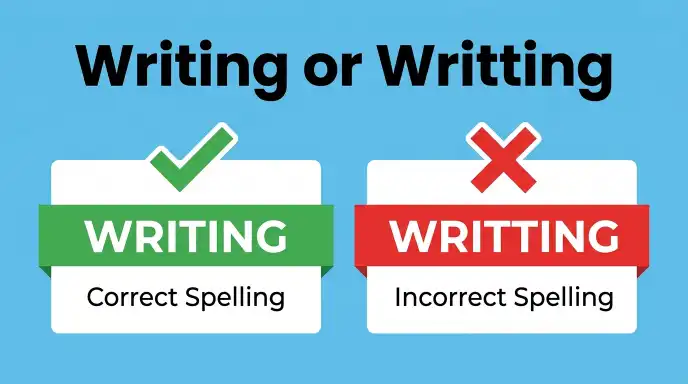
Have you ever paused while typing the word “writing” and wondered if it needs one t or two? The correct spelling is writing, with one t. Writting is a common spelling mistake and is not accepted as the standard spelling of this word.
People often search for writing or writting because English spelling rules can be confusing. Many verbs double their final consonant when we add an ending. For example, sit becomes sitting. However, write becomes writing because the final e is dropped before adding -ing.
The word writing can mean the act of forming words, the skill of expressing ideas in text, or a written piece of work. You may use it in school assignments, emails, business reports, books, blogs, and everyday messages. Using the correct spelling makes your writing clearer and more professional.
In this guide, you will learn why writing is correct, how the spelling rule works, and how to avoid common mistakes. You will also find practical examples, regional guidance, grammar tips, and answers to frequently asked questions.
Writing or Writting: Quick Answer for Readers
Writing is the correct spelling. Writting is incorrect in standard English.
The word comes from the verb write. To form its -ing form, remove the final e and add -ing.
- Correct: I am writing an email.
- Incorrect: I am writting an email.
- Correct: She enjoys writing stories.
Easy rule: Write write + ing = writing. Do not double the letter t.
Writing or Writting: Featured Snippet Answer
The correct spelling is writing, with one t. The word comes from write, and its final e is dropped before adding -ing. Writting is a common misspelling. Use writing when describing the act of putting words on paper or a screen, creating text, or expressing ideas in written form.
What Does Writing Mean?
Writing is the act or skill of forming words and sentences to share information, ideas, feelings, or stories. It can also refer to a piece of written work.
The word has several common uses.
Writing as an Action
Writing describes the act of putting words on paper or typing them on a device.
Examples:
- I am writing a letter.
- He is writing his homework.
- They are writing notes during class.
In these sentences, writing is the action taking place.
Writing as a Skill
Writing can also mean the ability to express ideas clearly through words.
Examples:
- Her writing has improved.
- Good writing helps readers understand a message.
- He practices writing every day.
Here, the word refers to a skill rather than one action.
Writing as a Piece of Work
Writing may describe something that a person has written, such as an essay, report, story, or article.
Examples:
- The teacher reviewed my writing.
- His writing appears in several magazines.
- The report contains clear and simple writing.
What Does Writting Mean?
Writting is not the standard spelling of the word. It usually appears because someone mistakenly doubles the letter t.
Incorrect: She is writting a story.
Correct: She is writing a story.
The spelling does not change in British English or American English. Both use writing.
The Origin of Writing or Writting
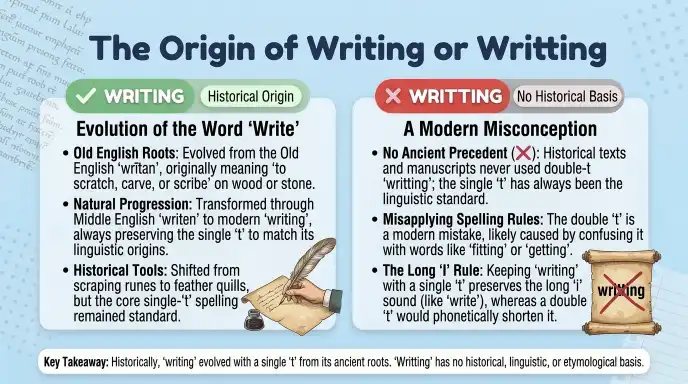
The spelling of writing makes more sense when you understand its base word and how English forms words with endings.
Where Does the Word Writing Come From?
Writing comes from the verb write, which has roots in Old English. The older verb was wrītan, which originally referred to making marks, drawing, or inscribing.
Over time, the meaning developed to include forming letters, recording information, and expressing thoughts through written language.
Today, writing includes many activities, such as:
- Writing letters and emails.
- Creating stories and books.
- Preparing reports and essays.
- Posting messages online.
- Recording notes and ideas.
Why Does Writing Have One T?
The spelling follows a common English rule. When a verb ends in a silent e, we usually drop that e before adding -ing.
For example:
- Write → Writing
- Make → Making
- Take → Taking
- Drive → Driving
- Hope → Hoping
The final e disappears, but the consonant t does not double.
Why Do People Write Writting?
Many learners know that English sometimes doubles a final consonant before adding -ing. This rule applies to words such as:
- Sit → Sitting
- Run → Running
- Stop → Stopping
- Plan → Planning
However, write follows a different spelling pattern because it ends in a silent e. The correct form is writing, not writting.
The key is to learn the base word and its spelling change before adding an ending.
British English vs American English
British English and American English both use writing. There is no regional spelling difference between writing and writting.
Both varieties follow the same rule: drop the final e in write before adding -ing.
British English Examples
- She is writing a letter.
- He enjoys writing short stories.
- The students are writing their answers.
American English Examples
- She is writing an email.
- He enjoys writing fiction.
- The students are writing their essays.
The spelling remains the same in both regions.
British vs American English Comparison Table
| British English | American English | Example |
| Writing | Writing | She is writing a report. |
| Writting is incorrect | Writting is incorrect | Do not write “writting a report.” |
| Write | Write | I write every morning. |
| Written | Written | The letter was written yesterday. |
Do Style Guides Prefer Different Spellings?
No. Standard British and American dictionaries recognize writing as the correct form.
Editors, teachers, publishers, and professional writers should use writing in both varieties. Regional spelling differences do exist in English, such as colour and color, but this is not one of them.
Which Version Should You Use?
Always use writing. The correct spelling does not depend on your country, audience, or type of writing.
United States
Use writing in schoolwork, emails, articles, and professional documents.
Example: I am writing a report for my manager.
United Kingdom
British English uses the same spelling.
Example: She is writing a letter to her friend.
Canada
Canadian English also uses writing.
Example: He is writing an essay for class.
Australia
Australian English follows the same rule.
Example: They are writing a new book.
International Writing
If your readers live in different countries, choose writing. It is the standard form across English varieties.
Academic Writing
Use writing in essays, research papers, exams, and assignments.
Example: The student is writing a summary of the chapter.
Business Writing
Use writing in reports, emails, proposals, and workplace messages.
Example: I am writing to confirm our meeting.
Professional tip: When you are unsure, check the base verb. The verb is write, and its -ing form is writing.
Common Mistakes with Writing or Writting
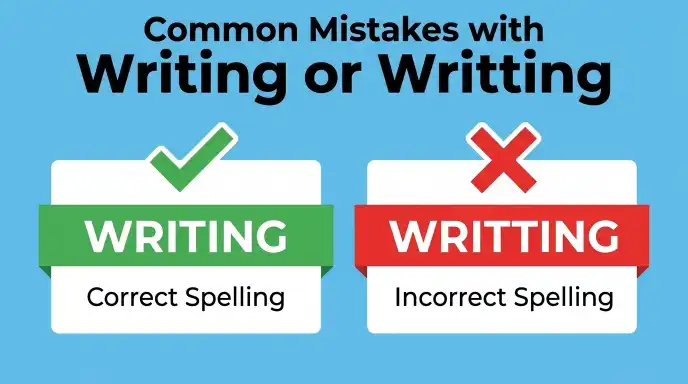
The most common error is adding an extra t. Other mistakes happen when writers forget to remove the final e or confuse related verb forms.
Doubling the T
Incorrect: I am writting a letter.
Correct: I am writing a letter.
Why? Drop the final e from write and add -ing. Do not double the t.
Keeping the Final E
Incorrect: She is writeing an email.
Correct: She is writing an email.
Why? The final e in write is dropped before adding -ing.
Using Writing Instead of Written
Incorrect: The report was writing by the manager.
Correct: The report was written by the manager.
Why? Use written, the past participle of write, in this passive sentence.
Confusing Write and Writing
Incorrect: I am write a story.
Correct: I am writing a story.
Why? After am, use the -ing form to describe an action happening now.
Misspelling Writing in Formal Work
Incorrect: I have attached the writting sample.
Correct: I have attached the writing sample.
Why? Writing is the standard spelling in formal and informal English.
Common Errors and Corrections Table
| Incorrect | Correct | Reason |
| Writting | Writing | Do not double the t |
| Writeing | Writing | Drop the final e |
| I am write | I am writing | Use the -ing form |
| Was writing by him | Was written by him | Use the past participle |
| Writting skills | Writing skills | Standard spelling |
Easy Memory Tip
Remember this pattern:
Write − e + ing = Writing
Think of the words make and making. You remove the final e without doubling the last consonant. The same rule applies to write and writing.
Writing or Writting in Everyday Examples
The word writing is common in daily life. You may use it when talking about school, work, creative projects, or online communication.
Emails
- I am writing to ask about the meeting.
- Thank you for writing back so quickly.
- She is writing an email to the client.
Business Writing
- Clear writing helps teams share ideas.
- He is writing a report for the director.
- The company needs better writing for its customer messages.
News Headlines
- Local Student Wins a Writing Award
- New Course Helps Adults Improve Their Writing
- Young Author Begins Writing a New Book
These examples show how writing can refer to an activity or a skill.
Blogs
- Writing useful content takes time and practice.
- She is writing a guide for new learners.
- Good writing makes complex ideas easier to understand.
Social Media
- “I am writing a new story today.”
- “Practice makes your writing better.”
- “Enjoying a quiet evening and writing my thoughts.”
Even in short posts, use writing, not writting.
Academic Writing
- The student is writing a research paper.
- Regular practice improves academic writing.
- The teacher gave feedback on her writing.
Daily Conversation
- What are you writing?
- I am writing a shopping list.
- He loves writing poems.
- She spends an hour writing every evening.
Everyday Usage Comparison Table
| Context | Correct example |
| Home | I am writing a shopping list. |
| School | She is writing an essay. |
| Office | He is writing a business report. |
| News | The author is writing a new book. |
| Social media | I am writing a short post. |
| Academic | The student is writing a research paper. |
| Conversation | What are you writing? |
Writing or Writting: Google Trends and Modern Usage
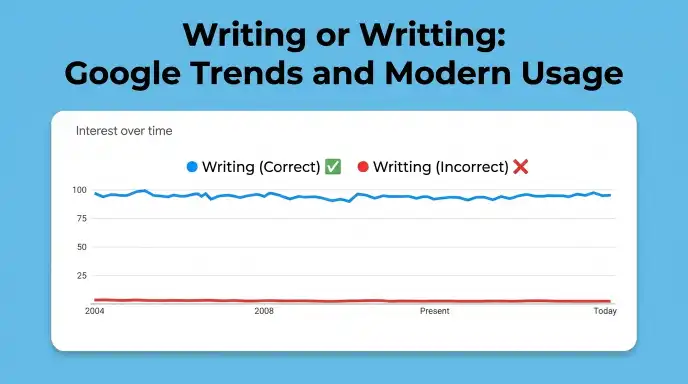
People search for writing or writting to check the spelling, learn the correct word form, or improve their English. The confusion often comes from the rules for adding -ing to verbs.
Why Do People Search for This Keyword?
Common reasons include:
- Spelling checks: People want to know if writing needs one t or two.
- English learning: Students practise verb forms and spelling rules.
- School assignments: Learners want to avoid errors in essays and homework.
- Professional communication: Workers want to write accurate emails and reports.
- Content creation: Bloggers and writers check spelling before publishing.
Regional Usage
The correct spelling is the same in major English-speaking countries.
| Region | Correct spelling | Regional difference |
| United States | Writing | None |
| United Kingdom | Writing | None |
| Canada | Writing | None |
| Australia | Writing | None |
| International English | Writing | None |
Which Word Is More Common?
Writing is the standard form. Writting is an error when intended as the usual -ing form of write.
Without current Google Trends results, exact country rankings or search figures should not be claimed. Search interest can change over time, and a search for writing may refer to many topics, including creative writing, academic writing, or writing skills.
How to Check Google Trends
To explore search interest, compare phrases such as:
- “writing or writting”
- “writing spelling”
- “how to spell writing”
- “write or writing”
Use the same time period and country for each comparison. Remember that Google Trends shows relative search interest, not exact search volume. It can show what people search for, but dictionaries and standard spelling rules determine the accepted form.
Quick Comparison Table: Writing or Writting
| Version | Meaning | Correct? | Region | Example |
| Writing | The act or skill of forming words | Yes | All English varieties | She is writing a letter. |
| Writting | Usually a misspelling of writing | No | None in standard usage | Writting a letter is incorrect. |
| Write | To form words or create text | Yes | All English varieties | I write every day. |
| Written | Past participle of write | Yes | All English varieties | The note was written yesterday. |
Final rule: Use writing with one t. The spelling stays the same in British, American, Canadian, and Australian English.
Key Takeaways
- Writing is the correct spelling.
- Writting is a common spelling mistake.
- Writing comes from the verb write.
- Drop the final e before adding -ing.
- Do not double the letter t in writing.
- British and American English use the same spelling.
- Use written as the past participle of write.
- Remember the pattern: write + ing = writing, after removing the final e.
FAQs About Writing or Writting
Q1. Is it writing or writting?
Writing is correct. Writting is a common spelling mistake. The word comes from write, and the final e is dropped before adding -ing. For example, write “I am writing a letter,” not “I am writting a letter.” Always use writing in schoolwork, emails, reports, and other standard English writing.
Q2. Why is writing spelled with one t?
Writing has one t because the base verb is write. When you add -ing to a verb that ends in a silent e, you usually drop the e. You do not double the final consonant. Therefore, write becomes writing, just as make becomes making and take becomes taking.
Q3. Is writting ever correct?
Writting is not the standard spelling of the -ing form of write. It may appear in informal messages or online because of typing errors, but it should not be used in standard English. If you mean the act of creating text or forming words, the correct form is writing.
Q4. What is the difference between write and writing?
Write is the base form of the verb. Writing is its -ing form and can describe an action in progress or the activity of creating text. For example, “I write every day” describes a habit, while “I am writing now” describes an action happening at this moment.
Q5. Is writing correct in British and American English?
Yes. Both British English and American English use writing with one t. There is no regional spelling difference for this word. Writers in the United States, United Kingdom, Canada, and Australia should all use writing in standard communication.
Q6. What is the past tense of write?
The past tense of write is written. Its past participle is written. For example, “I wrote a letter yesterday” uses the past tense, while “I have written a letter” uses the past participle. Writing is the -ing form, as in “I am writing a letter.”
Q7. Why do people misspell writing as writting?
People often double the t because English sometimes doubles a final consonant before adding -ing, as in sit becoming sitting. However, writing follows the silent e rule.
Drop the final e and add -ing to make writing. Remembering the base verb helps prevent this error.
Q8. How do you use writing in a sentence?
You can use writing to describe an action, a skill, or a written piece of work. Examples include “She is writing an email,” “His writing is clear,” and “I enjoy creative writing.” The meaning depends on the sentence, but the spelling always uses one t.
Conclusion: Writing or Writting
The correct spelling is writing, with one t. Writting is a common mistake and is not accepted as the standard form of the verb write. The rule is simple: remove the final e from write and add -ing. This gives you writing.
You can use writing to describe an action, a skill, or a piece of written work. For example, “I am writing an email” describes an action, while “Her writing is clear” describes a skill. The spelling stays the same in British, American, Canadian, and Australian English.
Remember that the related forms are write, writing, wrote, and written. Each form has a different role in a sentence, so choosing the right one will make your message clearer. When editing your work, look for the misspelling writting and correct it to writing.
Good spelling helps readers focus on your ideas instead of your errors. Keep practising this simple rule in emails, essays, reports, and everyday messages.
Remember: write becomes writing, never writting. Practise using the correct form in your next sentence and build stronger writing habits.

I’m Nora Ellis, an English language writer passionate about making grammar, spelling, and confusing words easy to understand. I share clear explanations and practical examples to help readers improve their English and use words with confidence.