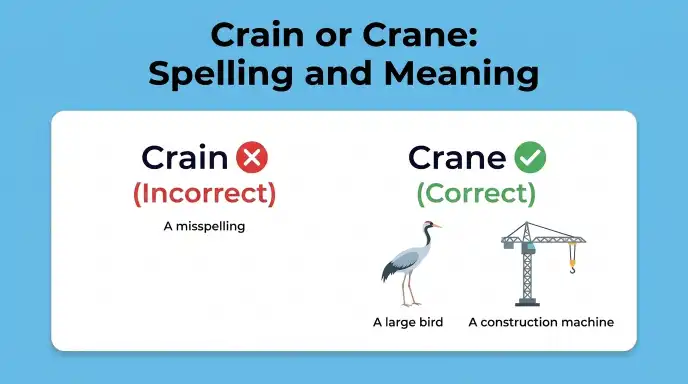
Crane is the correct spelling for a lifting machine, a large bird, or the act of stretching your neck to see something. Crain is generally a misspelling of the common word, but it can be a correct surname or proper name.
Many people search for crain or crane because the two spellings look and sound similar. A small spelling mistake can change how a sentence looks and may confuse readers. If you are writing about construction equipment, wildlife, or a person’s name, it is important to choose the right form.
The word crane has several meanings. It can describe a machine that lifts heavy objects, a long-necked bird, or the action of stretching your neck to see something better. In contrast, crain is not the standard spelling for these common meanings.
This guide explains the meaning, origin, grammar, and correct usage of both words. You will also learn the differences between British and American English, common spelling mistakes, and practical examples for emails, business writing, news, and school assignments. By the end, you will know when to use a crane and how to avoid this common spelling error.
Featured Snippet: Crain or Crane?
Crane is the correct standard spelling for a lifting machine, a long-necked bird, and the verb meaning to stretch your neck to see something. Crain is generally incorrect when used with these meanings. However, Crain may be correct as a person’s surname or an official name. For ordinary English writing, use a crane.
Crain or Crane: Quick Answer
Crane is the correct spelling for the common English word. Use it when you mean a machine, a bird, or the action of stretching your neck.
Examples:
- Correct: The workers used a crane to lift the steel beams.
- Correct: A crane stood beside the lake.
- Correct: She craned her neck to see over the crowd.
- Incorrect: The workers used a crain to lift the beams.
Easy rule: Use crane for the bird, the lifting machine, and the related verb. Use Crain only when it is the correct spelling of a person’s name or another proper noun.
What Does Crain or Crane Mean?
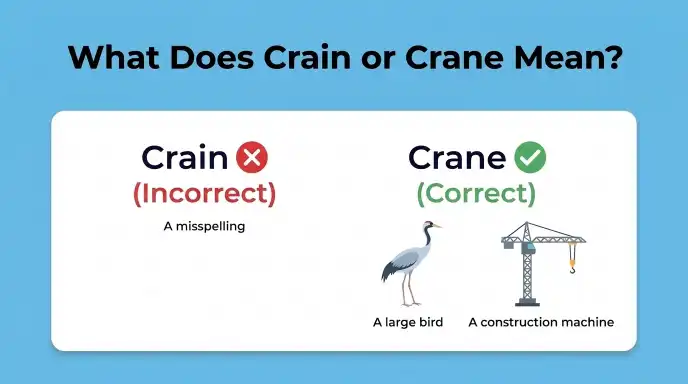
The main difference between crain and crane is spelling. Crane is a standard English word with several meanings, while crain is generally used as a proper name rather than the ordinary word.
What Does Crane Mean?
Crane is both a noun and a verb. Its meaning depends on the sentence.
Crane as a Lifting Machine
A crane is a machine used to lift and move heavy objects. Construction workers often use cranes to move steel, concrete, and building materials.
Examples:
- The crane lifted a heavy beam.
- A tall crane stood beside the new building.
- The crew used a crane to move the equipment.
Crane as a Bird
A crane is a large bird with long legs, a long neck, and a long bill. Many crane species live in wetlands, grasslands, and other open areas.
Examples:
- A crane walked through the shallow water.
- We watched a crane fly over the marsh.
- The crane searched for food near the lake.
Crane as a Verb
As a verb, crane means to stretch or lean your neck or body to see something better.
Examples:
- He craned his neck to see the stage.
- She craned forward to read the sign.
- The child craned over the fence.
The verb forms include crane, cranes, craned, and craning.
What Does Crain Mean?
Crain is not the standard spelling of the common word crane. Do not use it for a lifting machine, a bird, or the action of stretching your neck.
However, Crain can be a family name or part of an official name.
Examples:
- Incorrect: The crain lifted the steel beam.
- Correct: The crane lifted the steel beam.
- Correct as a name: Crain may be someone’s surname.
Always consider the meaning before deciding if the spelling is correct.
The Origin of Crain or Crane
The history of crane helps explain why this is the standard spelling and how the word developed its different meanings.
Where Does the Word Crane Come From?
The English word crane, meaning the bird, comes from Old English cran. Related forms appear in other Germanic languages.
Over time, the word also became associated with lifting machines. The machine was named for its resemblance to the bird, especially its long neck-like shape and extended arm.
The verb crane developed to describe stretching or extending the neck to see something better.
Why Is Crane Spelled with an E?
The standard English spelling is crane, with an e at the end. This is the established spelling used in modern dictionaries.
The spelling crain may occur because people hear a similar vowel sound in both forms. English spelling does not always match pronunciation in a simple way, so learning the standard written form is helpful.
Why Do People Confuse Crain and Crane?
People may confuse these words for three main reasons:
- Similar pronunciation: Both forms may sound alike to many English speakers.
- Similar appearance: The words differ by only one vowel.
- Typing errors: People may type the wrong letters when writing quickly.
Learning the correct spelling is the simplest way to avoid confusion.
British English vs American English
British English and American English both use crane. There is no standard regional spelling difference between crane and crain.
Both varieties use crane for the bird, the lifting machine, and the verb meaning to stretch the neck.
British English Examples
- A crane lifted the materials at the building site.
- We saw a crane near the wetland.
- He craned his neck to see the parade.
American English Examples
- The construction crane moved a steel beam.
- A crane stood at the edge of the lake.
- She craned her neck to see the screen.
British vs American English Comparison Table
| British English | American English | Example |
| Crane | Crane | The crane lifted the beam. |
| Crane | Crane | A crane stood near the lake. |
| Craned | Craned | He craned his neck to see. |
| Craning | Craning | She was craning to look over the wall. |
| Crain as a common noun | Crain as a common noun | Not the standard spelling |
Standard English dictionaries use crane for the common word. Writers in the United States and the United Kingdom should follow this spelling.
A person’s name is different. If someone’s official name is Crain, keep that spelling when referring to the person or organization.
Remember: Regional spelling rules do not change crane to crain.
Which Spelling Should You Use?
For ordinary English writing, choose crane. The spelling is correct across English-speaking countries and in international communication.
United States
Use crane in school assignments, emails, reports, and everyday writing.
Example: The construction crew used a crane to lift the roof beams.
United Kingdom
British English also uses crane.
Example: A crane lifted the equipment onto the building site.
Canada
Canadian English uses the same standard spelling.
Example: The workers moved the materials with a crane.
Australia
Australian English also uses a crane for the machine and the bird.
Example: We saw a crane near the wetlands.
International Writing
If you write for an international audience, use a crane. It is the standard form readers will recognize.
Academic Writing
Use crane in essays, reports, research papers, and classroom work. If you are discussing a bird species, use its exact species name when needed.
Business Writing
In construction plans, equipment lists, and safety reports, write crane. Correct spelling helps readers understand the equipment or activity being described.
Final advice: Use crane for the ordinary word. Use Crain only when it is the correct spelling of a name or another proper noun.
Common Mistakes with Crain or Crane
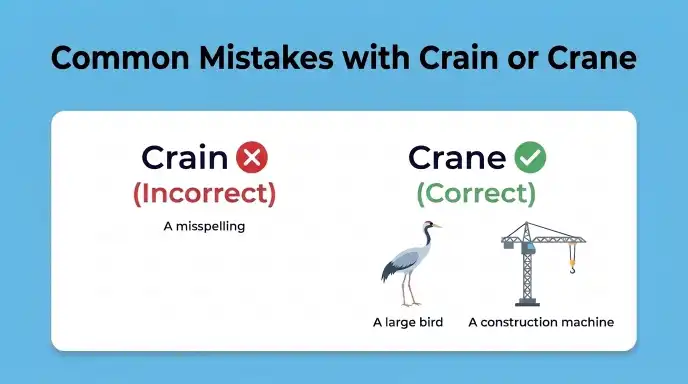
Writers often confuse these spellings because they look and sound similar. The examples below show common errors and their corrections.
Using Crain for a Machine
Incorrect: The crain lifted the heavy container.
Correct: The crane lifted the heavy container.
Why? Crane is the standard spelling for a machine that lifts and moves heavy loads.
Using Crain for a Bird
Incorrect: A crain stood beside the river.
Correct: A crane stood beside the river.
Why? The name of the bird is spelled crane.
Misspelling the Verb
Incorrect: He crained his neck to see the show.
Correct: He craned his neck to see the show.
Why? The past tense of crane is craned, not crained.
Using Crain in a School Assignment
Incorrect: The bird was a type of crain.
Correct: The bird was a type of crane.
Why? Standard spelling matters in academic and formal writing.
Changing a Person’s Name
Incorrect: The person’s name is Crane, even though the official spelling is Crain.
Correct: The person’s name is Crain.
Why? Proper names should follow the person’s actual spelling. Do not automatically change a surname to match a common word.
Common Errors and Corrections Table
| Incorrect or intended form | Correct form | Explanation |
| The crain lifted the load. | The crane lifted the load. | Correct machine spelling |
| A crain flew away. | A crane flew away. | Correct bird spelling |
| He crained his neck. | He craned his neck. | Correct verb form |
| Crain your neck to see. | Crane your neck to see. | Correct base verb |
| A person named Crane | Crain, if that is the official name | Preserve proper names |
Memory tip: Think of the crane as a tall machine or a long-necked bird. Both use the same spelling with an e.
Crain or Crane in Everyday Examples
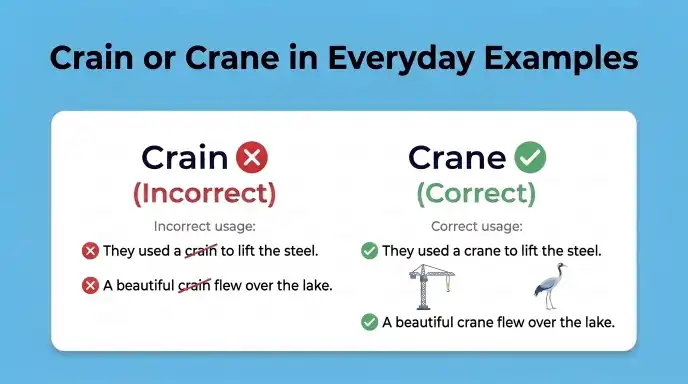
The word crane appears in many settings, from construction and wildlife reports to everyday conversation.
In Emails
Use a crane when discussing equipment, site work, or a visit to see birds.
Examples:
- The crane will arrive at the site tomorrow.
- Please confirm that the crane inspection is complete.
- We saw a crane during our visit to the wetland.
In Business Writing
Business documents often use a crane when discussing construction equipment, transport, or lifting operations.
Examples:
- The contractor rented a crane for the project.
- The team checked the crane before lifting the materials.
- The report explains how the crane was used.
Always check the spelling in equipment lists and safety documents.
In News Headlines
News stories may discuss cranes in construction, transport, or wildlife.
Examples:
- Crane Lifts Steel Beams at New Building Site
- Rare Crane Spotted Near Local Wetland
- Workers Use a Crane to Move Heavy Equipment
These are illustrative headline examples, not reports of actual events.
In Blogs
A blog may explain construction tools, bird species, or word meanings.
Examples:
- How a crane helps workers lift heavy materials.
- Where to look for a crane in wetland habitats.
- Why do people confuse crain or crane?
On Social Media
The word can appear in short captions and posts.
Examples:
- “That crane is lifting a huge beam!”
- “We spotted a crane during our morning walk.”
- “I had to crane my neck to see the stage.”
Even in casual writing, crane is the correct common-word spelling.
In Academic Writing
Use crane in science, engineering, and language assignments.
Examples:
- A construction crane can lift heavy materials.
- The crane is a large bird with long legs.
- The writer used the verb crane to describe a stretching movement.
In scientific writing, identify the exact bird species when the context requires it.
In Daily Conversation
Here are some natural examples:
- The crane is working near the road.
- We watched a crane by the water.
- He craned his neck to see the match.
- The workers moved the beam with a crane.
The meaning becomes clear from the surrounding words.
Google Trends & Modern Usage
The search phrase crain or crane reflects a common spelling question. People want to know which form is correct and if the two words have different meanings.
There is no need to assume that one spelling is more popular in a particular country without checking current search data. The standard spelling is crane across major English-speaking regions.
Why Do People Search for Crain or Crane?
People may search for this phrase for several reasons:
- Spelling confusion: The two forms look almost identical.
- English learning: Students want to know the correct spelling.
- Construction: Writers need the right word for lifting equipment.
- Wildlife: Readers want to spell the bird’s name correctly.
- Proofreading: Writers check if they have made a typing error.
Is Crane Used in Modern English?
Yes. Crane is a standard English word used in construction, engineering, wildlife, education, news, and everyday speech.
The word also appears as a verb in expressions such as craned his neck. This describes someone stretching or leaning to see something better.
Which Country Searches for Crane More Often?
A reliable country-by-country comparison requires current Google Trends data. Without that data, exact rankings or percentages should not be reported.
Google Trends can help compare search interest in crane, crain or crane, and related terms over a selected period. However, it measures relative interest rather than providing a complete count of every search.
How Should Writers Use This Information?
Search trends can help writers understand what readers want to know. They do not change the correct spelling.
For an article about this word, explain the difference clearly, include useful examples, and answer questions about meaning and usage. Avoid repeating the incorrect spelling more often than necessary.
Quick Comparison Table
This table summarizes the difference between crain and crane.
| Version | Meaning | Correct? | Region | Example |
| Crane | Lifting machine | Yes | All English varieties | The crane lifted the beam. |
| Crane | Large bird | Yes | All English varieties | A crane stood by the lake. |
| Crane | Stretch the neck to see | Yes | All English varieties | She craned her neck. |
| Crain | Intended as the common word | No | Not standard | Write crane instead. |
| Crain | A person’s surname | Yes, if officially spelled this way | Depends on the person | Mr. Crain arrived early. |
The key difference: Crane is the standard word. Crain may be correct as a proper name, but it should not replace crane in ordinary writing.
Key Takeaways
- Crane is the correct standard spelling for the bird and lifting machine.
- Crain is generally incorrect when used as the common English word.
- Crane can also mean to stretch your neck to see something.
- British English and American English both use crane.
- The past tense of the verb is craned, not crained.
- A person’s surname may correctly be spelled Crain.
- Use crane in schoolwork, business writing, emails, and formal documents.
- Check the meaning and context before correcting a proper name.
FAQs About Crain or Crane
Q1. Is it crain or crane?
Crane is the correct spelling for the common English word. It refers to a lifting machine, a large bird, or the action of stretching your neck to see something. Crain is generally a misspelling when used with these meanings, although it can be a correct surname.
Q2. What does crane mean?
Crane has several meanings. It can refer to a machine that lifts heavy objects, a large bird with long legs and a long neck, or a verb meaning to stretch your neck to see something better. The context of the sentence tells you which meaning applies.
Q3. Is crain a real word?
Crain can appear as a family name or part of an official name. However, it is not the standard spelling of the common English word crane. If you are writing about a bird, lifting machine, or stretching your neck, use a crane.
Q4. Is crane spelled differently in British and American English?
No. Both British English and American English use crane. There is no standard regional spelling difference for this word. You should use the same spelling in essays, reports, emails, and other forms of writing in either variety.
Q5. What is the plural of crane?
The plural of crane is cranes. Add -s to the singular form when referring to more than one bird or machine.
Examples: “Two cranes stood near the lake” and “The construction site used three cranes.”
Q6. What is the past tense of crane?
The past tense of the verb crane is craned. It means that someone stretched or leaned their neck or body to see something better.
Example: “She craned her neck to see the performers.” The standard spelling is craned, not crained.
Q7. Why do people confuse crain and crane?
People confuse crain and crane because the words look similar and may sound alike in speech. The difference is one letter, which makes a typing error easy. Learning the standard spelling and checking your writing can help prevent this mistake.
Q8. Can Crain be a person’s name?
Yes. Crain can be a person’s surname. Proper names do not always follow the spelling of common words, so you should preserve the official spelling when referring to a person, family, or organization.
Q9. How do you use crane in a sentence?
You can use crane as a noun or a verb.
Examples:
- The crane lifted the steel beam.
- A crane walked through the wetland.
- He had to crane his neck to see the screen.
Each sentence shows a different meaning of the same word.
Q10. How can I remember the correct spelling of crane?
Remember that the bird and the lifting machine are both called a crane, with an e at the end. When you describe someone stretching their neck, use the same base spelling. The past-tense form is craned.
Conclusion: Crain or Crane
The correct spelling for the common English word is crane, not crain. A crane can be a machine used to lift heavy objects, a large bird with long legs and a long neck, or a verb that describes stretching your neck to see something better. The meaning depends on how the word is used in a sentence.
Both British English and American English use crane, so there is no regional spelling difference to remember. In formal writing, school assignments, business emails, construction reports, and everyday messages, choose crane whenever you mean the ordinary word. If you are describing the past action of stretching your neck, write craned, not crained.
The spelling Crain can still be correct when it is someone’s surname or part of an official name. In those cases, follow the person’s actual spelling rather than changing it to match the common word.
To avoid this mistake, remember the simple rule: the bird, the machine, and the action are all spelled cranes. When you are unsure, check the meaning and context before choosing your word. Use this rule in your next piece of writing to keep your spelling clear and accurate.

I’m Nora Ellis, an English language writer passionate about making grammar, spelling, and confusing words easy to understand. I share clear explanations and practical examples to help readers improve their English and use words with confidence.