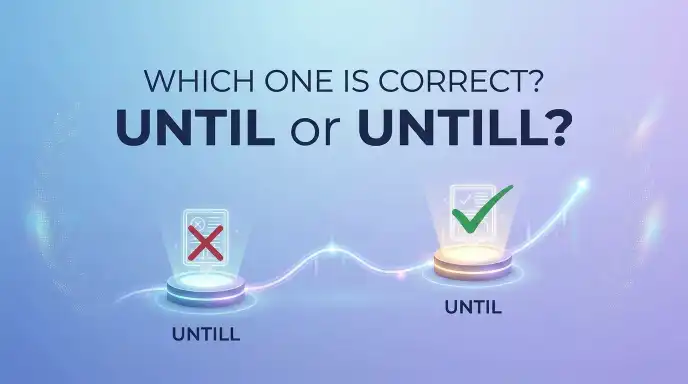
Until is the correct spelling, while untill is incorrect in standard English. The word until means “up to a particular time” or “up to the time that something happens.” For example, “Wait until Monday” is correct, while “Wait until Monday” is incorrect.
This spelling question is common because English has many words with double l, such as still, full, and will. It is easy to assume that until should also have two ls. However, standard English uses only one l until, in both British and American English.
The confusion becomes even greater because the related word still has two ls. Some writers therefore add an extra l to until by mistake. Others may also confuse until with informal forms such as ’til.
In this guide, you will learn the correct spelling, meaning, history, British and American usage, common mistakes, everyday examples, and practical writing advice. Let’s start with the simple rule.
Until or Until – Quick Answer
Until it is correct. Until is incorrect in standard English.
Use until when you mean “up to a particular time” or “up to the time when something happens.”
Correct examples
- Please wait until tomorrow.
- The store is open until 9 p.m.
- We stayed there until the rain stopped.
Incorrect example
- Please wait untill tomorrow. ❌
The easiest rule to remember is:
One L: until.
This spelling is used in both British and American English. There is no standard regional spelling until.
Definition and Meaning of Until or Untill
Until is a preposition and conjunction. It shows that something continues up to a particular time, event, or point.
For example:
I worked until midnight.
This means the work continued up to midnight.
As a conjunction, until can introduce another clause:
Wait until I call you.
Here, the action of waiting continues up to the time when the speaker calls.
Simple meaning
In simple English:
Until = up to a certain time or event.
Examples:
- until Friday
- until noon
- until tomorrow
- until the meeting ends
- until she arrives
Until with time
Use until to show an ending point in time.
The library is open until 6 p.m.
I will stay here until Monday.
Until with an event
You can also use until before a clause describing an event.
We waited until the bus arrived.
Don’t leave until I return.
Until in negative sentences
Until is also common in negative sentences.
I didn’t understand it until yesterday.
This means the person understood it only after that point.
She didn’t call until evening.
The call happened in the evening, not before it.
What about until?
Until is not the standard spelling. It is usually a spelling mistake caused by adding an unnecessary second l.
Correct:
We waited until noon.
Incorrect:
We waited until noon.
The Origin of Until or Untill
The spelling has a long history in English. It comes from an older form connected with till.
The word until appeared in Middle English and developed from earlier forms related to the idea of reaching or continuing up to a point in time.
Interestingly, till is older than until. Historical forms of till existed in Old English and Old Norse, while until developed later.
This history helps explain why writers sometimes wonder if until should contain two ls. Because till is spelled with two ls, it can look logical to extend that spelling to until.
However, modern standard English does not do this.
The correct spelling is:
until
not:
untill
So the extra l in untill is not a British or American spelling difference. It is simply an incorrect spelling in standard English.
British English vs American English Spelling
There is no spelling difference between British and American English for this word.
Both use:
until ✅
Neither standard variety uses:
untill ❌
| Feature | British English | American English |
| Correct spelling | until | until |
| Incorrect spelling | untill | untill |
| Meaning | Up to a time or event | Up to a time or event |
| Example | Wait until Friday. | Wait until Friday. |
| Alternative | till | till |
Both British and American English use until.
Is it still different from until?
Usually, till and until have the same basic temporal meaning.
Compare:
Stay here until 5 p.m.
Stay here till 5 p.m.
Both sentences are correct.
However, until is often a safer choice in formal writing because it is clear and widely accepted across contexts.
What about ’til?
You may see:
I’ll wait ’til tomorrow.
This is an informal shortened form associated with until.
For professional, academic, and formal writing, until is the best choice.
Which Spelling Should You Use?
For US English
Use until.
The office will remain open until Friday.
Do not use until.
For UK English
Use until.
The shop is open until 8 p.m.
British English is also commonly used till, but untill is not a British spelling.
For Canada and Australia
Use until in standard writing. The same spelling works naturally in Canadian and Australian English.
For global English
Until is the safest choice because it is standard and easily understood across English varieties.
For academic writing
Choose until.
The researchers continued the experiment until the results stabilized.
Avoid informal forms such as ’til in formal academic work.
For business writing
Use until in emails, reports, policies, and professional documents.
The offer is available until December 31.
Common Mistakes with Until or Untill
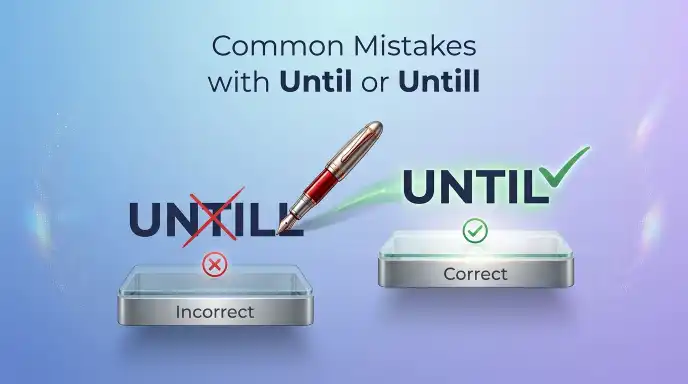
Writing until
❌ We will stay here untill noon.
✅ We will stay here until noon.
Why?
Standard English spells the word with one l.
Memory tip:
Until = one L
Assuming British English uses until
❌ Untill is the British spelling.
✅ Until is used in British English.
There is no standard British spelling until.
Confusing until with till
Both can be correct.
I waited until noon.
I waited till noon.
The main difference is often style and context, not basic meaning.
Using ’til in formal writing
❌ The event runs ’til Friday.
✅ The event runs until Friday.
‘Til is informal. Use until in academic and professional writing.
Confusing until and by
These words can express different ideas.
I will work until 6 p.m.
This means the work continues up to 6 p.m.
I will finish the report by 6 p.m.
This means the report will be finished no later than 6 p.m.
Until or Until in Everyday Examples
Emails
I will be available until 4 p.m.
Please wait until I confirm the details.
News Writing
The road will remain closed until Monday.
Officials said the restrictions would continue until further notice.
Social Media
I can’t wait until the weekend!
Stay tuned until the next update.
Formal Writing
The policy will remain in effect until further notice.
The study continued until sufficient data had been collected.
Academic Writing
The participants were observed until the experiment ended.
Everyday Conversation
Wait until I get home.
Don’t start until everyone arrives.
Business Writing
The offer is available until December 31.
Employees must remain in the office until the meeting ends.
Until or Until – Google Trends & Usage Data
People search until or until because the two spellings look similar, especially to learners who notice that till has two ls.
The important point is that this is not a British-versus-American spelling issue. Standard English is used in both varieties.
Modern English also shows widespread use of until across general, academic, professional, and everyday contexts.
Exact Google Trends values can change over time and depend on the selected country, period, and search category. Therefore, fixed percentages or rankings should not be claimed without a current Trends dataset.
The practical search-intent pattern is clear: users commonly want to know if untill is an acceptable spelling.
It is not.
For modern standard English:
until = correct
untill = incorrect
Until or Until – Quick Comparison Table
| Word | Correct? | Meaning | Usage | Example |
| until | ✅ Yes | Up to a time or event | Standard English | Wait until Monday. |
| untill | ❌ No | Intended to mean until | Spelling mistake | Wait untill Monday. |
| till | ✅ Yes | Up to a time or event | Standard, often less formal | Wait till Monday. |
| ’til | Informal | Shortened form associated with until | Informal writing | I’ll stay ’til noon. |
FAQs
Q1. Is it the correct spelling?
Yes. Until is the correct spelling in standard English. It is used in both British and American English. Until, with two ls at the end, is a spelling mistake. For example, “Wait until tomorrow” is correct.
Q2. Is it until a word?
No. Until is not the standard spelling of the English word. Writers usually create this form by adding an unnecessary second l. The correct form is until, if you are writing British, American, Canadian, Australian, or international English.
Q3. Why does it have only one L?
The spelling developed historically from forms related to till, but modern English established until with one l. Although till has two ls, that does not mean until should also have two. The standard spelling is simply until.
Q4. Is it British or American English?
Until is used in both British and American English. There is no regional spelling difference between the two varieties. Both use until. Both can also be used till, although style and frequency may vary by context.
Q5. Is till or until more correct?
Both till and until are correct. They generally have the same meaning when referring to time. Until is often the safer choice for formal, academic, and professional writing, while till is also common in everyday English.
Q6. Can I use ’til instead of until?
You can use ’til in informal writing, especially in casual messages or dialogue. However, until is better for formal writing. Use the full form when you want your writing to sound polished and professional.
Q7. What is the difference between until and by?
Until describes how long something continues, while by usually gives a deadline. For example, “I will work until 6” means the work continues up to 6. “I will finish it by 6” means it will be completed no later than 6.
Conclusion:
The answer to until or until is simple: until is correct, and until is incorrect in standard English. The word is spelled with one l in both British and American English.
Use until when you want to show that something continues up to a particular time or event. For example, “The store is open until 9 p.m.” and “Wait until the teacher arrives” are both correct.
Do not assume that untill is a British spelling or an alternative American spelling. It is simply a common spelling error. The confusion may come from the related word till, which does have two ls.
For formal and professional writing, until is the safest option. In casual writing, till can also be used, while ’til is best kept for informal contexts.
The easiest rule to remember is:
Until I have one L.
Once you remember that simple rule, you can avoid one of the most common spelling mistakes involving this word.

I’m Nora Ellis, an English language writer passionate about making grammar, spelling, and confusing words easy to understand. I share clear explanations and practical examples to help readers improve their English and use words with confidence.


3 thoughts on “Until or Untill? Which Spelling Is Correct?”